



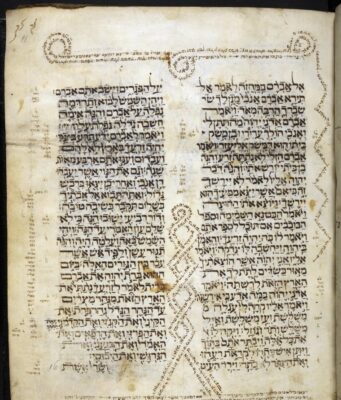

The Tunneling Burglar and the False Prophet: Opening New Chapters of Biblical Interpretation
In this essay, Yaakov Taubes explores and elucidates methods of dividing the Humash into sections, and analyzes their significance -- particularly through the lens of Parshat Mishpatim.

Irony of the Torah: A Tool for Moral Education and Self-Reflection
Hershey H. Friedman & Linda Weiser Friedman
Some scholars, such as Alfred North Whitehead, have argued that the Hebrew Bible lacks humor. However, a counter-argument...

Letters to the Editor: A Rejoinder to the Review by Martin Lockshin
In this letter to the editor, David E.S. Stein, the project manager and revising translator of the JPS TANAKH: Gender-Sensitive Edition, responds to the review by Martin Lockshin.

Should the Bible be Translated in a Gender-Sensitive Way?
Martin Lockshin reviews the Jewish Publication Society’s latest Bible translation, the JPS Tanakh: Gender-Sensitive Edition.

Hendiadys in the Pre-Shofar Acrostic Prayer: An Introduction to an Overlooked Principle of Biblical...
In unpacking the meaning of a tricky verse from Eikhah that we say as part of the Shofar service on Rosh Hashanah, Mitchell First introduces us to the literary principle called hendiadys, which can help us understand various phrases throughout Tanakh.

The Four R’s: An Orthodox Educational Framework for Engaging with Biblical Criticism
Thanks in part to several new publications, portions of the Orthodox world have been engaging with modern biblical scholarship in a more significant way than ever before. Gil Perl provides a four-step framework for how Jewish days schools might profitably teach many aspects of biblical criticism that do not conflict with our mesorah.

Letters to the Editor: The Boundaries of Torah u-Madda
The dynamic conversation continues with three letters to the editor widening our perspective on Torah u-Madda. Steve Gotlib grapples with the challenges of living Torah u-Madda in the real world; Ezequiel Antebi Sacca adds a Sephardic view from Argentina; and Eugene Korn adds insight to the Jewish view on Christianity.

It Will Be Torah and I Am Compelled to Study It: A Philosophy of...
Elinatan Kupferberg argues that the boundaries between Torah and Madda have blurred and evolved throughout Jewish intellectual history. This erudite analysis upends our assumptions about Torah u-Madda and breathtakingly reimagines its past, present, and future.

The “Judeo-Christian” Tradition at Yeshiva
Yisroel Ben-Porat offers historical, hashkafic, and personal reflections on what’s often called the “Judeo-Christian” tradition and whether a Torah u-Madda outlook can embrace the study of Christianity.

Must Creativity and Rigor be Either/Or?
In his review of Michael Hattin’s commentaries on the books of Joshua and Judges, Francis Nataf explores how greater collaboration between creative Tanakh teachers could help reduce the number of overly speculative readings.




 Site Operations and Technology by The Berman Consulting Group.