


Avot 5:6: The Mouth of Korah’s Earth and the 2nd Edition of the...
We only rarely have the opportunity to compare and analyze instances where a rabbi or scholar changed his interpretation over time, yet R. Yom Tov Lipman Heller published his Mishnah commentary, Tosafot Yom Tov, twice in his lifetime. Yaakov Jaffe examines the evolution of R. Heller's interpretation of the term “the Mouth of the Earth” in Pirkei Avot.
What If Jethro Was the First to Imagine Sinai?
Whose idea was Sinai? A midrash contends that Sinai was first conceived by Jethro. Ezra Zuckerman Sivan supports this Midrash from the Torah's text, and explains why Jethro was the appropriate vehicle for providing the rationale of Sinai.

Why Celebrate the Torah at The Wheat Harvest?
The biblical account of the holiday we refer to as Shavuot bears no relationship at all to the giving of the Torah at Mount Sinai. The emergence of the association between this harvest festival and the Sinai covenant has therefore occupied both traditional and academic thinkers for centuries. Tzvika Aviv argues for a previously unexplored approach to the question, one which bridges the mystical insights of the Zohar with current scientific knowledge regarding wheat genetics.
The Duality of Kisuy Ha-Dam
I. Introduction: The Puzzle of Vayikra 17
The mitzvah of kisuy ha-dam, the commandment to cover the blood of a slaughtered bird or wild animal,...

Love Bends the Line
David Curwin
“Ahavah mekalkelet et ha-shurah.”
— Bereishit Rabbah 55:8
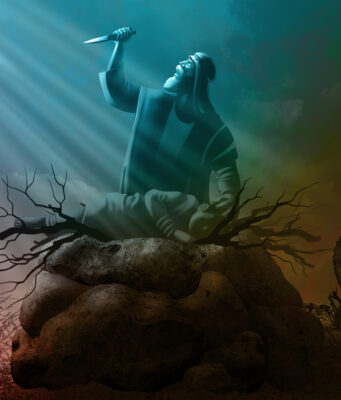
The sages used the above phrase “love bends the line” to describe Abraham’s actions before the akeidah:...

The Tabernacle as a Response to the Failure in the Garden of Eden
Michael Kurin analyzes the building and existence of the Mishkan as a form of spiritual redemption for the mistakes which took place in the Garden of Eden.

The Tunneling Burglar and the False Prophet: Opening New Chapters of Biblical Interpretation
In this essay, Yaakov Taubes explores and elucidates methods of dividing the Humash into sections, and analyzes their significance -- particularly through the lens of Parshat Mishpatim.

Tu b’Shvat and the Question We Can’t Keep Avoiding: Is the Tree of the...
In this essay, Aviva Lauer analyzes the Biblical prohibition against cutting down fruit trees in wartime, and connects it to messages about human dignity.

Rejoicing at the Downfall of Enemies: From Ancient Egypt to Modern Israel
The propriety of celebrating the downfall of enemies presents a complex web of questions and seemingly contradictory Jewish texts. Michael Kurin makes sense of this subject and proposes a framework for applying it to matters of Israeli public policy.

The Other Patriarchal Narratives
Malka Simkovich compares the narratives of Noah and Lot, and the ways their stories trigger the beginnings of rival nations of Bnei Yisrael.



 Site Operations and Technology by The Berman Consulting Group.