

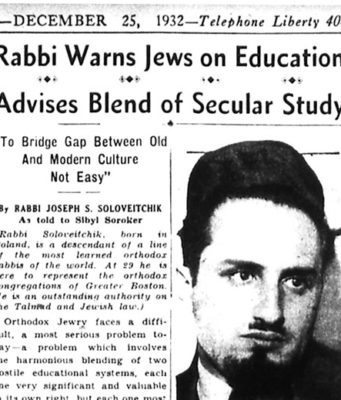



Who Will Defend Maimonides? Rav Soloveitchik on the Mishneh Torah and the Guide
With the aid of some new primary sources, David Curwin offers a fresh view of the Rav's embrace of Rambam and his most important writings.

Rudolph Kastner and How History Becomes Midrash
Chesky Kopel looks at the various tellings and retellings of the controversial deal that Rudolph Kastner made with Nazi leadership in Budapest and argues that they represent a modern-day Midrashic presentation of the history.

Did Rashi Draw the Diagrams in his Commentary to Eruvin?
Rashi’s commentary to Eruvin contains many explanatory diagrams. In anticipation of the Daf Yomi cycle’s study of the tractate beginning tomorrow, Eli Genauer shares some manuscripts that shed light on whether Rashi drew these pictures.

Rabbi Norman Lamm’s Theology of Anti-Racism
Shmuel Lamm examines Rabbi Norman Lamm's sermons for insights on a crucial issue.
The Origins of Jewish Universalism: What it is, and Why it Matters
Malka Simkovich provides a valuable corrective on the parameters of universalism in Judaism and Christianity.

Aspects of My Father’s Philosophy of Jewish History
This essay by Aaron Zeitlin—originally published in Yiddish in 1967 and translated here into English by Daniel Kraft—explores Aaron’s father Hillel Zeitlin’s approach to anti-semitism by way of the Book of Jonah.

Bati Le-Gani and the Triumph of Humanity
In honor of Yud Shevat, The Lehrhaus presents an excerpt from Eli Rubin’s forthcoming book Kabbalah and the Rupture of Modernity: An Existential History of Chabad Hasidism. Rubin explores the theological meaning of an influential series of discourses by the sixth Lubavitcher Rebbe, R. Yosef Yitzchak Schneersohn.

Tzaddik ve-Ra Lo: Revisiting the Problem of Evil in Chaim Grade’s My Quarrel with...
Marina Zilbergerts presents the philosophical questions posed by Chaim Grade's “My Quarrel with Hersh Rasseyner,” and compares his arguments to those of other major thinkers such as Voltaire, Rousseau, Dostoevsky, and Nietzsche.
Thriller
William Kolbrener offers insight into the intellectual underpinnings of the Rav's 1932 interview recently re-published by The Lehrhaus.

There Are No Lights in War: We Need a Different Religious Language
A growing list of dati le’umi leaders and thinkers frame war as a desirable state and even an opportunity for spiritual elevation. Religious Israeli activist Ariel Shwartz traces this trend with alarm and argues that it contradicts deep-rooted Torah values. Translated by Mordechai Blau.




 Site Operations and Technology by The Berman Consulting Group.