

Joel B. Wolowelsky
Good literature always yields new readings—even contradictory ones—because it reflects the complexity and paradoxes of life itself, which is rarely straightforward. This is especially true of biblical narratives, which are rich in symbolism, depth, and emotional nuance. These passages invite continual rereadings, often suggesting diverse meanings that remain anchored in the text. Indeed, this is the goal of midrash—the Jewish tradition of exploring scripture through imaginative, multifaceted commentary.
Midrash does not seek to resolve contradictions but to probe them, uncovering spiritual and ethical insights that speak anew to each generation. While this approach may diverge from literal or traditional readings, such tension is not a weakness—it is the mark of a living tradition. These interpretations do not reject the past but expand it, showing that sacred texts continue to reveal new truths as we return to them with fresh eyes and changing lives.
Two midrashim can seem contradictory while actually supplementing each other, together exploring the emotional landscape of human experience that is full of contradiction—coexisting feelings that defy logical categories. Emotions are non-binary. One can love and hate, grieve and rejoice, trust and doubt—all at once. Feelings are not logical propositions; they live in the gray areas that logic denies. It is not surprising, then, that different readers find different emotions in the same text.
Rabbi Aharon Lichtenstein, late co-rosh yeshivah of Yeshivat Har Etzion, wrote:
Surely, recognition of the human and emotional dimension of even our greatest—so amply, vigorously, and imaginatively portrayed by midrashim—is critical for a proper understanding of their lives and their meaning.[1]
Rabbi Mosheh Lichtenstein, the current co-rosh yeshivah, echoes that approach:
Human events as well as metaphysics are woven into the text [of Bereshit]. This is true of Noah, Avraham and Sarah, Yitzhak and Rivka, Yaakov and his family, and many others. … The characters are living people with real emotions, coping with the whole range of situations with which human existence challenges them.[2]
Even the greatest characters of the Bible are to be seen not as distant icons but as flesh‑and‑blood people, noble yet vulnerable, shaped by triumphs and shadowed by their own imperfections. The Torah does not veil their struggles; it lets us witness their hesitations and even their misjudgments. In this spirit, Rabbi Samson Raphael Hirsch, nineteenth-century foundational figure of Torah im Derekh Eretz, illuminates the idea with a voice that feels both timeless and alive:
The Torah never presents our great men as being perfect; it deifies no man, says of none “here you have the ideal, in this man the Divine became human.” Altogether it puts the life of no man before us as the pattern out of which we are to learn what is right and good, what we have to do, what refrain [sic] from doing. Where the Word of God would set a pattern before us for us to imitate, it places no man born of dust [sic], there God says, “Look at Me, imitate Me, wander in My Ways.” We are never to say: “This must be right for did not so-and-so do it!” The Torah is no “collection of examples of saints.” It relates what occurred, not because it was exemplary but because it did occur.
The Torah never hides from us the faults, errors and weaknesses of our great men. Just by that it gives the stamp of veracity to what it relates. But in truth, by the knowledge which is given us [sic] of their faults and weaknesses, our great men are in no wise [sic] made lesser but actually greater and more instructive. If they stood before us as the purest models of perfection we should attribute them as having a different nature, which has been denied to us. Were they without passion, without internal struggles, their virtues would seem to us the outcome of some higher nature, hardly a merit and certainly no model that we could hope to emulate.[3]
Of course, this is not to say that our biblical heroes were “just” ordinary living people. They were unmistakably towering spiritual figures, achieving levels far beyond our reach. If the Torah portrays them in human terms, it is to tell us: Don’t think you are above doing or feeling anything in particular. Even our giants did the same.
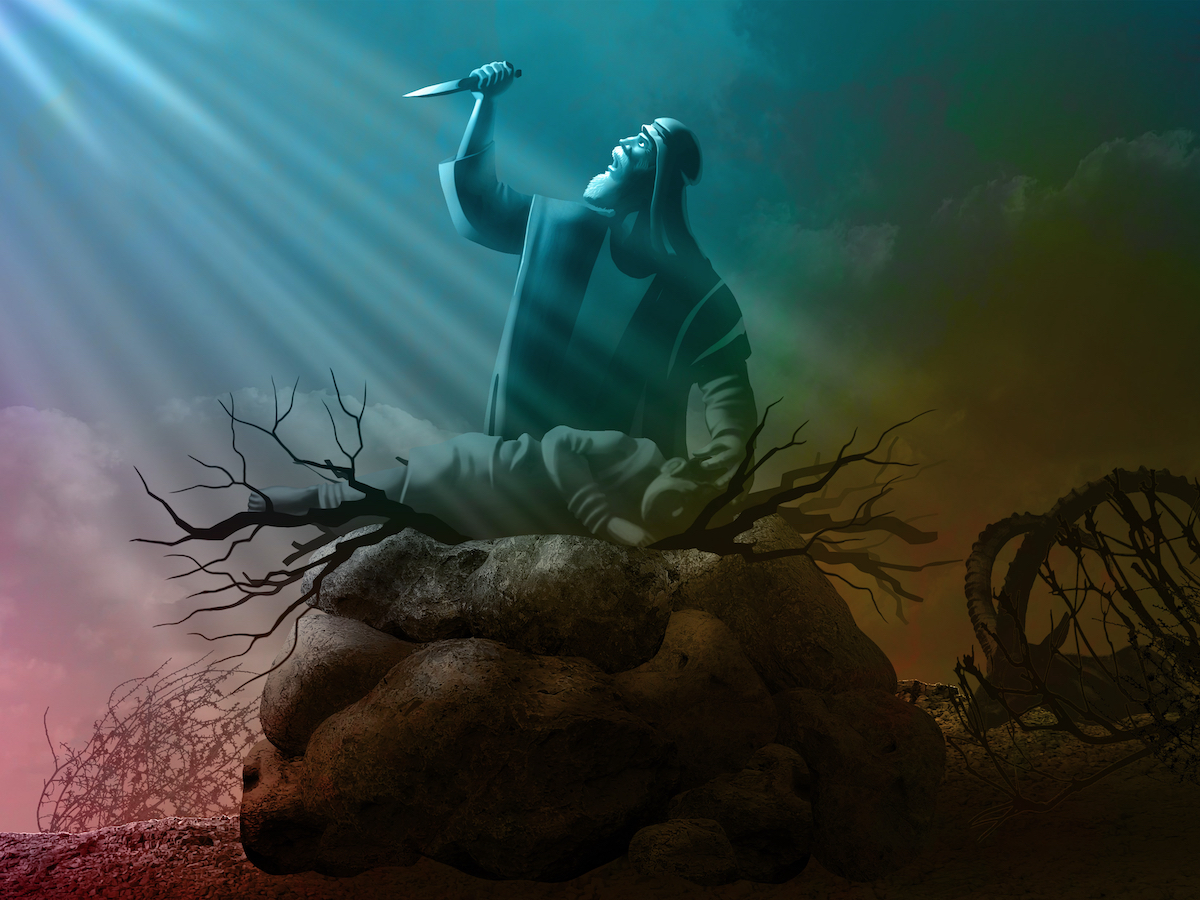
In reading the Akedah—the Binding of Isaac in Genesis 22—we should keep in mind that the narrative tells us how Abraham acted in response to God’s command to sacrifice his son, but it leaves us to discern his emotions and thoughts.[4] Abraham’s only recorded response in the peshat is silence: He “rose early in the morning and saddled his donkey” (22:3). This silence leaves room for various midrashic interpretations of Abraham’s experience.
Midrash Tehillim (112) portrays Abraham’s obedience as joyful: “His delight is greatly in His commandments”—he delights in fulfilling them with willingness. Rabbi Avraham Saba comments that Abraham “rushed to fulfill his Creator’s command.”[5]
Meanwhile, Midrash Aggadah Bereishit (Vayera 22) suggests a very different mindset:
When they were travelling, the Satan came to Abraham. He said to him, “Old man, what are you thinking? Are you going to slaughter the son who was granted to you by God when you were one hundred years old? I am the one who has deceived you and instructed you saying, ‘Take your son….’”
Avivah Gottlieb Zornberg suggests that the Satan can be read as a projection of Abraham’s inner turmoil and worst fear. “The Satan who blocks Abraham’s way is not simply a metaphysical adversary; he is the voice of Abraham’s own inner resistance, the voice of sanity that whispers, ‘What are you doing? Will you destroy your son?’”[6] According to this reading, this is not a joyful moment!
Zornberg hears Abraham’s resistance in the Midrash. Jonathan Jacobs, through his close literary reading of the biblical text, detects moments when Abraham loiters at the edge of action, hardly rushing to fulfill his Creator’s command. Abraham’s silence masks turmoil rather than serenity, his inner world exposed.
The text [in verses 9–10] expresses this delay with another list of six successive verbs: “And he built—and he arranged—and he bound—and he placed—and he put forth—and he took.” This long list of actions, recalling the series of six verbs that appeared in Scene 2 (verse 3), conveys to the reader a sense of busyness, a lingering activity.[7]
Jacobs concludes his discussion with an observation that Abraham’s apprehensiveness does not detract in any way from his stature and from his complete desire to fulfill God’s will:
Abraham is presented as a complex, human figure who is torn between his personal and family needs and wants and the desire to fulfill God’s command. His decision to fulfill God’s word although it conflicts so painfully with his own needs, illuminates the patriarch of the Israelite nation not as someone who fulfills God’s command in a mechanical fashion, devoid of thought or independent will, but rather as a great figure who chooses to fulfill God’s word even where this entails waging a difficult inner battle.[8]
These insights into Abraham’s personal turmoil should actually be reassuring to the religious individuals striving to fulfill God’s will while encountering inner conflict and resistance of their own. If even Abraham, our Knight of Faith, can wrestle with such tensions and remain close to God, then our own conflicts need not be destabilizing. That is part of the gain in seeing our biblical heroes in human terms.
Interestingly, Midrash Tanhuma (Vayera 23) offers a strikingly powerful portrait of Abraham allowing himself to reveal his thoughts once it has been settled that Isaac is not to be sacrificed:
“It was in my heart, yesterday, to remind You that You told me that Isaac was my seed, when You said to me: Take him for a burnt-offering. But I restrained myself and did not challenge You. Therefore, when Isaac’s descendants sin and are being oppressed, recall the binding of Isaac, reckon it as if his ashes were piled upon the altar, and pardon them and release them from their anguish.” The Holy One, blessed be He, answered: “You have spoken what was in you heart, now I will say what I wish to say. In the future Isaac’s descendants will sin against Me, and I will judge them on Rosh Hashanah. If they want Me to discover something to their credit, and to recall for their advantage the binding of Isaac, let them blow upon this shofar.” Abraham asked: “What shofar?” The Holy One, blessed be He, said: “Turn around. Then it was that Abraham lifted up his eyes, and looked, and behold, behind a ram caught in the thicket by his horns (Gen. 22:13). This was one of the ten things that were created at twilight.
This midrash reframes Abraham not as a serene believer but as one angered at being tested, one who dares to make demands of God in return. God does not protest but quickly agrees—with a puzzling counter-demand that they must blow the shofar. God’s answer introduces the shofar as the symbol of the ram that had always been waiting to replace Isaac. God insists that there be no misunderstanding: the ram was there from the beginning, and there was never an intention to sacrifice Isaac. The shofar symbolizes God’s rejection of child sacrifice, making unmistakable the true meaning of the Akedah.
With all this in mind, let us reread the Akedah story and consider some basic questions: Why would God find it necessary to test Abraham? And why would Abraham follow God’s instructions with equanimity? Indeed, given the reticence of Abraham in comparison to the defiance that he exhibited in the preceding story of the rescue of Sodom, the reader is surely thirsty to understand what transpires in the patriarch’s mind.
The Akedah story opens with the phrase “After these things.” This is not merely a chronological marker; it calls the reader to recall prior events in order to understand the Akedah. We propose that the key to appreciating God’s motive here is to return to Abraham’s debate with God regarding the destruction of Sodom (18). God explains that He reveals His plan to destroy Sodom precisely because He has chosen Abraham “to keep the way of the Lord by doing what is right and just” (18:19). God gives Abraham the opportunity to express his doubts, and endorses his challenge: “Will You indeed sweep away the righteous with the wicked?” (18:23). God encourages the exchange by debating the issue with him, agreeing in the end that innocents will not be killed.
In our unconventional reading, the Akedah is a continuation of this understanding of God’s educational process. Abraham is presented with what should be an obviously unethical demand. It is an opportunity for him to protest: Could the Judge of all the earth demand what is morally indefensible? God would then concede the point, thereby not only encouraging His people to protest what they see as unethical but also making a statement agreeing that child sacrifice is unacceptable, contrasting Jewish ethics with those of Abraham’s world, where child sacrifice was a familiar expression of devotion. Indeed, Scripture itself records that King Mesha of Moab offered his firstborn son as a burnt offering (2 Kings 3:27).
In this rereading, God is not testing Abraham. He would surely assume that Abraham sees killing innocent children as murder, not divine devotion. He is giving him an opportunity to model God’s ethics. Indeed, the medieval commentator Don Isaac Abarbanel challenges the conventional translation of the Hebrew word nissah (Gen. 22:1)—typically understood as tested—and instead links it to nes, meaning “banner” or “sign.”[9] God was elevating Abraham, making him a moral banner for a new kind of faith, not suggesting that he submit to the twisted then-contemporary logic of child sacrifice.
But how, then, are we to understand Abraham’s response? He does not protest this time. Instead, he rises early and departs in silence. How can we understand his state of mind?
Let us try to picture Abraham when he hears the request to sacrifice Isaac. He knows that this could not possibly be what he is actually supposed to do. But suppose he hears it not as an opportunity but as the test it seems to be. He mistakenly thinks that God is actually testing whether he understood that his God is different from the pagan deities. After years of devotion and painful trials, Abraham might well have felt wounded—or even angry—at this new demand, as though his understanding of his faith was still unproven. His silence becomes its own language: not submission, but quiet defiance. It is obedience tinged with protest, a performance of faith that exposes the tension between command and conscience. Abraham seems to say: If You must test me, then see how I obey—but know that such obedience rebukes the very notion of the test.
Still, Abraham has not lost faith. He tells the servants, “We will both return to you” (22:5). Yet when Isaac asks where the lamb is, Abraham’s answer—“God will provide”—carries a tone that may blend faith with bitterness.
Each step heightens the tension. Will God make clear that He has been misunderstood? When Abraham raises the knife, the angels watching from on high have had enough. One finally calls out, “Abraham! … Do not stretch out your hand against the boy!”—adding, “and do not do anything (me’umah) to him” (22:12). Rashi, following alternate manuscripts, reads me’umah as mum—a blemish. Perhaps Abraham was planning to declare Isaac improper as a sacrifice by creating a small blemish, but the angel insists that even that would be too much. Even the smallest wound would be too much.
The angel, speaking for God, continues: ki atah yada’ti. This is commonly translated as “now I know.” But ki can also mean “indeed,” and Rabbi Shlomo Ephraim ben Aaron Luntschitz (Keli Yakar) notes that atah need not exclude what came before, and yada’ti may be read as hoda’ti, “I have made known.” Rashi (22:12) follows this line: “Now I can respond to the accusers”—those who doubted Abraham’s devotion. In other words, God admits: “Indeed, I already knew that you fear God.” Truly, Abraham had already demonstrated this when he had sent away Ishmael, his firstborn, at God’s command despite the matter distressing him greatly (21:11). That was a profound act of faith and surrender. The Akedah does not prove Abraham’s obedience anew; it clarifies that such obedience does not entail the blood of the innocent.
When Abraham lifts his eyes, he sees a ram caught in the thicket. According to Pirkei Avot (5:6) and Pirkei de-Rabbi Eliezer (ch. 31), this ram had been prepared for this purpose since the beginning of creation. Having a substitute was no coincidence but rather part of the original divine plan. The Akedah thus reveals that divine will is bound to moral law.
The angel promises Abraham descendants through Sarah and possession of the land. However, these are not new rewards but reaffirmations of blessings already unfolding. Isaac has been born. Abraham has settled in Be’er Sheva. Avimelekh has recognized him as a source of blessing. Faith had already been proven; what remained was making sure that it was understood by all that true faith renounces cruelty.
While the angel’s intercession moved the standoff forward, the consequences of unresolved misunderstandings often linger. Abraham and God never speak again to each other. And so too with Isaac, who was not asked for his agreement to participate in this event. Abraham and Isaac walked together (yahdav) up the mountain (Gen. 22:6, 8), but Abraham came back alone, going to Be’er Sheva together (yahdav) with his anonymous attendants instead (22:19).
After this high drama, the Torah closes the chapter with what seems an anticlimax: a genealogy. Abraham is told that his brother Nahor has fathered many children. These few verses seem innocuous but are so integral to the Akedah story that they are included in the Rosh Hashanah Torah reading of the Akedah. Rabbi Joseph B. Soloveitchik[10] offers a striking insight: After the Akedah, Abraham might well have wondered, “Why me? Why must I endure years of longing and trial, while my brother Nahor, an idolater, flourishes effortlessly? Is it worth it?” This is the real test of all believers.
It is interesting that the information about Nahor is “told to him” (22:20). Abraham was a rich and powerful individual who could have enquired about the family he left behind decades before if he had cared. He did not, but those whom Abraham was trying to proselytize might well have taunted him with such questions. In the end, Abraham offers the ram. “Judaism has a tremendous tradition: it is not simple or easy to live a life of Torah and mitzvot. One must be willing to sacrifice on its behalf many things, large and small.”[11] One must have a heart strong enough to surrender, yet discerning enough to know what God never asks. Moral conscience lies at the very heart of covenantal faith.
[1] R. Aharon Lichtenstein, “Introduction,” in Francis Nataf, Redeeming Relevance in the Book of Genesis: Explorations in Text and Meaning (The Genesis Institute, 2006), 11.
[2] R. Mosheh Lichtenstein, Moses: Envoy of God, Envoy of His People (Ktav, 2008), 250, 244f.
[3] R. Samson Raphael Hirsch, The Pentateuch: Translated and Explained by Samson Raphael Hirsch. Genesis, trans. Isaac Levy, 2nd ed. (Judaica Press, 1963), on Gen. 12:10.
[4] I have elsewhere read the Akedah story as a staged drama in which Abraham and Isaac knew that there was no request for child sacrifice. See Joel B. Wolowelsky, “The Akedah Drama,” Jewish Bible Quarterly 54, no. 1 (2026): 49–52.
[5] R. Avraham Saba, Tzror Ha-Mor, commentary on Genesis 22:3.
[6] Avivah Gottlieb Zornberg, The Beginning of Desire: Reflections on Genesis (Doubleday, 1995), 137.
[7] Jonathan Jacobs, “Willing Obedience with Doubts: Abraham at the Binding of Isaac,” Vetus Testamentum 60, no. 4 (2010): 556.
[8] Ibid., 559.
[9] Cf. Bereshit Rabbah 55.
[10] R. Joseph B. Soloveitchik, Yemei Zikkaron, ed. Mosheh Kroneh (World Mizrachi, 1986), 161.
[11] Ibid.



 Site Operations and Technology by The Berman Consulting Group.