

Joel B. Wolowelsky and Avner Taler
At a first reading, the chronological timeline of Abraham – still called Abram – in Parashat Lekh Lekha appears straightforward. God commanded him to go to Canaan when he was 75 (Gen. 12); he then went to Egypt and returned (Gen. 13); he then went to war to save his nephew Lot (Gen. 14); he experienced the Brit Bein Ha-Betarim, the Covenant of the Pieces (Gen. 15); and he had a son at age 86 (Gen. 16). Thus, at the time of the Covenant, Abraham was between 75 and 86. Let us say that, for convenience in this discussion, he was around 80.
However, in various traditional Jewish exegeses, Abraham’s age at the time of the Covenant was calculated to be 70.[1] The suggestion that the chapters in the Torah are not in chronological order is in and of itself not problematic, as we have the principle of ein mukdam u-me’uhar ba-Torah (there is no chronological order in the Torah, Pesahim 6b). However, we present here a rereading of chapter 15 that maintains both the chronological sequence of the chapters and the suggestion that Abraham was 70 at the time of the Covenant.
Our reading takes us back to chapter 10. When Abraham was 48, his society was freed to think and explore as the Tower of Babel was liberated, so to speak.[2] He found God, and over the next decade or so brought Terah into his spiritual community. Shortly before he was 70, Abraham and Terah felt a draw to leave Ur and search out the Land of Canaan. They set out together, stopping in Haran when he was 70.
Rabbi Joseph B. Soloveitchik’s description of how Jerusalem later drew Abraham once he had entered Canaan from the north applies just as well to the magnetic effect Canaan wielded over Abraham and Terah while they were still in Ur:
Here is a central idea in Judaism: kedushah attracts. This was perhaps the greatest discovery made by Abraham. The generation of the flood thought that beauty is fascinating and that it is man’s duty to respond quickly to the aesthetic challenge, to succumb to the beautiful and pleasant. The generation of the dispersion thought that power is the idea that overwhelms man; technological achievement takes man prisoner, making him worship the genius who made this kind of achievement possible. Abraham proclaimed to the world that kedushah is the great attractive force. [3]
Terah’s draw to Canaan waned. He remained in Haran and Abraham, committed to kibbud av (honoring his father), stayed with him.[4] After a few years, when Abraham was 75, God told him to move on and leave Terah in Haran.[5] Over the next few years he underwent various trials and journeys. Chapter 15 opens with the timestamp of “It was after these things,” when Abraham was about 80.
In verse 1, God promises Abraham protection and great rewards, but in verse 2, Abraham responds not with gratitude but a challenge: “What is whatever you offer worthwhile if I do not have the children you promised?” At approximately 80 years of age, Abraham found himself shaken by the realization that Lot will not be his heir. God does not respond immediately, as the next verse begins not with God’s reply but “Vayomer Abram,” an indication of Abraham’s continued soliloquy after a pause waiting for a response. Then, while in verse 2 Abraham speaks with formal restraint, by verse 3 he drops the diplomatic protocol to state his painful reality directly. Abraham completely drops the formal titles. He does not say “Lord God” this time; he simply launches straight into his grievance. He stops asking questions and starts stating facts. He uses the exclamations “Hen” (“Behold!”) and “Hinei “ (“Look!”) in a single sentence to demand immediate attention.
In verse 4, God responds forcefully with a straightforward statement that Abraham will indeed have the promised children. Abraham was explicit: “A servant born in my house is to be my heir.” God issues an un-nuanced, absolute refusal: “This man shall not be your heir.” He answers Abraham’s directness with total clarity, instantly eliminating Eliezer from consideration. Moreover, God subtly strengthens the language of His previous promises. Earlier, He spoke generally about giving Abraham “seed” or “descendants.” Now, in response to Abraham’s deeply personal crisis, God uses intensely visceral and physical language: the heir will come “out of your own body/bowels (mi’me’e[k]ha).”
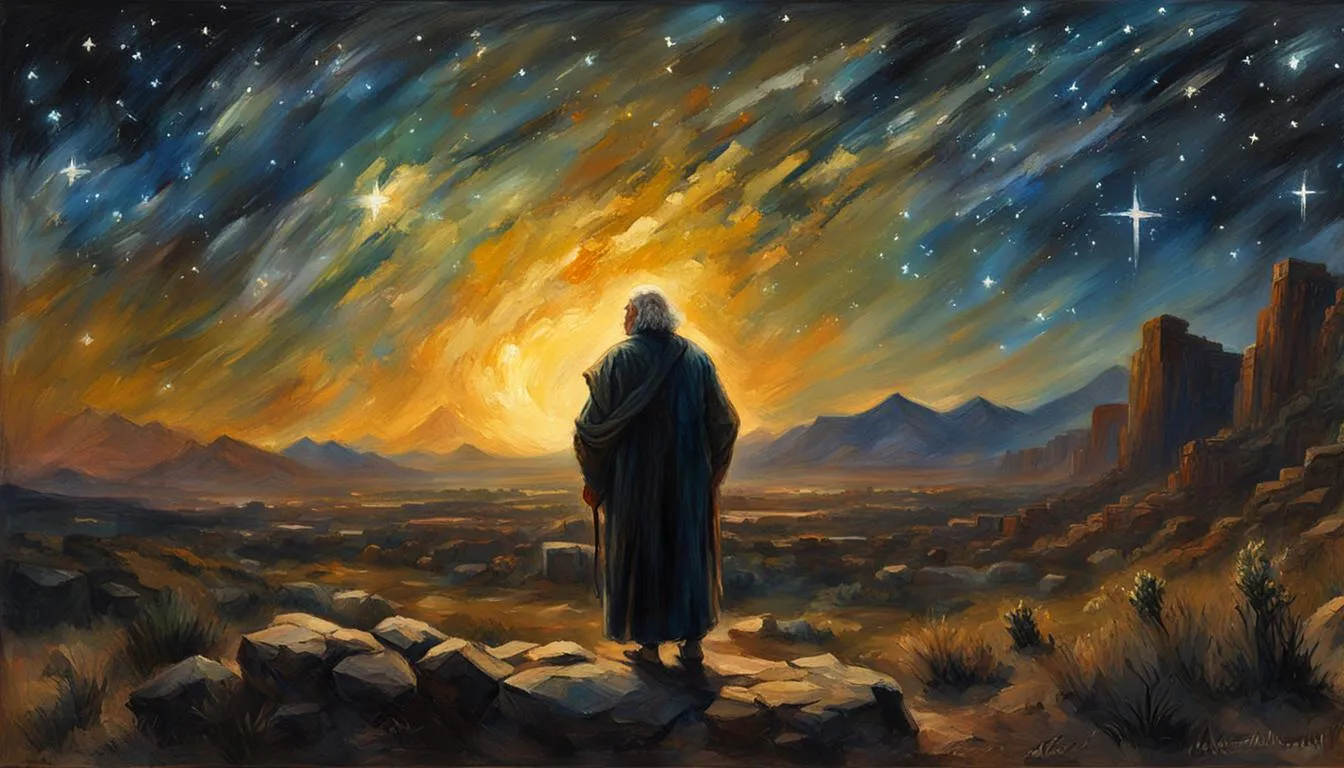
Then, in verse 5, God tells Abraham to look up at the stars and try to count them. The stars had long ago provided Abraham with the awareness of God and now would in some way reassure him:
“God brought him outside” – by his lapels, so to speak – and said, Stop brooding, Abraham! Remember the nights in Mesopotamia when you were a boy, a young lad, how you used to watch the stars, observe them, study them, trying to find out the position of each star and each constellation, to find all the galaxies. You were so full of enthusiasm and ecstasy. You failed so many times, but you never gave up. “Look up at the sky.” …. Look up, the way you were accustomed to do in your youth, and begin to count the stars. Count long and don’t give up. The command is an allusion, a hint, comparing the old Abraham with the young Abraham, telling Abraham to act young.[6]
God told Abraham to look up at the stars with the same wonderment and curiosity that brought him to discover God in his youth.[7]
Then, God waits for a response from Abraham, as indicated by the word “Vayomer” mid-verse 5 without a change in speaker. Not getting a response, God makes it clear that “Such shall be your seed!” Verse 6 then tells us that Abraham had recaptured his faith in God,[8] and “vayahsheveha lo tzedakah,” (he reckoned it as a righteousness). The deliberate ambiguity in the antecedent of the pronoun allows for two interpretations: God credited Abraham’s faith as a meritorious, righteous act and, on other hand, Abraham acknowledged that God’s faithfulness and reliability are inherently righteous. The Torah uses this grammatical ambiguity to reflect the dual nature of the breakthrough: a human reclaiming youthful faith, and God validating it.
Verse 7, however, seems to present a difficulty. Having just affirmed Abraham’s renewed faith, why would God repeat now the promise for the Land that He had made when Abraham was 75 (Gen. 12:7) and spark a new challenge from Abraham? Rather, we suggest that verse 7 is not a continuation of God’s reassurance to the eighty-year-old Abraham. It marks a shift from Abraham’s present crisis to his recollection of an earlier divine encounter when God spoke to him the words “Ani Hashem Elokekha.”
The memory analeptic shift (flashback)[9] is triggered by God’s command to gaze at the stars. It reconnects Abraham with the wonder and confidence of his youth. God is not announcing a new promise to the eighty-year-old Abraham in Canaan. Instead, the narrative moves into Abraham’s recollection of a covenantal encounter that occurred when he was 70, a time at which he still maintained his youthful amazement. God had then revealed Himself as the source of the magnetic pull that had drawn Abraham out of Ur toward Canaan, when he was just short of 70.
Now, in verse 7, Abraham revisits how, when God had revealed Himself as the source of this spiritual magnetism, He revealed its purpose: to give the land to which Abraham had been drawn as an inheritance to him.
In verse 8, Abraham re-experiences how he had then asked how he can be sure this will come to fruition. God tells him to butcher various animals and arrange them in a particular way. This surely seems strange to the modern reader. However, as Rashi notes on verse 10, “It was the custom of those who made a covenant to divide an animal and pass between its pieces, as it is stated later, ‘Those who passed between the pieces of the calf’ (Jeremiah 34:18).” Similarly, Rabbeinu Bahya comments on verse 18, “For such is the way of those who make a covenant. They first swear an oath, and afterward they make the covenant. The covenant consists of passing between the pieces of the animal, as it is written (Jeremiah 34:18), ‘The calf which they cut in two and passed between its pieces.’ This covenant was like a heirem (ban/curse), and it served as the confirmation of the oath that they had already sworn, as if to say, ‘Let whoever transgresses the oath be cut in pieces like this animal.’” God did not speak to Abraham in an inaccessible, alien language; He met him exactly where he was, utilizing the strict Near Eastern legal rituals Abraham grew up observing in Ur.
Strikingly, modern archaeological discoveries of Hittite and Amorite treaties have corroborated this centuries-old insight. Cuneiform tablets from the Bronze Age demonstrate that sealing a pact required literally ‘cutting’ the treaty—slaughtering and separating animals to form a corridor of a ‘self-maledictory oath.’ The vassal would walk between the halves, inviting his own destruction if he were to breach the terms.[10]
God uses this familiar Ancient Near Eastern legal framework, but subverts it. In a standard Hittite treaty, the weaker party (the vassal) walked the path, because the weaker party bore the risk of default. Here, Abraham, the human vassal, is cast into a deep sleep and is prevented from walking the path. Instead, the smoke and fiery torch representing God passes through the pieces alone. In a theological reversal of secular law, the Sovereign King takes the curse upon Himself, transforming a standard conditional treaty into an unconditional, eternal divine guarantee. Then, in verse 18, the narration returns to the then-present. We are told in closing that bayom hahu, on that day – the one a decade before that we have just relived with Abraham in the flashback – God had made a Covenant to give Abraham’s descendants the land from the Wadi of Egypt to the great river, the Euphrates.
This rereading of Genesis 15 allows us to preserve the plain chronological flow of Abraham’s life while also accounting for the traditional view that the Brit Bein Ha-Betarim occurred when he was seventy years old. More importantly, it reveals the Covenant not merely as a divine promise about the future, but as a remembered experience that restores Abraham’s confidence in a moment of crisis. The chapter thus becomes a study in religious memory. Faced with doubt at age 80, Abraham is led back to the vision and certainty of his younger self, reexperiencing formative moments of divine disclosure. The Torah’s use of retrospective narration transforms the Brit Bein Ha-Betarim from a historical episode into a living source of spiritual renewal, suggesting that faith is sustained not only by new revelations but also by the capacity to revisit and reengage past encounters with God.
[1] The Torah explicitly states that Isaac was born when Abraham was 100 years old (Gen. 21:5). At the Brit Bein Ha-Betarim (Genesis 15), God informs Abraham that his descendants will be strangers in a land that is not theirs and will be enslaved for 400 years. However, in Exodus (40:41) a period of enslavement is given as 430 years. According to Seder Olam Rabbah, the 400-year decree began precisely with the birth of Isaac. Hence, the count of 430 must have begun when Abraham was informed of the decree, which was at the Brit Bein Ha-Betarim. Subtracting 30 years from Abraham’s age of 100 at Isaac’s birth means that Abraham was 70 years old at the time of the Covenant. The Tosafot commentaries on Berakhot 7b (s.v. “Lo haya adam“) discuss the timeline of Abraham’s life, specifically agreeing that he was 70 at the Covenant.
[2] See Joel B. Wolowelsky, “The Tower of Babel in Human Language,” Tradition, 58:3 (Summer 2026), 197-203.
[3]R. Soloveitchik, Abraham’s Journey, 62.
[4] The Torah tells us (10:32) that Terah died before informing us (12:1) that God tells Abraham to leave Haran, giving the impression that Abraham left after Terah died. But Terah was 70 years old when Abraham was born (11:26), and Abraham left Haran at age 75 (Gen. 12:4). Therefore, Terah was only 145 years old (70 + 75) when Abraham left him. Since Terah lived to be 205 years old (11:32), Terah was still very much alive and lived for another 65 years after Abraham left him. Rashi explains that the Torah masks the chronological reality to avoid it looking like Abraham was abandoning his filial duties. God explicitly gave Abraham permission to leave his living father, but the Torah records Terah’s death early so that the general public wouldn’t judge Abraham harshly.
[5] Maharal (Gur Aryeh commentary on Rashi to Shemot 12:40) says that Abraham traveled to Canaan twice, the first time when he was 70 years old, at the time of the Brit Bein HaBetarim. He calls this opinion “divrei Hazal.” (See Bereishit Rabba 39): “Rabbi Nehemiah said, ‘Lekh lekha,’ ‘Go,’ two times [to Canaan], one from Aram Naharaim and one from Aram Nahor.” So, too, R. Eliyahu Mizrahi argues that God actually took Abraham out of Haran temporarily at age 70 to make the Covenantin Canaan, after which Abraham returned to Haran for five years, before permanently moving to Canaan at age 75. Presumably, he returned to Haran to be with his father.
[6] R. Joseph B. Soloveitchik, Abraham’s Journey: Reflections on the Life of the Founding Patriarch, eds. David Shatz, Joel B. Wolowelsky, and Reuven Ziegler (Toras HoRav Foundation, 2008), 141f.
[7] Poetically paraphrasing Mishneh Torah, Laws of Idolatry 1:3, Rabbi Soloveitchik writes: ”When Abraham was a lad, when he was a shepherd and remained in the field at night, he could not sleep because he was restless. He could not understand the cosmos; the grandeur of the cosmic drama puzzled him. Chaldea was the land where astronomy was born. They were the first to describe the skies and draw maps of the heavens. And Abraham counted the stars; he discovered God with the stars” (Abraham’s Journey, 142).
[8] In verse 6, “he’emin” is generally translated as “he believed.” This traditional reading views the verse as a direct result of the instructions in verse 5: Abraham looked up at the stars and then he believed in God. Verse 7 follows by initiating a historical flashback to Abraham’s past. Normally, we would expect the narrative prose to use the standard form “vaya’amein,” but the text uses a different form of this verb that is not found anywhere else in the Bible. This might suggest that “he’emin” is better translated as “he had [already] believed.” This reading turns verse 6 into a clear, logical segue to the flashback in the next verse. It states that Abraham had already believed in God a decade ago.
[9] Rabbi Elchanan Samet (“Reuven’s Attempt to Save Yosef,” Yeshivat Har Etzion, VBM) defines the biblical flashback, or “retrospective storytelling,” as a deliberate narrative tool where the Torah withholds past data to reframe a character’s present psychological state. This structural mechanism serves to delay information to maintain plot momentum and forces a re-evaluation of a character’s emotional state during a crisis by introducing hidden, past experiences. Here it facilitates a vital contrast between Abraham’s emotional state at age 80 with that which it was when he was 70, which helps him regain that former perspective.
[10] See, for example, Jared T. Parker, “Cutting Covenants,” BYU Religious Studies Center, available at https://rsc.byu.edu/gospel-jesus-christ-old-testament/cutting-covenants.






 Site Operations and Technology by The Berman Consulting Group.