

Steven Gotlib
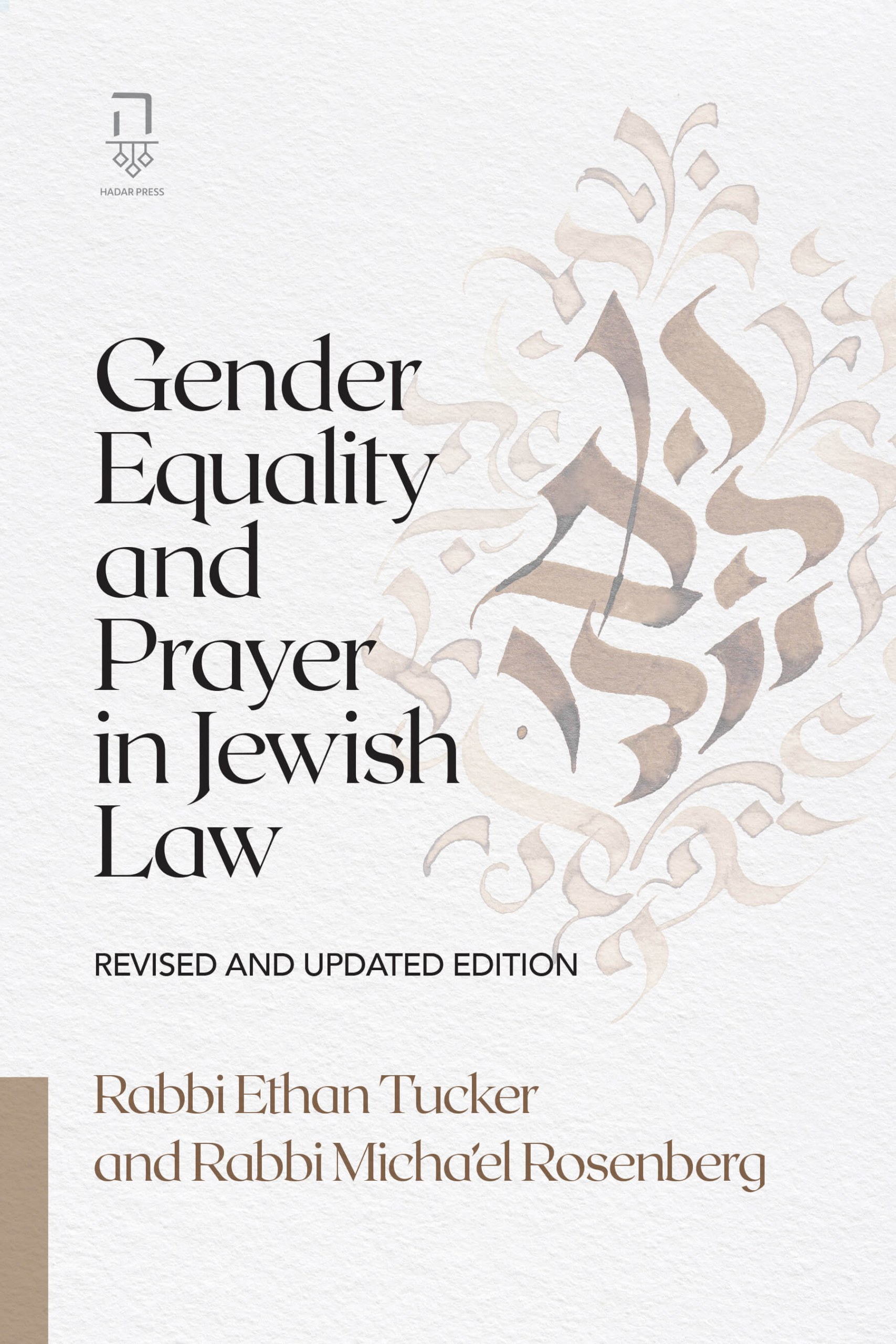
Review of Rabbi Ethan Tucker and Rabbi Micha’el Rosenberg, Gender Equality and Prayer in Jewish Law: Revised and Updated Edition (Hadar Press, 2025)[1]
The 2021 second edition of Professor Tamar Ross’s Expanding the Palace of Torah featured an epilogue reflecting on how the religious landscape had changed since its initial publication in 2004. One phenomenon that Ross noted was the proliferation of “partnership minyanim” in which women receive aliyot, read from the Torah, and lead non-mandatory parts of the prayer service while maintaining a mehitzah separating the genders. Such minyanim have gradually increased in popularity throughout Modern Orthodoxy to the point that nearly every major community has one meeting at least monthly.[2]
“Nevertheless,” Ross wrote, “although partnership minyanim have achieved some degree of grudging tolerance from mainstream Orthodoxy, prophets of doom who warned against the slippery slope effect of this prayer format and its concessions to egalitarianism are now finding their worst fears realized.”[3] She continues:
…Over the course of time, these practices have extended in a few of the partnership minyanim to blanket acceptance of women as leaders for all communal prayers; according women of priestly or Levite descent ritual privilege equal to that of their male counterparts; including women in the minimum count of ten required for a minyan, or at least waiting for a quorum of ten women after the requirement of ten men has been fulfilled; and even doing away with the symbolically loaded bottom-line requirement of praying with a mehitzah. For some members of the partnership movement, the varying positions on these options among different minyanim rather than the legitimacy of the partnership format itself are now the live issues animating their struggle for gender equity. While still continuing to use the traditional Orthodox prayer book (rather than revised editions of the Conservative or Reform movements’ books), otherwise fully egalitarian minyanim render the original compromise of partnership minyanim—adhering to Orthodox methods of implementing change—inadequate to its task. Furthermore, in their willingness to rely on halakhic reasoning that does not stem from authoritative, commonly accepted Orthodox sources and blatantly diverges from traditional precedent, their efforts exhibit a new and striking disregard for maintaining denominational borders that characterized the endeavors of halakhic feminism in the past.[4]
Ross credits R. Ethan Tucker and R. Micha’el Rosenberg’s Gender Equality and Prayer in Jewish Law (Ktav, 2017) as “the most articulate defense of full-fledged egalitarianism from a halakhic point of view, generally relied upon by proponents of this position.”[5] Hadar, the non-denominational organization for which Tucker serves as president and rosh yeshiva, empowers hundreds each year “to create and sustain vibrant, practicing, egalitarian communities of Torah, Avodah, and Hesed.”
In the near-decade since the book’s release to the general public,[6] Hadar has significantly expanded its operations in North America and Israel, including establishing a rabbinic ordination program. Its impact is felt within much of the liberal Modern Orthodox world. Hadar Press’s newly expanded edition of Gender Equality and Prayer in Jewish Law makes this an ideal time to examine the reception of its arguments within Modern Orthodoxy and chart potential paths forward.
The Halakhic Egalitarian Argument in a Nutshell
Per the new edition’s preface, Gender Equality and Prayer in Jewish Law was first published to “help those who are exploring greater gender inclusivity in Jewish prayer for the first time” (1) and to aid “those who are already deeply enmeshed in halakhic egalitarian practice” by providing them a methodology that understands “all of the voices of halakhic conversation as binding, even if their specific conclusions may be culturally conditioned” (2).[7]
To their credit, Tucker and Rosenberg appreciate that readers “with a prior presumption of gendered rules” (that is, coming from an Orthodox background) will find that “the most convincing and reassuring path for exploring gender-egalitarian practice is one that does not require large reworking of broad conceptual frameworks… but rather one that sticks to the close reading of premodern texts and their implications for halakhic practice” (1). Their argument is then structured modularly, such that readers are free to accept premises they find compelling up to any point. Tucker himself noted in an interview with Professor Alan Brill that Orthodox people sometimes tell him “they can buy the conclusions of part I of the book—full equality of leadership of the service—but not part II—full equality of citizenship through minyan,” which may be “the right next step” for some communities.[8]
Relatedly, Gender Equality and Prayer in Jewish Law explicitly sidesteps the question of mehitzah, which has served as, in the words of Professor Lawrence Grossman, “the criterion for Orthodox authenticity, the boundary marker between Modern Orthodoxy and Conservatism” since the 1950s.[9] Tucker and Rosenberg believe it “possible to have separate conversations about gender equality on the one hand, and the mixing or separation of the genders in public space, on the other” (16). They ultimately affirm that “delicate questions of whether equality should be played out through mixed-gender practices as opposed to separate-gender ones can—and must—be assessed community by community, with great sensitivity to the social context” (193).[10] In theory, it might well be possible within their framework to have a fully egalitarian minyan with a mehitzah still in place.[11]
Let us now briefly examine the case made by Tucker and Rosenberg for full egalitarianism. Their initial argument for women to serve as shelihot tzibbur is three-pronged:
- “There is no solid basis for any claim that women are, by dint of the fact that they are women, any less obligated than men in prayer” (47).
- “A fully egalitarian Torah reading can justify itself without reevaluating assumptions and categories by simply endorsing the approach… that allows communities to waive kevod tzibbur” (92).[12]
- “There is no strong textual or conceptual background to any claim that tries to make devarim shebikdushah [barekhu, kaddish, and kedushah] gendered” (123). Furthermore, “[e]ven working with a model of vicarious fulfillment, there is no reason to assume a gender gap… these rituals are rooted in the obligations to sanctify God’s name (kiddush hashem) and to pray (tefillah), in which women have equal obligation” (126).
Thus, Tucker and Rosenberg argue that the primary concerns around women serving as full prayer leaders are those of “custom and stability” rather than Halakhah (127).
The argument for counting women in a minyan is more complex, with Tucker and Rosenberg presenting two different approaches in parallel. They first argue that Rabbenu Tam,[13] Rabbenu Simhah,[14] and Mordekhai[15] seem to provide a framework in which “minyan is nothing less and nothing more than a convocation of ten people anchored to the Jewish people through ancestry or obligation and any such group is theoretically an appropriate manifestation of benei yisrael.” It must, however, “not violate the standard of יקרא דשמיא, ‘the honor of heaven,’ which captures the notion of a gathering that is objectively dignified and worthy of God’s serious attention” (157). Within such a framing, the question to be asked becomes: “Will the de-gendering of minyan be experienced as a cheapening of communal prayer in order to lower standards and increasing [sic] the participation of marginal members? Or will it be experienced as raising the dignity of communal prayer to keep it in line with the standards of gender equality that reflect the dignity and seriousness found elsewhere in society?” (192–93).
A second approach to minyan identified by Tucker and Rosenberg is that of Levush (R. Mordekhai ben Avraham Yoffe), whom they summarize as asking: Can those who are not fully obligated in mitzvot (such as women, slaves, and minors who are all less obligated than adult Jewish men) “possibly help constitute a microcosm of the Jewish people?” (162). Arguing for women to count in a minyan within that framework requires a much broader argument. In their words,
One would need to argue that the term אשה, “woman,” in classical literature is sometimes used as a placeholder for a sociological status that women shared with slaves and minors in most times and places in human history. Under that reading, contemporary changes in the status of women have resulted in corollary shifts in women’s religious obligations such that they now are, through proper application of halakhah, maximally obligated Jews and thus self-evidently included in a minyan just like men. (193)
Following such a change in conceptual understanding, women would not only be able to count in a minyan but would also be maximally obligated in all positive time-bound mitzvot. It is this category-shift argument (often referred to as “paradigm shift”) with which Hadar’s approach has become most associated. The authors maintain, however, that “[i]n communities where distinctions between men and women remain strong generally, tampering with an all-male definition of minyan may weaken the status of communal prayer and the seriousness with which it is approached” (191).[16]
This new edition also includes a lengthy appendix showcasing examples throughout Jewish history in which “a claim that a certain object or action that was once properly classified under one rabbinic category has now shifted categories and the applied law should look different” (196). In the context of this book, it’s meant to justify the shift of women away from the Talmudic category of nashim, but the thirty-four-page appendix does not make that connection directly.[17]
Before moving on to the volume’s reception within Modern Orthodoxy, it should be noted that one surprising, perhaps even ironic, aspect of this new edition of Gender Equality and Prayer in Jewish Law is the absence of any female contributions to the volume. The original printing suffered from this as well, but it was launched with a fascinating panel discussion featuring Rabbis Judith Hauptman and Joanna Samuels. One may have thought that this new edition would have included reflection from a woman associated with Hadar or otherwise involved in conversations around gender egalitarianism.[18] This absence, of course, does not detract at all from the book’s substance. It is, however, unfortunate in light of Dr. Malka Simkovich’s sharp critique of discourse around the first edition:
I follow discussions about women’s ritual participation on social media and in print with interest, but also with detached bewilderment. The majority of these discussions are occurring between men, despite the fact that we are fortunate today to have plenty of women who are knowledgeable in rabbinic literature… I’m afraid that the most important question, Freud’s question, gets overlooked in these discussions: What does a woman want?[19]
Halakhic Egalitarianism’s Orthodox Reception
Hadar does not identify with any particular denomination of Judaism. As quoted by JTA, Tucker and the institution he founded instead aim to present “a strong religious vision that has all the entire Jewish community as its audience.”[20] Indeed, although Tucker is the son of a prominent leader of the Conservative Movement and received his PhD from the Jewish Theological Seminary (JTS), he also attended a Modern Orthodox gap-year program and received rabbinic ordination from the Israeli Chief Rabbinate.[21] In his above-cited interview with Brill, Tucker expressed that he tends to see “allies everywhere, not competitors or rivals” when it comes to moving the overall community closer to egalitarianism.[22] Rosenberg, at the book’s launch, similarly remarked that the excessive self-awareness of breaking from tradition which characterizes so many of the “twentiethth-century Modern Judaisms” does a disservice rather than an advantage.
The book’s initial reception by North American Modern Orthodoxy, to the extent that it was received within that world at all, was mixed. R. Ysoscher Katz of Yeshivat Chovevei Torah Rabbinical School (YCT) said in his own interview with Brill that Torah and Midrash contain many statements that are “uttered by God… clearly about essentialist gender and not about a subjective social construct.” Therefore, “certain gender-based Halakhic distinctions, because of their biblical origin, will (unfortunately) continue in perpetuity. It will, of course, always trouble us, but we will never be able to change that. Our religious mandate, instead, is to, subserviently, accept the burden of divine capriciousness. Rav Ethan’s attempt to alleviate that burden, cannot work because we disagree on the fundamentals.”[23]
In his review of the first edition of the book, my teacher R. Aryeh Klapper praised Tucker and Rosenberg for “clearing away the claim that halakhic change to the intersection of gender and prayer is theoretically impossible.” He also praised them for their “prima facie case that no one has successfully articulated a convincing modern rationale for Orthodoxy’s gender-differentiated practice.” Klapper acknowledged that the book’s arguments are “halakhically conceivable” but that this does not mean any one is “halakhically compelling in and of itself.” For Klapper, the primary concern is “whether these proposals have enough authority to legitimate action on the part of those who buy into the underlying analysis.”[24]
At the time, the extent of Hadar’s inroads in Modern Orthodox spaces was not obvious. Klapper’s conclusion, thus, was that Hadar’s place within the extended Orthodox community ought to be as a “loyal opposition” who are “entitled to keep agitating for change, but must recognize the authority of the legal status quo.”
In the intervening years, Hadar and the Halakhic Egalitarian approach that it champions seem to have been accepted as fellow travelers within the left flank of Modern Orthodoxy.[25] This is observable by the clear and unapologetic presence of Hadar’s vision and leadership in volumes published by that side of our community for external consumption. One example of this is the inclusion of an article by Tucker in a book published by Yeshivat Maharat (and authored/edited by one of the signatories of its semikhah certificate) defending the legitimacy of women’s ordination. In it, Tucker argued that “the time has come where we cannot give a free pass to conversations that simply assume the biological/chromosomal meaning of נשים / women in all Jewish texts and then run away to questions of authority and tradition.”[26] Tucker also presented on well-attended panels at the 2017 Jewish Orthodox Feminist Alliance (JOFA) conference, speaking about “Rabbis and Feminism” as well as “Blurred Boundaries” and “Post-Orthodoxy.”[27]
Where Do We Go from Here?
It would seem that there are two potential directions in response to the inroads Halakhic Egalitarianism continues to make within Modern Orthodoxy. The first is modeled by R. Mordechai Willig in a controversial devar Torah:
…In the words of a “pioneer of the religious feminist wave” cited in the aforementioned article, “What is happening today is a direct continuation of the beginning of Talmud studies for religious women in the 1980’s.” This candid admission must, for the genuinely Orthodox, call into question the wisdom of these studies. Although there are ample reliable sources that encourage individual women who have proper yiras Shomayim and whose motives are consistent with our mesorah to further their Torah study, the inclusion of Talmud in curricula for all women in Modern Orthodox schools needs to be reevaluated. While the gedolim of the twentieth century saw Torah study to be a way to keep women close to our mesorah, an egalitarian attitude has colored some women’s study of Talmud and led them to embrace and advocate egalitarian ideas and practices which are unacceptable to those very gedolim.[28]
In other words, one possibility is for the Modern Orthodox community to nip gender egalitarianism in the bud regardless of any halakhic rationale behind it. Certain innovations may well be halakhically acceptable but nonetheless inadvisable and thus ignored on principle in order to avoid religious discomfort.
A similar argument regarding partnership minyanim was made in 2001 by R. Yehuda Herzl Henkin, who felt that “if done without fanfare, an occasional aliyyah by a woman in a private minyan of men held on Shabbat in a home and not in a synagogue sanctuary or hall can perhaps be countenanced or at least overlooked.” Nevertheless, he paskened against such practices in synagogues on the basis of preventing a slippery slope:
Regardless of the arguments that can be proffered to permit women’s aliyyot today—that kevod ha-tsibbur can be waived, that it does not apply today when everyone is literate, that it does not apply when the olim rely on the (male) ba`al qeri’ah and do not themselves read—women’s aliyyot remain outside the consensus, and a congregation that institutes them is not Orthodox in name and will not long remain Orthodox in practice. In my judgement, this is an accurate statement now and for the foreseeable future, and I see no point in arguing about it.[29]
The slippery slope from partnership minyanim to full egalitarianism feared by Henkin and reported above by Ross may be partially by design. In his editorial introduction to a 2010 volume published by JOFA in defense of women’s aliyot (Women and Men in Communal Prayer), Dr. Chaim Trachtman noted:
A thoughtful reader might protest that they have been misled by a mismatch between the cover and the contents of the book. However, in defense of the editorial choices that were made, qeri’at ha-Torah is both a highlight of Orthodox communal prayer and the first element of the service that has been subjected to widespread critical halakhic analysis regarding the possibility of modifying its performance to enable more complete participation by women… Any community that adopts the practice of qeri’at ha-Torah in the style of partnership minyanim is likely to be open to explore additional aspects of communal prayer that can be shared by women and men. Thus, this book should be seen as a first of many steps in a process to enhance the meaning and spirituality of communal prayer for women and men.[30]
It is far from obvious that such a slope would come to a halt in the context of prayer rather than continue slipping into broader subjects. This is evident in a contribution by R. Aviva Richman, Hadar’s co-rosh yeshiva, in a volume published by Yeshivat Maharat addressing lesbian sexual intimacy in Halakhah. Richman notes:
…An approach to same-sex sexuality based on left-handedness articulated by my colleague and teacher R. Ethan Tucker leaves room for the heterosexually-focused halakhic discourse on sexuality to remain alive, albeit with the need for translation into one’s own “orientation.” Much of what Talmud and halakha have to say about practices rooted in right-handedness (e.g. laying tefillin) is still applicable to someone who is left-handed but requires an act of translation. So too, two women entering into marriage would inherit and be guided by Torah and halakha’s approach to sexuality, including the substantive concerns behind ma-aseh Eretz Mitzrayim and pritzut, while translating these concerns into a different sexual orientation.[31]
She then goes on to offer her own framework for thinking through the subject, clearly in line spiritually with that expressed by Tucker and Rosenberg in Gender Equality and Prayer in Jewish Law:
It does a disservice to halakha and to religious people’s experience to approach the material and analysis R. Fox brings to the table merely as the discovery of a kula (leniency) that establishes freedom from an halakhic stricture such that halakha has no more to say about female-female sexuality. The content surfaced through his analysis brings to our attention many fundamental aspects about the nature of sexuality and partnership that can be a source of learning for all Jews. When is sexual behavior pritzut and when is it tzniut? What kinds of sexual relationships are a toevah and why? What halakhic sources speak to the importance for everyone to have the option to pursue meaningful sexual intimacy and raise children in the context of a partnership that is conducive to happiness?[32]
The derekh ha-limmud displayed by Richman clearly has its roots in the egalitarian framework espoused by Tucker and Rosenberg. The same formulations, with wording relevant to prayer swapped in, would not at all be out of place in the latter half of Gender Equality and Prayer in Jewish Law. Once one is willing to countenance this sort of category reinterpretation, it is unreasonable to assume it would not be applied across various subjects.
Of course, the mere presence of Hadar’s perspectives in outward-facing volumes published by Yeshivat Maharat does not necessarily entail agreement. It does, however, imply that such views are seen as acceptable to not only hold but to advocate for within that segment of Modern Orthodoxy. Were that not the case, the voices of Tucker and Richman would not have been included in either volume.[33]
Given this degree of de facto coalescence, an alternative direction to consider is offered in Klapper’s above-cited review of Gender Equality and Prayer in Jewish Law:
But for the role [of Halakhic Egalitarianism as a “loyal opposition” within Orthodoxy] to be meaningful, and therefore psychologically tolerable, it is vital that those who support the status quo genuinely listen to those who seek change, acknowledge that change is not inconceivable, and indicate that they would themselves become a loyal opposition should change happen legitimately. Failure to do these things breeds cynicism, and then disengagement and/or rebellion.
One way forward may thus be for the liberal Modern Orthodox community to acknowledge this growing voice in our midst and allow history to play itself out naturally from there. If Halakhic Egalitarianism can be explicitly recognized as a legitimate internal voice, as it seems already to have been implicitly, we must prepare ourselves for the possibility of potentially becoming their loyal opposition in a world in which Orthodox self-identification has about as much to do with one’s position on gender equality as it does with figuring out which eruvin or kashrut agencies to hold by. That is to say, a question of significant religious importance but sociologically low-stakes in the grand scheme of things.
What might such a future look like? Professor Adam Ferziger wrote in 2015 that “it is not difficult to envision” a future in which the liberal Modern Orthodox world is pushed by the Orthodox Right “to form a new coalition with the growing trend toward nondenominationally affiliated synagogue communities that aim to be both fully egalitarian and halakhic” with “the intellectual base for this burgeoning coalition… found in the egalitarian yeshiva Mechon Hadar.”[34] Indeed, he noted even then the presence of events “jointly sponsored and staffed by YCT, Yeshivat Maharat, Drisha, and the non-Orthodox Mechon Hadar.”[35] More recently, Ferziger also noted that “Hadar has many faculty and participants in its programs who identify as Orthodox.”[36]
One example of this is R. Yitz Greenberg. In 2022, he wrote a post on social media justifying participation in Hadar’s shabbaton:
Hadar is my fantasy of the future modern Orthodox community. Hadar is committed to Torah learning and full observance of mitzvot. At the same time, the principle of egalitarianism was so precious and important that they practiced it in the here and now, not in a distant future. I too believed in egalitarianism, but as my community had still not accepted it as determining their halachic practices, women were excluded from various religious roles. I joined these services as part of being a member of this Hadar community. But I hoped in time that the Modern Orthodox community – which was, step by step, moving in this direction [=women Rabbis and maharats, partnership minyanim with women leading Kabbalat Shabbat services or Psukei D’Zimra prayer sections] would some day come to full participation of women and their leadership in all the services… just like Shabbat is a taste of the future Messianic perfection of the world, so I felt that the Hadar religious experience was a foretaste of a future progressive Orthodox community.[37]
Indeed, YCT and Maharat founder R. Avi Weiss has himself advocated for “an inclusionary Orthodoxy that empowers women to be more involved in Jewish ritual and spiritual leadership; that invites religious questioning and promotes dialogue across the Jewish spectrum; welcomes people regardless of sexual orientation or level of religious observance; and looks outward, driven by a sense of responsibility to all people,”[38] made up of the organizations he founded alongside “the more conservative wing of Hadar and the more progressive graduates of Chabad, Yeshiva University, and Yeshivat Har Etzion…”[39]
At the end of the day, only time will tell whether Modern Orthodoxy has an egalitarian future.[40] As R. Dr. Sam Lebens has noted:
Many factors play a role in bringing the Torah closer to its heavenly paradigm. Social and political movements, other religions, and more directly, non-Orthodox denominations within the Jewish world, all play a role in awakening certain sensitivities and attitudes within the Orthodox community. Liberal segments of that community agitate for change within the halakha. Conservative elements within the same community resist any change. The legal traditions themselves create obstacles to some changes, whilst being more amenable to other changes. The changes and evolutions that make it through this process can claim to be an echo of Sinai.[41]
In the meantime, Tucker and Rosenberg’s exploration of the question will have certainly succeeded in their goal to lead communities on both sides of the literal and metaphorical aisle “to a deeper understanding of their own practices, a sense of the underlying values that have guided these conversations throughout the centuries, and a profound desire to properly apply God’s eternal mitzvot to our personal and communal lives” (194).
Thank you to Chesky Kopel for editing, Ashley Stern Mintz for copyediting, and to several friends and colleagues from the Halakhic Egalitarian and Liberal Modern Orthodox orbits for offering insightful comments as this article was written.
[1] All in-text citations are from the volume under review.
[2] See Jofa’s Partnership Minyanim page for a directory of such minyanim.
[3] Tamar Ross, Expanding the Palace of Torah: Orthodoxy and Feminism, 2nd ed. (Brandeis University Press, 2021), 263.
[4] Ibid.
[5] Ibid., 341 n72.
[6] It was initially available as a teshuvah on the Hadar website for some time.
[7] This is framed slightly differently than the three originally expressed goals of the book:
- to clarify misconceptions and dismiss red herrings that often cloud discussions on this topic;
- to provide a sound basis for understanding the halakhic consequences of various positions related to gender and prayer; and
- to provide a unifying discourse that can make sense of both egalitarian and non-egalitarian practices in Jewish prayer and enable proponents of both to be able to share a unified halakhic conversation despite their divergent practical conclusions. (13)
[8] Alan Brill, “Interview with Rabbi Ethan Tucker,” The Book of Doctrines and Opinions, September 7, 2017.
[9] Lawrence Grossman, Living in Both Worlds: Modern Orthodox Judaism in the United States, 1945–2025 (Academic Studies Press, 2025), 77.
[10] The topic of mehitzah is directly addressed by Tucker here: “Good Fences Make Good Neighbors?,” Hadar Institute.
[11] Friends report that Hadar’s Israeli operation utilizes a tri-hitzah setup with separate sections for men, women, and mixed seating.
[12] This part of their argument is explicitly based on the work of R. Mendel Shapiro and R. Daniel Sperber in defense of partnership minyanim.
[13] Tosafot R. Yehudah Sirleon on Berakhot 47b. This does not appear in most printed Gemaras.
[14] As quoted in Mordekhai on Berakhot 173.
[15] Berakhot 158 and Gittin 401.
[16] This sort of argument seems to be supported by Yeshivat Har Etzion’s R. Yoel Bin-Nun, whose positions (cited by Tucker and Rosenberg) sometimes invoke similar language. Indeed, the authors relate that
In a personal communication, R. Bin-Nun confirmed that he would extend this logic [that “our women” are a different category than women of the past] to the realm of vicarious fulfillment; i.e., a woman in this category could blow shofar for a man. Interestingly, in discussing the concept of minyan, R. Bin-Nun says: “…It would seem that one can, in our day, follow the position of R. Tam.” R. Bin-Nun means this in the practical sense that R. Tam’s position theoretically allows for ten women to constitute the minyan. But the essence of R. Bin-Nun’s argument is in fact that contemporary women often have a different status than the women spoken of by Hazal, such that, according to R. Bin-Nun’s analysis, ten women can constitute a minyan even under the Levush’s theory (186 n77).
My friend R. Matthew Anisfeld pointed out to me that Bin-Nun’s framing predates that of Tucker and Rosenberg.
[17] R. Ysoscher Katz has criticized this argument on the following basis: “While Rav Ethan indeed provides multiple proofs for the claim that rabbinic categories are culturally subjective, none of them, however, are categories with a specific basis in the Torah… The common denominator in these examples is that they are all rabbinc [sic] concepts or formulations, none of them is predicated on an explicit biblical formulation.” R. Ysoscher Katz “Rabbi Ysoscher Katz Responds to Rabbi Ethan Tucker Interview,” The Book of Doctrines and Opinions, September 13, 2017.
[18] It is notable that the Conservative Movement’s most recent and most authoritative teshuvah on gender egalitarianism, “Women and Mitzvot,” is written by R. Dr. Pamela Barmash. Her conclusion is very similar to Tucker and Rosenberg’s:
The involvement of women in Jewish religious and liturgical life has changed significantly in the past century and even more in the past few decades. Jewish women are aspiring to the privileges and responsibilities enjoyed by Jewish men through the millennia. The halakhah has recognized that when social customs change significantly, the new social reality requires a reappraisal of halakhic practices. The historical circumstances in which women were exempted from time-bound positive mitzvot are no longer operative, and the Conservative movement has for almost a century moved toward greater and greater inclusion of women in mitzvot. In Jewish thought and practice, the highest rank and esteem is for those who are required to fulfill mitzvot. We rule therefore that women and men are equally obligated to observe the mitzvot. We call upon Conservative synagogues, schools, and camps to educate men and women in equal observance of mitzvot and to expect and require their equal observance of mitzvot. (Barmash, 32)
[19] Malka Z. Simkovich, “Malka Z. Simkovich Responds to Rabbi Ethan Tucker Interview,” The Book of Doctrines and Opinions, September 11, 2017. I am not oblivious to the fact that this review itself, written by a male rabbi, contributes to that reality.
[20] Jackie Hadjenberg, “Is Hadar a New Denomination of Judaism in Light of Recent Growth?,” The Jerusalem Post, July 2, 2024. This is not to imply that Hadar is “pluralistic.” Using its three-pronged framework, in which any space can embody only two of three values—pluralism, integrity, and community—Hadar prefers to be a community with integrity. See “Pluralism, Integrity and Community: You Can’t Have Them All, Part 2.”
[21] Tucker’s stepfather was also Joe Lieberman, a Modern Orthodox U.S. senator and the 2000 Democratic vice-residential nominee. Tucker’s eulogy for Lieberman can be read here: “My Stepfather Joe Lieberman Set One Path as a Jew in Politics. Will His Many Successors Follow It?,” JTA, July 26, 2024.
[22] Discussion of how much credit the Conservative Movement can take for Hadar is beyond the scope of this essay. However, some Orthodox colleagues have shared that, based on their own experiences, Hadar seems to react primarily to aspects of the Conservative Movement and its institutions that its founders and participants interpret as flawed or soulless, rather than reacting to anything in the Orthodox world. Regarding the developments within Orthodoxy mentioned at the beginning of this essay, R. Dr. Neil Gillman of JTS wrote in the early 2000s:
Orthodoxy, for its part, began to recognize Jewish women as halakhic authorities in their own right, and even allowed them to assume selected but significant liturgical and ritual roles. These developments should be appreciated [within Conservative Judaism] as a backhanded tribute to where we have located ourselves all along. (Rabbi Neil Gillman, Doing Jewish Theology: God, Torah, & Israel in Modern Judaism [Jewish Lights, 2008], 204)
[23] “Rabbi Ysoscher Katz Responds to Rabbi Ethan Tucker Interview,” The Book of Doctrines and Opinions, September 13, 2017.
[24] Aryeh Klapper, “Book Review-Gender Equality and Prayer in Jewish Law,” The New York Jewish Week, July 15, 2020.
[25] This is not to say that the left flank of Modern Orthodoxy is illegitimate or insufficiently Orthodox. Such arguments have been had ad nauseum throughout the past two decades and, in my view, are unproductive.
[26] “Ethan Tucker’s Response,” in Rabbi Daniel Sperber, Rabba, Maharat, Rabbanit, Rebbetzin: Women with Leadership Authority According to Halachah (Yeshivat Maharat and Urim Publications, 2020), 190.
[27] JOFA Conference 2017: Full Schedule. In the latter panel, he filled in at the last minute for his Hadar colleague, R. Dr. Shai Held.
[28] Rabbi Mordechai Willig, “Trampled Laws,” TorahWeb, 2015.
[29] Yehuda Herzl Henkin, “Qeri’at Ha-Torah by Women: Where We Stand Today,” The Edah Journal 1, no. 2 (Sivan 5761 [2001]).
[30] Chaim Trachtman, ed., Women and Men in Communal Prayer: Halakhic Perspectives (Jewish Orthodox Feminist Alliance and Ktav Publications, 2010), xviii.
[31] “Rabbi Aviva Richman,” in Rabbi Jeffrey Fox, Nashim Mesolelot: Lesbian Women and Halakha: A Teshuva with Responses (Yeshivat Maharat and Ben Yehuda Press, 2024), 134–35. Tucker’s article can be read here: “Uniformity and Diversity: Left-Handedness and Halakhah.”
[32] Ibid., 135–36.
[33] Both volumes featured dissenting opinions, of course. But it is obvious that such voices (the OU’s position on women in clergy roles, included in Sperber’s volume, for example) are within the broader Orthodox camp, while one would not automatically make the same assumption about Hadar.
[34] Adam S. Ferziger, Beyond Sectarianism: The Realignment of American Orthodox Judaism (Wayne State University Press, 2015), 221.
[35] Ibid., 289 n77.
[36] Adam S. Ferziger, Agents of Change: American Jews and the Transformation of Israeli Judaism (NYU Press, 2025), 373 n19.
[37] Facebook post by Rabbi Yitz Greenberg, December 12, 2022. Brackets in the original.
[38] Avraham “Avi” Weiss, Journey to Open Orthodoxy (Urim Publications, 2019), 80–81.
[39] Ibid., 82. Perhaps relatedly, in a 2018 interview with R. Shmuly Yanklowitz, R. Asher Lopatin—then president of YCT—acknowledged belief that Orthodox Judaism would one day become fully egalitarian and mentioned casually that, in his opinion, women could lead devarim she-bi-kedushah.
[40] Admittedly, my gut instinct is negative. Even as Halakhic Egalitarianism continues to gain traction within the leftmost edge of Orthodoxy, the rest of the community is likely to follow in the footsteps of figures like Willig and Henkin. Within the Orthodox left, if one cares enough about the label of Orthodoxy, there is no benefit to becoming a “loyal opposition” to Halakhic Egalitarianism. This may lead to a healthy middle group within American Jewish life but is unlikely to make inroads into centrist and right-wing Orthodoxy given how small the Orthodox left already is by comparison. Based on the statements within and publications from the left wing of Modern Orthodoxy surveyed here, Halakhic Egalitarianism is likely to at least remain an acceptable yesh omrim within that world for the foreseeable future.
[41] Samuel Lebens, The Principles of Judaism (Oxford University Press, 2020), 218.





 Site Operations and Technology by The Berman Consulting Group.
