

Michael Blank
My efforts are aimed at finding the proper “language” that will allow the translation of the words of our Sages and the Rishonim into an idiom that can be understood in our postmodern world… This must be accomplished without damaging the classic understanding of limud Torah as the covenant between the student and God.[1]
The problem of language plagues many of the thinkers who grace the digital pages of this very publication. What did, say, R. Yehoshua mean when he said those words? Can I be sure that my interpretation of R. Moshe’s pesak is that which he intended, or at least that which he intended people to think he intended?[2]
In fact, this might be the concern of every Jewish thinker worthy of their name. For while they are discussing the minutiae of the matter at hand, say the kashrut status of an etrog, the prevailing problem they are addressing is the extent to which they can access the meaning of the Text. Of course, the example we have chosen is itself fraught from the outset because the written Torah does not even name the fruit it wants us to use for the arba minim. And so, the project continues, that of understanding the word.
Much ink has been spilt on the history of approaches to this issue. An intellectual history of the problem would surely not be contained within the four amot of The Lehrhaus, but I think an engaging discussion may be gleaned from exploring how one thinker (R. Shagar)—in conversation, so to speak, with a concatenation of other ideas—dealt with the problem of language and translation, specifically as it relates to interpretation, in his oeuvre. The epigraph above is a good starting point: without translation we are lost.
The Tzaddik as Translator
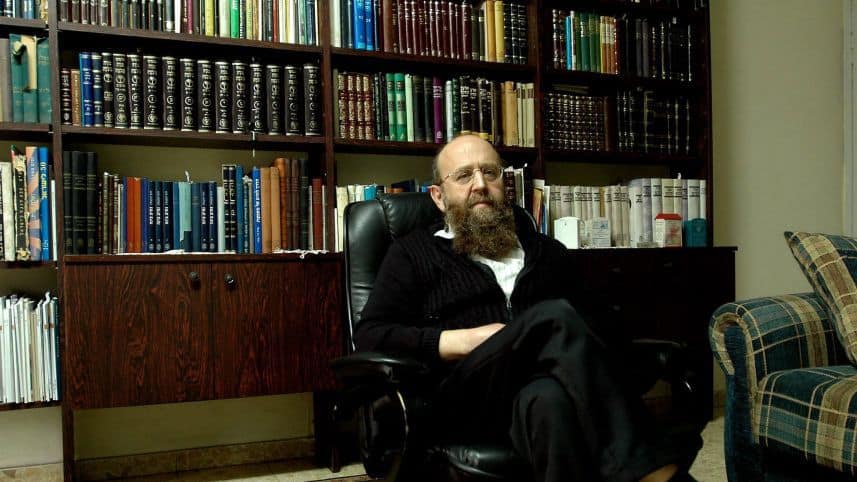
What follows seeks to develop the idea of translation by looking at a number of derashot, or exegetical passages. These are all spoken or written by Shimon Gershon Rosenberg, commonly known as R. Shagar, a prominent Israeli thinker and rabbi who died in 2007. Since his death, his works have been more widely disseminated, primarily in Hebrew but recently some in English. An in-depth analysis of translation in his thought is warranted.
In what follows, by way of a critical look at his analysis of one of Rebbe Nachman’s discourses (and subsequently in conversation with other parts of R. Shagar’s writings), we will better understand what I argue is the central project of R. Shagar: translation. However, it is by no means a straightforward activity; this is a multi-layered translation, one that at times is not even comfortable with itself as a project.
R. Shagar, in his shi’urim on Rebbe Nachman, provides us with a commentary on Torah 19, published in Likkutei Moharan, which was originally delivered by Rebbe Nachman on Shavuot 5564 (1804).[3] As we will see below, Torah 19 comprises a sequence of commentaries on the question of translation. Rebbe Nachman opens with a discussion on whether one should hear a tzaddik (the righteous leader of a Hasidic sect) in person, or perhaps merely read their ideas in books. We might infer from this that the act of coming to hear a rebbe in person was not a given, or perhaps had been put into question. As it was de rigeur to visit the tzaddik on festivals, it seems apropos for Rebbe Nachman to explore this question with those who have come to hear him.
In R. Shagar’s commentary on Torah 19, the question of the meaning of language is exposed immediately by a telling omission at the very beginning.[4] The quotation from Likkutei Moharan in the 2012 edition of R. Shagar’s shi’urim (“Everyone wonders why it is necessary…”[5]) excludes the verse Rebbe Nachman is commenting on, which is the first verse of the haftarah on the second day of Shavuot, Habakkuk 3:1, read only in the diaspora. This haftarah is thematically concerned with theophany, a theme one might assume relates to what follows in Rebbe Nachman’s Torah 19. Its absence in the R. Shagar version is not only due to economies of space. R. Shagar does not feel a need to read in either the historical or geographical context in which Rebbe Nachman’s Torah was spoken, and this omission sets the stage for what follows. In fact, midway through the shi’ur, while discussing whether language has the essence of a nation which speaks it, R. Shagar says:
Personally, I have no problem presenting Rebbe Nachman’s words about the uniqueness of the lashon ha-kodesh [holy language, or Hebrew] according to the historical interpretation. Even if his words about the uniqueness of the lashon ha-kodesh stem from his origin point, which is anchored in a particular historical context, they nevertheless express a sentiment whose truth can be understood in itself, even in other contexts.[6]
One could say more about how this omission of the Habakkuk verse only read in the diaspora reflects the rootedness of R. Shagar’s thought in the land of Israel, but for our purposes this merely illuminates that the project of translation is itself one of interpretation, or indeed may be that of omission. As we will see, R. Shagar is alive to the idea of the subjectivity of language, which is the lens through which he will interpret this teaching of Rebbe Nachman. And whereas the haftarah from Habakkuk is about theophany, his interpretation of Rebbe Nachman’s thought is very much one centered in the subjective, human experience.
The second text Rebbe Nachman uses for his discussion is a passage in the Zohar (Sifra De-Tzniuta 2) on “face-to-face” encounter with God. Yet what follows is a radical reinterpretation from Rebbe Nachman, and subsequently from R. Shagar. We move from the encounter with God (in the Zohar) to the encounter with the tzaddik (in Rebbe Nachman’s commentary), and then to a psychological and ethical interpretation of the encounter with the Other (in R. Shagar’s shi’ur). Ultimately this will segue into what I argue is R. Shagar’s personal project of translation. For the benefit of clarity, we will thrash out the key arguments in Rebbe Nachman, but the sheer breadth of R. Shagar’s interlocutors would not fit within these pages. (R. Shneur Zalman of Liadi, Arizal, R. Avraham Kook, Maimonides, Jacques Lacan, Sigmund Freud, Emmanuel Levinas, and Walter Benjamin all appear in the body of the text, and that does not even touch on the extent of the footnotes.)
The straightforward answer Rebbe Nachman gives as to why one should travel to see the tzaddik (he is certainly self-referential here) is that the larger the (physical) distance from the tzaddik, the further down the spiritual levels one descends. Crucially, however, the encounter with the tzaddik is like a mirror:
Now, the tzaddik has a pure countenance. Everyone can see his own face in the face of the tzaddik, as [he could] in a mirror. As a result, even without rebuke and without reproof, the other will feel remorse for his deeds just by having looked into the tzaddik’s face. This is because, by looking into his face, a person will see himself as if in a mirror and realize how he is immersed in darkness.[7]
This image of the mirror implies the revelation of self through the tzaddik, leading ultimately to teshuvah, or repentance. Assuming a lack in our own lives, the tzaddik, in R. Shagar’s terms, creates a kind of “mirror effect, allowing them to find their place and identity.” We might struggle to experience the revelation of the Absolute, but the tzaddik can mediate this. For our purposes, I deliberately avoid here the long-standing critique of this view of the tzaddik, but it suffices to say that in early Hasidic thought it is precisely through the hard work of the tzaddik that their students can elevate themselves.[8]
R. Shagar next introduces Lacan’s[9] three levels of human reality: the Symbolic, the Imaginary, and the Real. These intertwined dimensions allow an interpretation of the mirror concept in Rebbe Nachman. “Lacan’s descriptions can help us to read Rebbe Nachman’s words here in a further way [be-ofen nosaf].”[10] By read, R. Shagar means to interpret.
Lacan constructs reality on three levels which interact with each other. Slavoj Žižek helpfully illustrates these levels through a game of chess: the rules of the game (e.g., the knight can only move in a specific formation) are the Symbolic. This is different from the Imaginary level, in which the pieces represent the queen, king, knight, etc. in their appearance and names. In fact, one could keep the Symbolic (i.e., the moves a piece makes) and replace the Imaginary, such as by having characters from the Simpsons, in which the knight becomes Bart, the king becomes Homer, the queen becomes Marge, etc. The Real, by contrast, is the circumstances that affect the gameplay, such as how smart a player is, or some other external factor that might influence a game.[11]
The mirror in Lacan is crucial for the development of the Imaginary. A child looks in the mirror and identifies with the image, but is alienated from it, creating an ‘I,’ or the Imaginary. There is then a transition to the Symbolic, which occurs through language. The Symbolic is enacted when an adult validates that image.[12] According to R. Shagar, Rebbe Nachman uses the Imaginary stage (that of creating oneself) in describing how we see the face of the tzaddik as a mirror. I look in the ‘mirror,’ the Face, and create myself— return (teshuvah) to myself—in this interaction.
When R. Shagar introduces Emmanuel Levinas[13] into this picture, he uses the same phrase, be-ofen nosaf, as he had done with Lacan. He employs it to expand beyond Rebbe Nachman, similarly to how Rebbe Nachman uses the phrase behinah to signal he is exceeding a text he is commentating on. In exactly this way, R. Shagar is surely extending words beyond their original meaning, for he provides us with a new reading of Levinas. Levinas was concerned with the problem of Ethics, specifically the encounter with the Other: the Levinasian encounter with the Face of the Other is the appearance of the Absolute, the transcendent, in that face. In other words, even before I can begin my relationship with the other, I first see their face. That face leads to a call, an ethical responsibility. This encounter necessarily leads to the ethical demand, as I am ‘held hostage’ by that Other in the act of seeing their face. Seeing the Absolute in the face creates the ultimate responsibility which cannot be ignored. While Levinas sees this Absolute in every face, for Rebbe Nachman “the tzaddik manifests the absoluteness that Levinas sees in the face of every person.”[14] Rebbe Nachman has a very specific application of the notion of face; that manifestation in the tzaddik leads to teshuvah, in which we accept the infinite responsibility.
Dumplings and the Tanya
Rebbe Nachman’s ensuing discussion on the difference between lashon ha-kodesh and the seventy languages of the non-Jewish world does not seem to flow directly from the above section on the tzaddik as mirror. We might infer that the tzaddik is the one who understands the ‘holy tongue.’ R. Shagar will attempt to connect these themes later. In any case, Rebbe Nachman discusses how the seventy languages are fundamentally impure, but targum, or translation, allows for them to be elevated. He goes further, however, when he says “this is behinat the perfection of the lashon ha-kodesh by means of the targum.” The use of behinah here is a clear signal that Rebbe Nachman is supplying us with a profound new insight, and one that forms the center of this text. Indeed, the seventy languages are associated with evil, with the spirit of folly, with nocturnal emissions, etc., and yet the use of targum into lashon ha-kodesh elevates not only these other languages, but also, somehow, lashon ha-kodesh itself. In other words, instead of lashon ha-kodesh elevating the secular, the secular elevates lashon ha-kodesh. This jump, in which the outside world can be brought inside, as it were, represents a radical move, and we will see how R. Shagar is moved by this idea.
In a fascinating excursion into the philosophy of language and semiotics, R. Shagar discusses the modern interpretation of language. He argues that language creates reality; words are not only signs. In fact, he insists on the subjectivity of language, that “the world was created by language that creates reality,”[15] and then proceeds to cite Lacan, Saussure and Wittgenstein in the same footnote. R. Shagar’s worldview rejects ideology or certainty, and therefore does not assume the objectivity of language. Elsewhere, Alan Brill summarizes this way of thinking: “[W]e have now lost the ability to believe in meta-narratives or to achieve a solid grounding in our ideologies… Rabbi Shagar thinks language does not point to or describe a virtual reality, but rather, that language is one of holiness as understood through the confines of culture, the ‘signs’ and symbols of the study hall of Torah.”[16] Rather than retreating into himself, R. Shagar sees this perspective as an opportunity for creativity.
Typically for R. Shagar, each philosophical idea is corroborated by a real world example. This one is worth quoting in full, if only for its sentimentality:
Another example is the Yiddish language, which has unique terms for describing foods, which are not only names for the foods but also express their purpose and essence as well. Eating soup with kneidlach: he who eats dumplings does not taste the same taste. Language is part of the spirit of the matter, and does not just describe objects; amongst its words lies the spirit of the language, which shapes the matter from within, and he who does not belong to the particular language, does not have what the language creates.[17]
This emphasizes that the language used can shape how we experience the world (and the things in it) profoundly. R. Shagar compares this notion of language to that of R. Shneur Zalman of Liadi’s in Tanya, who says that the word brings objects from Nothingness (ayin) to Being (yesh). Creation occurs through speech. For Rebbe Nachman, lashon ha-kodesh can create, and while non-Jewish language is the language of impurity, the tzaddik can translate this impurity, using the targum to perfect lashon ha-kodesh. This practice of translation is a tikkun, an overcoming of evil.[18] And, as R. Shagar argues, it allows us to translate the philosophical language of our generation, for we have no choice but to translate.
R. Shagar, in what could be his most important, overriding concern, redefines what translation, targum, means. It might even be the meta-concern, which is at the foundation of his thinking.
Today, the teachings of Rebbe Nachman are not necessarily a translation of the Kabbalah, rather they themselves have become for us the Holy Language that requires translation, so that the translation has become a source, and we need another language of translation in order to understand his words in a form that will have power and vitality.[19]
By means of a discussion on Walter Benjamin’s perspective on the Creation story, R. Shagar next addresses two types of language: the language of God, in which the words correspond to essence, and the language of man, in which language is functional and describes objects. The language of God does not refer to objects that are discrete from it; it is the world itself, with no duality. By contrast, the language of man signifies other things or objects separate from it. The “Tree of Knowledge of Good and Evil is the language of translation,”[20] meaning that in the story of Adam and Eve language changes into a signifier, something separated from the objects. For Rebbe Nachman, lashon ha-kodesh is the language of God, where language is reality, not only a signifier, but we will shortly see how this is more complex than it seems.
Rav Kook and Rebbe Nachman
To keep this interpretation by R. Shagar on Likkutei Moharan in isolation would be a mistake; the different components of his oeuvre speak to each other. We see him refer to this text in his commentary on Hanukkah, where he compares Rebbe Nachman’s view to the thinking of R. Avraham Yitzhak Ha-Kohen Kook.[21] R. Shagar explores the themes of universalism and particularism which are key to Hanukkah, and contrasts Greek language with lashon ha-kodesh, in the sense of using one to interpret another. This is expressed via the dichotomy of Yafet (symbolizing the non-Jewish world) and the tents of Shem (symbolizing the Jewish world): “God shall enlarge Yafet, and he will dwell in the tents of Shem.”[22] Rav Kook, through interpreting this verse, argues that there is a distinction between the “medium of language, and the content expressed by it.” Secular thought may actually enhance our expression of the Torah, and would not threaten it. He has no problem with the tents of Shem being clothed by Yafet, in which the Torah can be enhanced by non-Jewish thinking. R. Shagar contrasts this with the thinking of Rebbe Nachman, for whom there is no distinction between the medium and the content. He is concerned with the very essence of Greek thinking, which would affect the essence of the Torah.
Strikingly, Rebbe Nachman goes beyond the dichotomy of Yafet and Shem. Although he cautions against the dangers of the language of the nations, in a reversal of Rav Kook’s position, for Rebbe Nachman sometimes Yafet can be clothed in the tents of Shem. Shem → Yafet becomes Yafet → Shem. This means that the religious world we know is transformed, not merely adorned with useful extraneous ideas. This transformation takes place in the act of storytelling because it completely removes us from the world we know: “The main purpose of Rebbe Nachman’s stories is to translate” which in the end “completes the holy language.”[23] Rebbe Nachman steps out of the sphere of lashon ha-kodesh, and enters a literary world; from that vantage point, he can translate back into lashon ha-kodesh, bringing a fresh perspective. Whereas Rav Kook centers the holy language as the point of departure, Rebbe Nachman reverses the relationship, stepping into a foreign world and from there translating back into the Jewish one. In a sense, he steps outside in order to return to the inside.
R. Shagar follows this contrast between thinkers with a quote from our text in Likkutei Moharan, Torah 19, in which in the holy language there is no difference between language and the essence of the thing. For R. Shagar our situation today is radically different from that of the past (a scenario in which translation is only for the tzaddik) because
the question is whether in the current situation in which we find ourselves, we have not become “and all Your people are righteous [tzaddikim]” (Isaiah 60:21), that is, where we have no choice but to exist in the space between inside and outside, between identity and alienation, and Rebbe Nachman’s guidance of innocence and simplicity is not addressed to our way of life as it is… For the better we are citizens of several cultures and live in more than one world of values. We cannot and do not deny this situation, because such a denial is a self-denial that will lead to a deep and radical damage to our religious faith itself. Therefore, not only is Rebbe Nachman’s translation required, but it is the only option to elevate the translation that is already happening anyway.[24]
For R. Shagar, the world has changed. We cannot help but see the world through the ‘Greek’ language, that of post-modernism, the media, academia, etc. And so Rebbe Nachman’s notion of translation, previously reserved for the tzaddik, is required for us all. Importantly, the commentary by R. Shagar in The Remainder of Faith differs somewhat from his longer commentary on Torah 19. He takes the notion of translation to the same conclusion, but then expands to demonstrate how faith is necessary to live in the world of translation. It is not enough to merely encounter the many different worlds outside Judaism; one must have a “deep personal faith.” Perhaps the comparison with Rav Kook gives R. Shagar a heightened awareness of the potential problems with Rebbe Nachman’s approach.
In both cases, nonetheless, R. Shagar sees us as outside the unified world (in which language is reality). “We look at the world from the outside,” from a place of targum, which is from a “place of reflectivity.”[25] This recalls the notion of the mirror above, in which we cannot view reality as it is, but only through a conduit. It is not that we reassign the lashon ha-kodesh to the language of translation, but that we find within the targum elements of the lashon ha-kodesh. It is noticeable that, in this essay on Hanukkah, R. Shagar eventually leaves behind Rav Kook’s depiction of Yafet vs. Shem; it is as if he initially uses it as a foil, then in the final three pages Rebbe Nachman’s is the position he favors. It is clear, especially when compared with his shi’ur on Torah 19, that precisely this novel notion of translation is central for R. Shagar.
In her essay at the end of Remainder of Faith, Gili Zivan remarks on how the medium of the derashah, or sermon, is not only a matter of style, but facilitates R. Shagar’s translation effort, because it allows for the “multiplicity” which is “the basis for the mystical and religious experience.” For Zivan, the sermon allows him to speak in a language in which he is comfortable, but it also allows him to join together “eclectic” sources. Through this, R. Shagar, like Rebbe Nachman before him, is “renewing the religious ideology that has become fossilized,” and he does this as ‘translation’.[26]
Completing the Circle
R. Shagar’s focus on translation takes one final turn in his shi’ur on Torah 19, which analyzes the role of the tzaddik in relation to the Imaginary. Rebbe Nachman reads the story of the biblical character of Joseph, who interpreted (translated) dreams. Dreams are a translation of the soul. By contrast, the wife of Potifar, who attempts to seduce him, speaks a foreign tongue. Her foreign language is therefore connected (by Rebbe Nachman) to sexual immorality, and it is this which must be corrected. The sexual urge could be found in sleep (dreams), but Joseph avoids this via interpretation of dreams, and in so doing this translation can elevate lashon ha-kodesh.
R. Shagar uses this framing to compare Freud and Rebbe Nachman: Freud sees the dream as translating a person’s libido through symbolic language, while Rebbe Nachman sees the spirit of the non-Jewish languages as providing the vitality to elevate sexuality to lashon ha-kodesh. Interpretation or translation can elevate the sexual realm. R. Shagar then takes this to the level of the Imaginary, bringing us back to the reading of Lacan with which we began.
Imagination itself, as Maimonides taught us, is also the evil instinct—but also the basis for prophecy, which is why it must be raised, as the tzaddik does. By this, Rebbe Nachman means to say that the sexual urge is found in sleep, on the fantastic level, and not on the conscious level of the lashon ha-kodesh; therefore it must be raised to holiness, and the imaginary dimension inherent in it must be clarified… Yosef, the tzaddik who symbolizes the sefirah of yesod,[27] is described as the solver of dreams, who reveals their secret in language, in speech. The language of translation is connected to the dream, to metaphor, because it does not directly indicate the thing itself.[28]
The tzaddik works with the instincts of the Imaginary, transforming it. Creativity cannot occur in a world without the chaos of the Imaginary.
Finally, R. Shagar returns to the face-to-face. He discusses Freud’s dichotomy between the desire for pleasure and the need to suspend this pleasure (or between pleasure and reality). The sexual drive is limited by culture and society, which require restraint, ultimately reaching some equilibrium. “In this sense, the introduction of the evil instinct into language expresses its subordination to the state of the ‘face-to-face’ described at the beginning of [Rebbe Nachman’s discourse], that is, to the social context.”[29]
One could easily gloss over how a reading of the face-to-face with God is transformed into the face-to-face with the Other in society. Theophany has been transformed into Ethics, which is certainly no mean feat. The power of this teaching is that the Absolute is not something inaccessible, but now can be accessed with the mediation of the face of the tzaddik. By visiting the tzaddik, we receive an elevated language, a translation. “The talent of the tzaddik is his ability to live in a consciousness of translation, that is, to relate to evil and elevate it, and this talent is also what enables his function as a mirror, which allows closeness to him and the ability to be reflected in his image, rather than creating a sense of distance and a gap which cannot be bridged.”[30]
This is self-evidently R. Shagar’s project too. Indeed, Rebbe Nachman reframes the text from Habakkuk, but R. Shagar is no less radical in his own project of targum, in which he translates so much contemporary thinking into the lashon ha-kodesh.[31] Using Rebbe Nachman’s model, targum becomes the means to ensure the ongoing relevance of the Torah.
Inimical Thinking?
On first glance, R. Shagar’s attempt to put these thinkers in conversation is not an obvious one, for a variety of reasons. Firstly, the thinkers themselves would not have recognized his project. Take Levinas, for example. It is no secret that Levinas does not think within the ‘mystical’ realm. He is a student of the Talmud and philosophy, embedded within the Mitnageddic tradition. While he was physically from Eastern Europe, we can place him firmly outside the Hasidic camp; he privileges Western, European, so-called rational thought, unapologetically.[32] Repeatedly he refers to the Gaon of Vilna and Hayyim of Volozhin as thinkers who embody this rationalist, non-mystical culture.[33] Putting him in conversation with Rebbe Nachman (a profoundly mystical thinker) therefore does not seem fitting. Secondly, R. Shagar (regardless of the thinkers’ relative compatibility) takes ideas out of the context in which they were written. Lacan’s discussion of the mirror is far removed from Rebbe Nachman’s discussion of the tzaddik’s face, and when these ideas speak to each other, they cross a large chasm in terms of the conceptual worlds of the thinkers. Thirdly, on the level of the argument, R. Shagar’s understanding of the face is actually a misunderstanding of Levinas; by definition, Levinas’s ‘face’ cannot be instrumentalized, and must remain Other. The description of the face of the tzaddik as carrying a purpose beyond the call to the Ethical is anathema to what Levinas has in mind. In fact, elsewhere R. Shagar disputes Levinas’ notion of the Other (in relation to God), saying that, “in my opinion the Jewish experience of God is not the experience of the ‘Other’ and ‘Otherness’ that Emmanuel Levinas speaks of.”[34] We are left with a muddle of ideas, seemingly irreconcilable.
There are different possible ways to justify this project. One would be to reframe the thinkers’ ideas, focussing on the commonalities between them, in a form of apologetics. Levinas, while a non-mystical thinker, is certainly interested in the individual and their ethical work. Likewise, Rebbe Nachman reframes Kabbalah and Hasidut away from the community into an individually-focused project.[35] This approach requires the deliberate glossing-over of some fundamental—one might say irreconcilable—differences. The approach that R. Shagar seems to take is not apologetic. Instead, I want to argue that his entire project is that of translation. In the act of putting these disparate speakers together, he translates one into the other. The notion of the ‘face’ is a good example of this. The Levinasian face allows access to the absolute Other, in its transcendence. Rebbe Nachman, himself commenting on the theophany in the Habakkuk haftarah, uses the Zohar passage to reach an understanding of how we can elevate non-holy language to a holy plane. By translating the Levinasian idea into the notion of the face of the tzaddik, we see these ideas open into new meaning. This is translation as interpretation. There is nothing objective in this translation; rather, there is an intense flurry of meaning between the two which expands out to a new understanding.
In translation, we indeed lose something, but we also benefit. Is the translation an a posteriori [be-diavad] matter, only for those who have fallen to the lowest places, or is it a move towards the a priori [le-hat’hilah]? This question is irrelevant to us, because we have no other option, we have no choice but to translate if we want to turn the Torah that we are studying into a Torah of life.[36]
Although he compares the two thinkers in a different context, in The Burnt Book,[37] Marc-Alain Ouaknin attempts to find common ground between Levinas and Rebbe Nachman. Ouakin refers to the Levinasian concepts of the ‘saying’ and the ‘said.’ The ‘said’ refers to that which is already spoken, which can be totalized, or objectified, by the other. In a way, the ‘said’ is what has already left our mouths, and therefore takes on a life beyond ourselves. The ‘saying,’ on the other hand, is that prior to the ‘said,’ that which precludes thematization; in a way it is unutterable. The ethical is within the ‘saying,’ for it cannot be objectified. (Or to use Benjamin’s idea above, the ‘saying’ is the language of God.) Oukanin uses this idea to relate to the aggadah, or interpretative discourse on the written Torah. While the said, the written word, can be grasped, the hiddush allows for endless interpretation, or the saying. Ouaknin interprets Rebbe Nachman’s destruction of his Sefer Ha-Nisraf, the Burnt Book, as a realization of the saying, the ineffable.
We might say, along the lines of Martin Kavka’s critique of Ouaknin, that “what defines Breslav thought is not the impossibility of tiqqun [the mystical notion of correction], but the very necessity (albeit difficulty) of tiqqun… [T]iqqun is the union of saying and said and the deconstruction of their reputations as absolution.”[38] While Ouaknin’s thought is to be found in the postmodern world, where the lack of absolutes allows a new reading of texts unchallenged by the secular world, we can say that R. Shagar is most certainly open to outside ideas. He does not believe the Torah and the secular world can be separated. To return to Shagar’s commentary, tikkun requires the tzaddik to overcome the problems of ambiguity inherent in language, in order to reach a relation with the Shekhinah, the divine presence. Unlike Ouaknin, Shagar does see the potential of tikkun through translation; it is the essence of his project.
Translation and Interruption
To interrupt briefly, we can remark on Rebbe Nachman as a person, not only a thinker. The Shavuot in which he delivered the discourse of Torah 19 occurred in the crucial year of 1804. Tsar Alexander I’s decree that year led to the coerced urbanization of half a million Jews, which entailed an unprecedented modernization of the Jewish population. To be clear, I am not suggesting Rebbe Nachman had read the statute. In fact, in Shavuot 1804, the decree had not yet been issued. What is crucial context, however, is the tumultuous moment to which he is responding. It is his awareness of a seismic shift in the Jew’s relationship to the outside world. It is precisely in 1804 that Rebbe Nachman instituted the tikkun hatzot, a midnight prayer ritual designed to bring the messianic era, through a reconstitution of the sefirot. The absence of the Shekhinah that is lamented in the tikkun hatzot represents a profound awareness of this moment of upheaval, and a hope for a different future.
One could dwell on Rebbe Nachman’s physical decline and untimely death, in 1810, from tuberculosis, as well as the impact of the death of many family members. Indeed, R. Shagar likewise died at a young age, leaving behind a vast body of thought. On a less personal level, from a thematic perspective, both Rebbe Nachman and R. Shagar are alive to the philosophical and societal changes occurring around them, which resulted in brand new challenges for their students. Reading the paragraph below, one is struck by the ease with which one can substitute ‘R. Shagar’ in the place of Rebbe Nachman. In his inimitable way, R. Shagar concocts the beginning of an answer to the crisis he faces, but he himself is part of that answer.
It is the unabated and unavoidable dynamisms of [Rebbe] Nachman’s position that we should keep in mind as we turn to read his work. Indeed, it was through just this dynamism that he himself represented his role as zadik to his followers; moving between historical, social, even theological forms, negotiating between faith and heresy, enlightenment and tradition—this was the “position” of the zadik.[39]
We might summarize that R. Shagar has connected the (mirrored) face of the tzaddik, the use of translation, and Lacan’s idea of the Imaginary, to come to an understanding of Rebbe Nachman’s notion of translation as that which is required to allow the lashon ha-kodesh to speak. But we are not where we started. We cannot remain in Rebbe Nachman’s text anymore. The face of the tzaddik is murkier, harder to access. And, as R. Shagar says, even Rebbe Nachman’s words now require their own targum. While meant disparagingly, the name toyte Hasidim (dead Hasidim), to refer to those who follow Rebbe Nachman after his death, actually takes on new meaning. The absence of an ongoing dynasty allows the text to become the tzaddik in the absence of a subsequent human tzaddik.[40] This allows for the individual creativity that facilitates R. Shagar’s translation project.
At this point, we are reminded of Levinas’s own notion of interruption, the way that the ethical will interrupt one’s own thinking. A book could also be interrupted, by a reader, or even by itself in the form of a preface. The very article in front of you might choose to interrupt the thought of the philosophers it is critiquing. R. Shagar is doing something of this in his project, even if not explicitly citing Levinas.
A book is interrupted discourse catching up with its own breaks. But books have their fate; they belong to a world they do not include, but recognize by being printed, and by being prefaced and getting themselves preceded with forewords. They are interrupted, and call for other books and in the end are interpreted in a saying distinct from the said.[41]
What is most remarkable about R. Shagar is that, in this discourse on translation, he does not use Levinas more. It is as if he is so opposed to the idea of a systematic approach, something anathema to his project, that he excludes someone with whom he is already in conversation; Levinas is put into dialogue with Rebbe Nachman primarily on the subject of the Face. However, Levinas is bothered by this question of translation too. We often see him discussing the idea of “translating Jewish thought into the language of modern times,” or into “Greek.”[42] His entire project is that of “teasing [en sollicitant] the texts, of course, but these are texts which invite teasing [sollicitent la sollicitation]; without it, they remain silent or incongruous.”[43] Levinas remains within the tradition (perhaps even offering a stabilizing force for R. Shagar’s project) when he argues that:
a distinction is allowed to be made between the personal originality brought to the reading of the Book and the pure play of fantasies of amateurs (or even of charlatans); this is made both by a necessary reference of the subjective to the historical continuity of the reading, and by the tradition of commentaries that cannot be ignored under the pretext that inspirations come to you directly from the text.[44]
We can say with some certainty that Rebbe Nachman, R. Shagar, and Emmanual Levinas all share the same starting point: a moment in history that represents a crisis, requiring a novel response in the form of translation. While Levinas responds to the post-Holocaust moment in time, Rebbe Nachman responds to that of an unprecedented upheaval in Jewish life both geographically and intellectually, and R. Shagar is himself at a new inflection point requiring a unique targum.
Concluding Remarks
Rebbe Nachman quotes Habakkuk, and a passage in the Zohar on theophany, and arrives at an elevated notion of translating profane ideas. R. Shagar begins with Rebbe Nachman, but omits the Habakkuk and Zohar quotes, and uses Lacan and Levinas in his argument for a retranslation of Rebbe Nachman’s ideas. But his appropriation of Levinas transforms the universality of the notion of the face to the particular tzaddik who “manifests the absoluteness that Levinas sees in the face of every person.”[45] We are a long way from the original text. I suspect that the implication of Shagar’s translation project would be that the original text is no longer attainable. Or, if the ur-text still existed, it could no longer speak to our generation. Translation is a form of continuity, a way to ensure the tradition continues.
We can certainly say that this is a radical idea within the dati le’umi, or National Religious, world he inhabits. It problematizes notions of revelation that assume the divine content of Halakhah. One might claim, as Rebbe Nachman does, that translation allows the holy to emerge, but it still requires translation, as opposed to a direct chain of transmission. Rather than dwelling on which camp R. Shagar can be found in—a sociological question—it might be better to ask: do I find his argument cogent? Is he convincing?
Here I leave the discursive realm. Permit a personal reflection to finish. I am not particularly moved by his use of, say, Lacan, to illuminate Rebbe Nachman’s thought (perhaps because I do not live in a community that reveres a tzaddik). Similarly, I don’t find Levinas’s notion of Face very helpful in understanding the project of translation. R. Shagar, however, allows one to suspend rational disbelief and immerse within his thinking, and through that his ideas become incredibly profound and life changing. R. Shagar says that he lives in the “remainder” of faith, found deep within. It is his worldview, cumulatively over many passages and shi’urim, often through the medium of the derashah, which sweetens the heavy, heavy load of being Jewish in a world without absolutes. His all-encompassing love of Judaism and the Torah welcomes us in.
[1] Shimon Gershon Rosenberg, The Human and the Infinite: Discourses on the Meaning of Penitence (Koren, 2004), 6. Translation by Naftali Moses.
[2] This is of course a common problem with—to highlight one example—Maimonides’ work, where apparent contradictions between one passage and another are pointed out, and then attempts are made to ‘understand’ and resolve the contradiction. In Hilkhot Berakhot 1:5, Maimonides says “it is not suitable” to subtract from, make changes to, or add to blessings. Elsewhere, in Hilkhot Keri’at Shema 1:7, he says this “is not permitted.” And, confusingly, in other places (e.g. Hilkhot Tefillah 6:2), he rules that additions are permitted. R. Yosef Karo comments on this in Kesef Mishneh to Hilkhot Berakhot 1:5, s.v. “ve-khol ha-meshaneh etc.,” writing “it is hard for us to understand why [Maimonides] changed the language,” and attempts to resolve the contradiction. There are endless examples of such contradictions which have been thoroughly analyzed.
[3] See Arthur Green, Tormented Master: The Life and Spiritual Quest of Rabbi Nahman of Bratslav (Jewish Lights Publishing, 1992), 177.
[4] Shimon Gershon Rosenberg, Shi’urim on Likkutei Moharan [Hebrew], ed. Netanel Lederberg (Va’ad Kitvei Ha-Rav Shagar and Michlelet Yerushalayim, Vol. 1, 2012), 215.
[5] Unless otherwise stated, English translations of Likkutei Moharan are from Sefaria.org, attributed to Moshe Mykoff of the Breslov Research Institute.
[6] Translations of R. Shagar are the author’s own.
[7] Translation edited for clarity
[8] Over forty years ago, Arthur Green pointed out the contrast between the ‘mirror’ imagery used by Rebbe Nachman here and the same imagery used elsewhere. Whereas here the disciple “through the mirror of the master’s face… sees his own face and is forced to confront the bleakness of his own spiritual life,” elsewhere he says the disciple reflects back the master’s light, “beyond the search for self.” These two stages correspond to the “existential” and “mystical” respectively, or put differently “individualizing” and “unitive.” Green, Tormented Master, 158.
[9] Jacques Lacan (1901-1981) was a significant psychoanalyst who built on, and sometimes modified, Freud’s theories.
[10] Shagar, Shi’urim on Likkutei Moharan, 218.
[11] Slavoj Žižek, Lacan (Granta Books, 2006), 8.
[12] I am struck by how relatable this notion is. Recently, I went to the Young V&A Museum in London with my daughter, where she had the opportunity to draw from a mirror image of herself (=Imaginary). She repeatedly affirmed her experience by talking to me about the image (=Symbolic), and then together we put her drawing on the wall, so it was displayed for everyone else.
[13] Emmanuel Levinas (1906-1995) was a Lithuanian-French Jewish philosopher whose primary concern was that of ethics, which always precedes philosophy. As we will see, this means being held hostage by the Face of the Other, creating responsibility for them.
[14] Shagar, Shi’urim on Likkutei Moharan, 220.
[15] Ibid, 221.
[16] Alan Brill. “Editor’s Introduction: The Essence of Rabbi Shagar,” in Living Time: Festival Discourses for the Present Age (Maggid Books, 2024), xxxi-xxxii.
[17] Shagar, Shi’urim on Likkutei Moharan, 222. While he does not refer to it explicitly, he is alluding to the Sapir-Whorf hypothesis, which posits linguistic relativity, or that language influences a person’s perspective.
[18] Cf. Likkutei Moharan II:64, in which the tzaddik responds to the absolute with Silence, but the paradox of God’s existence is resolved through the niggun; that passage was written after the death of members of Rebbe Nachman’s family from tuberculosis, probably in 1806 (according to Arthur Green in Tormented Master, 177 and 221), whereas the text we are commenting on precedes this by two years. See Shagar, Shi’urim on Likkutei Moharan, 285 (“Rebbe Nachman describes the tzaddik’s melody as a lifestyle, an experience that ultimately cannot be translated into a saying… silence is what allows one to truly encounter the world (and also oneself and others) as a revelation of God, as a reality.”)
[19] Shagar, Shi’urim on Likkutei Moharan, 227.
[21] Shimon Gershon Rosenberg, The Remainder of Faith [Hebrew] (Resling, 2015), 87-107.
[23] Ibid, 98.
[24] Ibid, 99.
[25] Shagar, Shi’urim on Likkutei Moharan, 227.
[26] Gili Zivan, “To Hold the Spirit, To Hear the Voice,” in Shagar, The Remainder of Faith [Hebrew], 206-207.
[27] The sefirah of yesod represents the divine power corresponding to the phallus, whereas the sefirah of atarah (diadem) represents the female element—the diadem of the husband—in a subordinate sense, as the corona of the phallus. See Moshe Idel, The Privileged Divine Feminine in Kabbalah (De Gruyter, 2020).
[28] Shagar, Shi’urim on Likkutei Moharan, 231.
[29] Ibid, 233.
[30] Ibid, 234.
[31] See the Preface to Shimon Gershon Rosenberg, Lottery is Destiny [Hebrew] (Yeshivat Siah Yitzhak, 2005), in which he also sees a need to translate from within Judaism. He writes “There is a need to translate these Hasidic sermons into the ‘language of our time’.” The vision requires translation from within as well as without.
[32] Emmanuel Levinas, “‘In the Image of God’ according to Rabbi Hayyim Volozhiner,” in Beyond the Verse: Talmud Readings and Lectures, trans. Gary D. Mole (Indiana University Press, 1994), 149.
[33] The veracity of his claims about Hayyim of Volozhin and the Gaon of Vilna are less important than what Levinas thinks. See, e.g., Allan Nadler, The Faith of the Mithnagdim: Rabbinic Responses to Hasidic Rapture, (Johns Hopkins University Press, 1999), where he shows that these thinkers do not spurn the mystical, but that their worldview dictated a pessimistic attitude as to the possibility of achieving theurgical goals.
[34] Shagar, The Remainder of Faith, 56.
[35] Shaul Magid, “Through the Void: The Absence of God in R. Nahman of Bratzlav’s Likkutei MoHaRan” (Harvard Theological Review 88:4 (1995)), 495-519.
[36] Shagar, Shi’urim on Likkutei Moharan, 227.
[37] Marc-Alain Ouaknin, The Burnt Book. (Princeton University Press, 1995), 279.
[38] M. Kavka, “Saying Nihilism,” in Shaul Magid, God’s Voice from the Void (SUNY Press, 2002), 227.
[39] Y. A Lewis, A Permanent Beginning: R. Nachman of Braslav and Jewish Literary Modernity (SUNY Press, 2020), 36.
[40] Shaul Magid, “Associative Midrash,” in God’s Voice from the Void, 19.
[41] Emmanuel Levinas, Otherwise than Being, or Beyond Essence, trans. Alphonso Lingis (Martinus Ninhoff, 1981), 170.
[42] Annette Aronowicz, ‘Translator’s Introduction,” in “Emmanuel Levinas, Nine Talmudic Readings. (Indiana University Press, 1990), ix.
[43] Ibid, 143.
[44] Emannuel Levinas, “Revelation in the Jewish Tradition,” in Beyond the Verse (Continuum, 2007), 132.
[45] Shagar, Shi’urim on Likkutei Moharan, 220.





 Site Operations and Technology by The Berman Consulting Group.