


Isaac (Amichai) Roszler
Rabbi Joseph Hirsch Dünner (1833-1911), also known as Ritzad, was one of the first modern academic scholars of the Bavli, the Babylonian Talmud. While better known in Israel, in the United States his work is not regularly cited outside of a few academic talmudists.[1] Indeed, in the US he is more likely to be mistaken for his great nephew of the same name, Rabbi Josef Hirsch Dünner (1913-2007), one of the last students of the Hildesheimer Rabbinical Seminary and leader of British Jewry. This is not to say that he has been entirely forgotten in English secondary literature. Indeed, in the Encyclopedia Judaica article on the “Babylonian Talmud,” one reads:
The Yefeh Enayim of Aryeh Leib Yellin, published in the Romm edition of the Bavli, made available for the first time an easily accessible listing of parallel traditions in the Yerushalmi and Tosefta, the Midrashei Halakhah, and Midrashei Aggadah. The novellae of R. Joseph Ẓvi Dünner attempted an integrated reconstruction of the historical evolution of the parallel versions of talmudic sugyot, and together these works can be seen to mark the beginning the period of the ḥokerim.[2]
Yet, such references are rare, especially when compared with the extensive literature on his contemporary, the Orthodox academic Rabbi David Zvi Hoffmann. This disparity may be attributed to three factors. First, Dünner, as opposed to Hoffmann, did not leave much in the way of responsa—many appear to have been lost during WWII—so he is not studied in a halakhic context. Second, many people come across Hoffmann through his commentary on Tanakh, which is even cited in the Artscroll Stone Chumash. Finally, the influence of the Dutch Jewish community on American Jewry has been significantly more limited than that of their German coreligionists.
Who, then, was this scholar, and what was his contribution to the academic study of Talmud? Born in 1833 in Cracow, Dünner was recognized as an illui, a prodigy, very early. After studying traditionally and receiving rabbinic ordination, he began to read maskilic works, although he always stayed within the Orthodox fold. In 1859, he enrolled in the University of Bonne and, in 1862, he received his PhD for a dissertation on Avraham ibn Ezra. That same year he became rector of Nederlands Israëlietisch Seminarium, the Orthodox seminary in Amsterdam, where he completely revamped the curriculum to include both secular studies and traditional learning. He became Chief Rabbi of Amsterdam in 1874 and he held that position until his death.[3]
Dünner’s work covered much of classical rabbinic literature, including the Mishnah, Midrash Halakhah, Yerushalmi, and Mishneh Torah. His major contributions, however, were to the academic study of the Tosefta and the Bavli.[4] With regard to the former, Dünner appears to have been one of the first to argue that the Amoraim were not familiar with the Tosefta that we have today and that, while containing authentic tanna’itic traditions, the Tosefta was only edited after the Bavli had been redacted.[5] This idea would later be further expanded upon by the works of Ḥanokh Albeck and Yaakov Elman.[6]
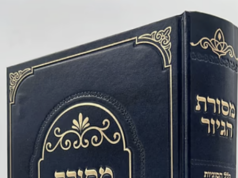
While his contribution to the study of the Tosefta is almost completely forgotten now, he is still recognized for his commentary on the Bavli. Originally published as Hagahot in seven volumes (1896-1929), it was later reprinted by Mossad ha-Rav Kook as Hiddushei ha-Ritzad in four volumes (1981-1999), and includes his commentary to Rambam’s Mishneh Torah.[7] The commentary covers nineteen masekhtot, tractates, although it is far from comprehensive. In some cases, masekhtot receive only a few comments and, in general, aggadic material receives much less attention than halakhic material. The commentary in many places is brief and, not infrequently, refers the reader to comments made elsewhere. This is especially pronounced in his notes on the Yerushalmi, Midrash Halakhah, and the Tosefta—placed at the back of each volume—which often refer the reader to his commentary on the Bavli.[8]
Despite its title, Hiddushei ha-Ritzad is not a traditional commentary, but a historical-critical analysis. Thus, for example, it is not uncommon for Dünner to write that the version of a tradition is incorrect in one rabbinic compilation, that an Amora was not familiar with a tanna’itic source, or that a tanna’itic or amora’ic comment was not said in the context in which it now appears. He also argues that certain sections of the Bavli post-date Ravina and Rav Ashi and, while he occasionally mentions the post-talmudic Savora’im, he is not always clear about when these traditions were created and added.[9]
While advanced for its time, the commentary falls short of modern standards of talmudic research. In general, Dünner does not have a systematic approach to the Bavli.[10] He also rarely makes use of Raphaelo Rabbinovicz’s Diqduqei Sofrim (1867-1897), which compares manuscripts of the Talmud.[11] Furthermore, some of Dünner’s interpretations are apologetic, as when he claims that unflattering stories about the Rabbis—such as when Rav and Rav Naḥman would go to a town looking for a temporary wife for a day (Yoma 18b) or when Rava states that he learned a halakhah from Rav Elazar be-Rabbi Shimon when the latter was on the toilet (Zevahim 102b)—were inserted by an errant student (looking to insult the Rabbis).[12] In contrast, modern scholars of these stories look to the Sasanian practice of “temporary marriage” or examine how Babylonian and Palestinian texts depict rabbis’ etiquette in bathrooms differently.[13]
Despite these caveats, Dünner’s commentary remains a valuable work from which much can be gained. As can be imagined, much of the commentary is complex and requires knowledge of the specific topic. However, I will summarize two brief, but representative, examples of both the value and limitations of Dünner’s commentary. For both of these examples, I have used the printed version of the Bavli, as that is what Dünner generally used.
The first example shows the benefits of Dünner’s commentary. Bava Metzi’a 33a records a baraita commenting on m. Bava Metzi’a. 2:11, which discusses the priority of returning lost objects when there are multiple objects to return at once. One of the conflicts that arises is between a person’s father and teacher, with the mishnah ruling that the teacher has priority because he taught the student wisdom. The baraita states:
Our Rabbis taught [in a baraita]: “‘His teacher’ that they mention is his teacher who taught him wisdom and not his teacher who taught him Scripture and Mishnah”— [these are] the words of R. Meir. R. Yehudah says: “[His teacher is] from whom [he learned] most of his wisdom.” R. Yose says: “Even if he only opened his eyes regarding a single mishnah, he is his teacher.”
By comparing this baraita to the version in the Yerushalmi [y. Bava Metzi’a 2:11, 8d; y. Mo’eid Katan 3:7, 83b; y. Horayot 3:4, 48b]—where R. Meir states: “Who is the rabbi that taught him wisdom? The one that first taught him ”—and t. Bava Metzi’a 2:30, which records variations on three named rabbis’ opinions, Dünner argues that R. Meir only stated: “His teacher that taught him wisdom,” and those that came after R. Meir interpreted his opinion in different ways. In our Babylonian baraita, they interpreted R. Meir as meaning “not his teacher who taught him Scripture and Mishnah,” while in the Yerushalmi they interpreted his statement as referring to the one that first taught him.[14] Here, then, Dünner looks at the problem of different versions of the same tanna’itic tradition—something also noted by modern scholars—and, seeing that they do not agree, suggests that there was a core tradition that was interpreted and added to in different ways in the Yerushalmi and Bavli.[15]
Another example shows the limitations of his commentary. Sukkah 31a reads:
It was taught [in a baraita]: A dry one is invalid; [but] R. Yehudah permits. Rava said: “The debate concerns lulav.” The rabbis believe we compare lulav to etrog: just as an etrog requires hadar, beauty, so does a lulav require hadar. Rebbe and R. Yehudah believe that we do not compare lulav to etrog, but everyone agrees that etrog requires hadar… Come and hear [from a baraita]: An old etrog is invalid; [but] R. Yehudah permits. A refutation of Rava—a refutation.
On this section, Dünner simply writes: “Rava still did not know of the baraita that teaches explicitly that an old etrog is invalid but R. Yehudah permits.”[16] This, indeed, is a straightforward read of the gemara; had Rava known that baraita, he would not have said that the debate was only about lulav.
By way of contrast, R. David Weiss Halivni—one of the foremost academic talmudists of the past generation—agrees with Dünner that Rava was unfamiliar with the second baraita, but goes into far more detail as to why Rava interpreted the first baraita as he did.[17] Weiss Halivni argues that because Rava only knew the small section of the baraita that stated in the singular, “a dry one is invalid,” he believed that this tradition only referred to one of the four species, the lulav. However, had Rava known of the collection of teachings in t. Sukkah 2:8-9—where the statement is in the plural, “R. Yehudah says: If they were dry they are valid”—he would have known that it also referred to the other species.[18] Further, Halivni also utilizes the extant manuscripts, and notes that there are versions of the second baraita that instead of reading “an old etrog is invalid” read “a dry etrog is invalid, which he believes is the better version.
I would also add that, while Dünner is sometimes sensitive to later interpolations, as shown in the first example, in this instance he does not comment on what appears to be later additions. Rava’s initial statement appears to have only been the short Hebrew sentence: “The debate concerns lulav.” However, the explanatory comment in the gemara text—the rabbis think we compare lulav to etrog, that just as an etrog requires hadar, so does a lulav require hadar; Rebbe and R. Yehudah think we do not compare lulav to etrog; [but] everyone agrees that an etrog requires hadar— is in Aramaic, and was likely added later to explain the reasoning behind Rava’s laconic comment.[19]
Dünner was a pioneering scholar whose contributions deserve more recognition. His theory concerning the post-Bavli redaction of the Tosefta continues to be debated among scholars today, even if he himself is not always cited. Additionally, Hiddushei ha-Ritzad still has much to offer the modern student of Talmud, with certain caveats. Dünner was very sensitive to many issues in the Bavli text, and his comparisons to other rabbinic compilations are particularly valuable. While modern scholars may offer alternative explanations, his proposed reconstructions of traditions merit serious consideration. While his work does not meet modern standards of talmudic criticism—lacking a systematic approach to the Bavli, largely ignoring manuscript evidence, and occasionally adopting an apologetic stance—these limitations should not overshadow the enduring significance of his contributions.
[1] Isaac Roszler is an adjunct assistant professor at the Jewish Theological Seminary of America. His current research focuses on the relationship between law and narrative in stories in the Babylonian Talmud. He received his P.h.D in Hebrew and Judaic Studies from New York University. Prior to beginning his doctoral studies, Isaac received a J.D. from the University of Pennsylvania Law School.
See, e.g., Elizabeth Shanks Alexander, Transmitting Mishnah: The Shaping Influence of Oral Tradition (Cambridge University Press, 2006), 180; Barry Scott Wimpfheimer, Narrating the Law: A Poetics of Talmudic Legal Stories (University of Pennsylvania Press, 2011), 116n.104.
[2] Stephen G. Wald, “Talmud, Babylonian,” in Encyclopaedia Judaica, 2nd ed., ed. Michael Berenbaum and Fred Skolnik (Detroit: Macmillan Reference USA, 2007), 19:481. There are a few other English articles and lectures about Dünner. See, e.g., Jacob S. Levinger, “Duenner, Joseph Ẓevi Hirsch,” in Encyclopaedia Judaica, 2nd ed., ed. Michael Berenbaum and Fred Skolnik (Detroit: Macmillan Reference USA, 2007), 16:41, and Isaac Hershkowitz, “The Works of Rabbi Joseph Tzvi Dünner and Their Reception in the Religious Circles in the Second Half of the Twentieth Century,” available at: https://www.academia.edu/1705493/The_Works_of_Rabbi_Joseph_Tzvi_D%C3%BCnner_and_Their_Reception_in_the_Religious_Circles_in_the_Second_Half_of_the_Twentieth_Century.
[3] Biographical information is taken from Benjamin de Vries, “Ha-Rav Dr. Joseph Tzvi Dünner z”l: Toledotav, Mif’alo, Mishnato,” in Ḥidushei Ha-Riṣad (Jerusalem; 1981-1990), 1:9-32. Note that de Vries and Jacob Nahum Epstein, mentioned below, married Dünner’s granddaughters.
[4] J. H. Dünner, Die Theorien über Wesen und Ursprung der Tosephtha, Kritisch Dargestellt (Seyffardt’sche Buchhandlung, 1874). See also his comments in Ḥidushei Ha-Riṣad, 2:181, s.v. ור״שׁ בן אלעזר הוא וכו׳.
[5] Yaakov Elman, Authority and Tradition: Toseftan Baraitot in Talmudic Babylonia (Ktav, 1994), 13, identifies the thirteenth century R. Samson of Chinon as the first to suggest this. Indeed, R. Samson of Chinon, Sefer Keritut (Divre Sofrim, 1965), 158, argues that what is referred to as “Tosefta” in the Talmud is not our Tosefta but rather explanatory comments on the Mishnah. R. Samson, however, does not explain what our Tosefta is, only that it postdates the Bavli.
[6] See Ḥanokh Albeck, Meḥqarim Bi-Veraita Ṿe-Tosefta Ṿe-Yaḥasan La-Talmud (Mosad Ha-Rav Kook, 1969), 86-138; Elman, Authority and Tradition. Dünner, however, is rarely directly cited in these works. On Dünner being a pioneer in the study of the Tosefta, see de Vries, “Ha-Rav Dr. Joseph Tzvi Dünner z”l,” 28; Hermann L. Strack and Günter Stemberger, Introduction to the Talmud and Midrash, 2nd ed. (Fortress Press, 1996), 153. Dünner and Albeck’s theories are usually contrasted with Jacob Naḥum Epstein’s, which posit that the editors of the Yerushalmi had knowledge of a version of the Tosefta we have now, but that the Bavli drew on a proto-Tosefta. See Jacob Naḥum Epstein, Mevo’ot Le-Sifrut Ha-Tannaim; Mishna, Tosephta Ve-Midreshei Halakhah (Magnes Press, 1957), 248, for a chart summarizing his position. For a survey of early research on the Tosefta, see Alberdina Houtman, Mishnah and Tosefta: A Synoptic Comparison of the Tractates Berakhot and Shebiit (Mohr Siebeck, 1996), 7-18.
[7] The original Hagahot can be found here: https://hebrewbooks.org/29057; https://hebrewbooks.org/29061; https://hebrewbooks.org/67622; https://hebrewbooks.org/67623; https://hebrewbooks.org/29060; https://hebrewbooks.org/29059; https://hebrewbooks.org/29058. The reprinted Hiddushei ha-Ritzad is available on the Otzar ha-Ḥachma website. When the Hagahot first came out, Saul Horovitz, “Die Dünner’schen Talmudglossen,” Monatsschrift für Geschichte und Wissenschaft des Judentums, no. 42 (1897), 385-394, gave it a very harsh review. While David Zvi Hoffmann, “Die Dünner’schen Talmud–Hagahot,” Israelitische Monatsschrift, no. 2 (1897): 14-15 was more complementary, he was also very critical of the commentary. In contrast, Dünner’s comments to Mishneh Torah were well received by Boaz Cohen, “Review: Duenner’s Annotations on the Mishneh Torah,” Jewish Quarterly Review 23 (1933): 394-97. For reception of Dünner’s work in general, see the lecture by Hershkowitz, “The Works of Rabbi Joseph Tzvi Dünner.”
[8] de Vries, “Ha-Rav Dr. Joseph Tzvi Dünner z”l,” 28n.16, notes that although Dünner compared the Bavli to the Yerushalmi, he did not believe that the former had knowledge of a redacted Yerushalmi. This is still an open question within the field today. For some studies that touch on this, see Martin S. Jaffee, “The Babylonian Appropriation of the Talmud Yerushalmi: Redactional Studies in the Horayot Tractates,” in New Perspectives on Ancient Judaism, ed. Alan J. Avery-Peck, vol. 4 (Lanham: University Press of America, 1989), 3-27; Alyssa M. Gray, A Talmud in Exile: The Influence of Yerushalmi Avodah Zarah on the Formation of Bavli Avodah Zarah (Providence, RI: Brown Judaic Studies, 2005); Marcus Mordecai Schwartz, Rewriting the Talmud: The Fourth Century Origins of Bavil Rosh Hashanah (Tübingen: Mohr Siebeck, 2019).
[9] For examples of post-Ravina and Rav Ashi material, see Joseph Hirsch Dünner, Ḥidushei Ha-Riṣad, 1:236, s.v.
;זר שסידר את המערכה חייב וכו’׳; 1.262, s.v. ‘היתה גבוהה מעשרים אמה וכו. Dünner will occasionally state that an addition is either from a late generation of Amoraim or the Saboraim. See, e.g., Ḥidushei Ha-Riṣad 1:229, s.v. ;רב אדא בר אהבה אמר הא מני; and 2:106, s.v. אמר להו הא טרחנא וכו׳. He, however, sometimes just states that the material post-dates the Amoraim without stating who was responsible for adding it. See, e.g., Ḥidushei Ha-Riṣad 1:296, s.v. ואי איתא לכסייה וכו׳.
[10] For a more programmatic approach to talmudic criticism, see the fourteen criteria of Shamma Yehuda Friedman, “Pereq ha’isha rabba babavli,” in Mehqarim umeqorot, ed. H. Dimitrovksi (New York: Jewish Theological Seminary, 1977), 301-308. See also the work of Friedman’s students at the Igud ha-Talmud project, available at https://www.talmudha-igud.org.il/nosafot.asp?lang=en. Admittedly, Halivni also was not as systematic as Friedman, but he did have a more developed approach to the Bavli than Dünner.
[11] de Vries, “Ha-Rav Dr. Joseph Tzvi Dünner z”l,” 30. A search on the Otzar ha-Ḥachma website shows that Dünner cited Diqduqei Sofrim approximately 29 times throughout his commentary. All of Diqduqei Sofrim is available on Hebrewbooks.com. Manuscripts of the Bavli are now available on the Hachi Garsinan portal of https://fjms.genizah.org/, which is in the process of being migrated to ktiv.nli.org.il.
[12] Joseph Hirsch Dünner, Ḥidushei Ha-Riṣad, 1:88, s.v. רב כי מקלע לדרשיש 4:88; and s.v. בבית הכסא: דנתה.
[13] Yaakov Elman, “The Torah of Temporary Marriage: A Study in Cultural History,” in A Thousand Judgements: Festschrift for Maria Macuch, ed. Maria Macuch et al. (Harrassowitz Verlag, 2019). While not discussing Zevahim 102b, Yael Wilfand, “Did the Rabbis Reject the Roman Public Latrine?,” BABESCH, no. 84 (2009): 183-96, does discuss the Rabbis’ relationship to public bathrooms. Dünner also makes many references to batei midrash in Palestine and Babylonia. While some of these appear to be references to post-talmudic institutions, he also seems to take at face value that they existed in the Amoraic period. Modern scholarship, however, has cast doubt on this assertion. See, for example, Jeffrey L. Rubenstein, “The Rise of the Babylonian Rabbinic Academy: A Reexamination of the Talmudic Evidence,” Jewish Studies: An Internet Journal 1 (2002): 55–68.
[14] Dünner, Ḥidushei Ha-Riṣad, 3:150, s.v. רבו שלמדו חכמה.
[15] While noting that the Yerushalmi’s language differs, R. David Halivni, Mekorot u-masorot: Masekhet Bava Meṣia (Magnes Press, 2003), 112, takes a different approach. Later in the sugya there is an Amoraic statement by Rav Yitzḥak bar Yosef in the name of R. Yoḥanan that the halakhah follows R. Yehudah. The Stam, however, notes that R. Yoḥanan elsewhere states that the halakhah follows an anonymous mishnah—which would agree with R. Meir’s opinion that it is the teacher that teaches him wisdom—and provides a weak answer. As a result, Halivni suggests that either the mishnah did not contain the phrase she-limdo hokhmah, or that R. Yoḥanan had a different version of the baraita, which may match the version in the Yerushalmi. Louis Ginzberg, A Commentary on the Palestinian Talmud: A Study of the Development of the Halakhah and Haggadah in Palestine and Babylonia: Volume IV, ed. David Halivni (Jewish Theological Seminary of America, 1961), 23 [Hebrew], also argues that the mishnah did not read she-limdo hokhmah. On this source, see Moulie Vidas, Tradition and the Formation of the Talmud (Princeton University Press, 2017), 118.
[16] Dünner, Ḥidushei Ha-Riṣad, 1:277, s.v. אבל באתרוג וכו׳.
[17] I have heard that Halivni read Dünner’s commentary, but I have not yet found a reference to it in the former’s commentary. There are, indeed, some instances where Halivni and Dünner reach the exact same conclusion. Compare, for example, Dünner, Ḥidushei Ha-Riṣad, 1:331, s.v. דאמר שמואל הלכה כדברי המיקל ולא סבירא לן כוותיה דתניא with David Halivni, Mekorot u-masorot: Masekhtot Eruvin u-Fesahim (Jewish Theological Seminary of America, 1981), 556-57.
[18] Tosefta, Sukkah, 2:8-9.
[19] Although these lines do appear in all manuscripts (except in MS Vat. 134, in which the second line was skipped as a result of a homeoteleuton). For an early discussion on how to separate the later comments from the Amoraic core, see Hyman Klein, “Gemara and Sebara,” The Jewish Quarterly Review 38 (1947): 67-91. In his commentary, Halivni does not discuss the stammaitic additions, but he does remove these lines when he copies the text before his commentary.





 Site Operations and Technology by The Berman Consulting Group.