

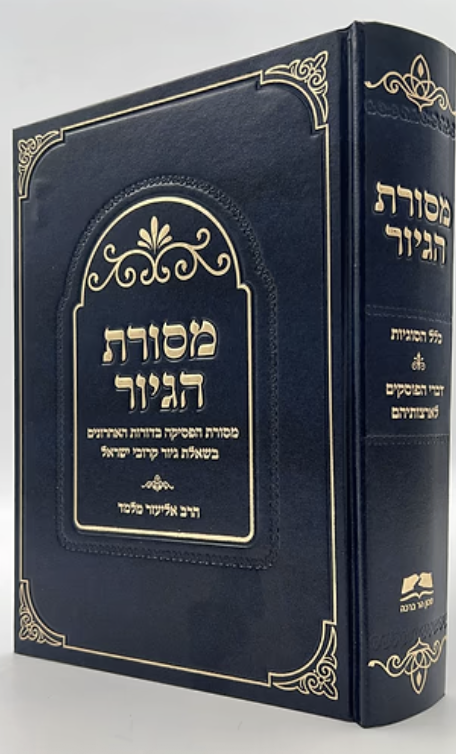
Review of R. Eliezer Melamed, Masoret Ha-Giyyur [Heb.] (Mekhon Har Bracha, 2023)
One of the great joys in my life—and also one of the great frustrations—has been guiding individuals on their journeys to become Jewish. Over the years, on three different continents, as a teacher, a dayyan on a beit din, and often simply as an advocate, I’ve helped facilitate the conversion of dozens of candidates, many of whom are now living in Israel. But it hasn’t been easy. The process is demanding and often lengthy: my students typically spend between a year and a half and three years in the program, largely because I insist that they reach real readiness—full observance and genuine knowledge across the breadth of halakhah.
I didn’t invent that standard. I was taught it in semikhah classes at Rabbi Isaac Elchanan Rabbinical Seminary over thirty years ago, and I assumed there was no other halakhic alternative. I viewed converts who did not yet know and observe all mitzvot as less than ideal—but still fully Jewish, unless they openly and defiantly flaunted aveirot immediately after conversion. Over the years, I have seen candidates live up to the lofty ideal of immediate full observance, and I have taken great pride in them. But I have also seen some fall short of full observance—some even rejecting a halakhic lifestyle entirely—and that has brought me consternation, along with the fear that perhaps I was doing a disservice to the Jewish people.
It isn’t only that conversion is a difficult process, or that many candidates struggle to live up to the very high standards set for them. I also genuinely sympathize with their plight. All they want is to join the Jewish people, yet they often find themselves in a frustrating and opaque process—jumping through hoops, waiting for responses from the beit din, preparing for tests, and never quite knowing whether they have enough of what it takes to become a Jew.
Each case is different, of course, yet many follow a similar route as they enter into a new web of Jewish communal life, compounded by adherence to law, understanding of the social pressures, and existential loneliness. Almost all the candidates I have encountered ask the same question with a mix of hope and apprehension: “But will I be accepted as Jewish in the State of Israel?” And because, in their eyes, acceptance by Israel is the gold standard, I’ve noticed that some candidates present themselves as Jews according to what they think is expected, i.e., more than according to what they genuinely believe it means to be a Jew. I’ve even caught myself telling my own students, “I think you can be lenient in this halakhah—but don’t say that on the test in front of the beit din.”
I have overseen conversions both in Israel and in the Diaspora. Each setting has its own flavor, but the core challenges are often the same. I don’t know whether anyone has a reliable global count of Orthodox conversions each year, but I did look into the data for Israel. In May 2025, the Times of Israel published an article lamenting the “thousands of converts unrecognized by the state, stuck in limbo.”[1]
The article notes a striking gap between those who begin the process and those who complete it:
According to data from the Conversion Authority at the Prime Minister’s Office (the body in charge of facilitating and ratifying all conversions performed in Israel outside the army), only about half of those who start the process to convert actually manage to complete the journey. Between 2022 and 2024, some 13,600 opened a file to convert, but only 6,400 succeeded.
One student of mine, whose father was Jewish, studied seriously for a year and converted through a private beit din, only to discover that the Israeli Rabbinate did not recognize it, so once in Israel she underwent a second conversion and, knowing what the system required, dressed up and played the part of a fully observant Jew (to that system’s standards) in order to be approved. She now lives in Israel, unobservant, married to an Israeli who serves in the IDF, with two children. Have I wronged her? Has she ‘fixed the system’?
Even the testing can become its own barrier, with exams so demanding that some rabbis accompanying the candidates would struggle to pass them, leading some converts to fail multiple times for not having advanced knowledge of intricate Jewish law, before finally succeeding. I recall hearing one rabbi ask a candidate a particularly detailed question in the laws of kashrut, which led to a debate amongst the beit din members themselves in order to arrive at an agreed-upon answer.
And then there are those who keep “upgrading” conversions—Reform to Conservative to Orthodox—only to find that suspicion follows them even once they seemed to have ‘graduated’ into an Orthodox framework, navigating the different batei din to find which one ‘is accepted by all’ – a utopian vision since batei din in certain countries consider their level of standards above Israel’s! There is an eerie feeling some converts carry with them, like an illness in remission, never entirely free of the worry that the doubt will return.
Taken together, these cases help explain the quiet, invisible majority as well, namely, those who choose not to convert at all, not because Judaism is not important to them and not because the Jewish people do not matter to them, but because the process seems unclear, humiliating, or simply impossible to navigate. The bottom line is simple: for too many candidates, conversion has become a mess.
The picture grows even more complex when we distinguish between conversion outside of Israel, where Orthodox batei din and programs operate in many countries, and conversion within Israel, where an estimated 400,000–500,000 Israeli citizens from the Former Soviet Union identify fully as Israeli yet are not halakhically Jewish. In Israel, the question is shaped not only by halakhic debate but also by institutional and political realities, including the outsized influence of the Haredi establishment over official conversion policy.
The practical demands of the process raise basic questions. How much knowledge and fluency in halakhic practice is expected of a candidate? What does genuine kabbalat ha-mitzvot (acceptance of the mitzvot) require at the moment of conversion? How should batei din evaluate someone who embraces Jewish identity and destiny while not fully committing to observance? Beneath all of this lies the central issue that R. Eliezer Melamed places at the heart of his Hebrew book, Masoret Ha-Giyyur (the Tradition of Conversion): does halakhah mandate a single, uniform model of conversion based on only one definition of kabbalat ha-mitzvot, or has the mesorah (tradition) historically made room for more than one legitimate approach?
R. Melamed, the rosh yeshivah of Yeshivat Har Bracha, where he also serves as the town rabbi, is the author of the Peninei Halakha series and many other works. After writing on most of normative halakhah, he turned his focus to the thorny topic of conversion. Ever the iconoclast, he breaks the barriers here and makes a bold claim to change the paradigm of what conversion in cases of emergency should be about! Of course, R. Melamed would love every convert to “observe all mitzvot in earnest” (104),[2] but the reality of the world is more complex. And what should the Jewish world do with the tens and hundreds of thousands who will be lost to us without a new approach?
He outlines his standards for these cases in Chapter 10. There, he divides prospective converts into four categories (155), of which he is ready to disqualify only one of them: Category 1 is the kofer, a person who rejects God and rejects Jewish identity, indifferent to the sacred tradition of our forefathers. Category 2 is zehut yehudit (Jewish identity), a person who will live a hiloni (secular) lifestyle but is deeply connected to Jewish culture and tradition. As such, they will certainly observe and even cherish many mitzvot and practices which reflect the special Jewish identity, such as brit milah, bar mitzvah, weddings, funerals, building up the land of Israel, supporting Jews returning to the homeland, supporting the army, identification with Jews all over the world and willingness to fight for them, respect for the Jewish Bible and the words of the Sages, and placement of a premium on the mitzvot bein adam la-havero—interpersonal laws such as kindness and tzedakah. They will often have a Friday night Shabbat dinner and prefer not to work on Shabbat, will hold a Seder for Pesach, light Hanukkah candles, and sometimes fast on Yom Kippur.
Beyond them is Category 3, the masorati (literally, “traditional”). This individual not only respects tradition but is more connected to mitzvot and open to observance. Their connection to Jewish tradition comes out of a sacral sense, commitment to religion and not just respect for the culture. Finally, Category 4 is the dati—the religious individual who lives a life committed to Torah values and fearing heaven, and observes mitzvot with diligence and deliberateness.
R. Melamed, without saying this outright in this book, has said in other forums that Category 2—zehut yehudit—is sufficient to justify conversion today, in light of our fear of losing so many Jews to intermarriage and assimilation.[3]
R. Melamed proves that there always existed a different standard of conversion based on a different definition of kabbalat ha-mitzvot (103). He is willing to challenge a Rabbinate which for the last fifty years has made a concerted effort to deny any legitimacy to leniency, to choose only one definition of kabbalat ha-mitzvot, and to cut out large swaths of the Jewish population who are enmeshed in mixed relationships.
In recent decades, the debate on conversion has increasingly focused on standardization, as many settings operate with a single Orthodox benchmark, and local batei din are judged not only by their halakhic reasoning but by whether other authorities will recognize their decisions. That focus can push the process beyond what appears in the classical sources, especially in Israel, where recognition affects citizenship, marriage, personal status, and one’s overall standing and status in the nation. That some conversion candidates also take up arms, placing themselves in danger to life and limb in the defense of that nation and its citizens, only further raises the stakes.
This dynamic became more visible about a decade ago, when the press reported on an internal list of diaspora Orthodox rabbis whose conversions were not accepted by the Israeli Chief Rabbinate, including some rabbis who are prominent communal leaders.[4] The episode highlighted how recognition can hinge on centralized criteria developed far from the communities in question.
Around the same period, the Rabbinical Council of America described its interest in standardizing conversion procedures in line with the Chief Rabbinate’s requirements, a move that illustrates how even major Diaspora institutions have felt pressure to align with the Israeli system in order to secure recognition. No doubt, the RCA leaders were looking out for their constituents’ best interest by ensuring they receive the ‘golden ticket’ of Rabbanut gushpanka (seal of approval), yet what they might have been willing to lose in that gambit is marginal positions, nuanced cases, rabbis with broader vision, and communities with special needs.
And so, the RCA and the flagship Modern Orthodox institution, Yeshiva University, have in the past decades adopted the (there is only one real) position of how to convert, of what kabbalat ha-mitzvot means, that has been taught to hundreds of semikhah students including this author. R. Melamed shows in his book that, historically, there was never just one way. He brings proof after proof that, over the course of 150 years, different communities had different needs and rabbis paskened in strict fashion or lenient, all within the framework of Orthodox Judaism.
We might argue that, even if we accept the historical position that there was never a true standard, the reality today has changed. Today we are living in a global village and a world of kibbutz galuyot (ingathering of exiles). In the nineteenth century, batei din in Minsk may have had little interest in the standards in Prague (and certainly as between Fez and Odessa!). The geirim from one would rarely seek to marry members of another, so a universal standard was not necessary. Times have changed and so have needs.
R. Melamed might answer very clearly (and boldly) that, first, there has never been one standard of psak in this matter and, the modern era notwithstanding, we should still respect the authority and wisdom of each beit din in each country given that they are most expert in the needs of conversion there. Additionally, he would say that as long as the Jewish world is losing Jews to intermarriage and assimilation, we are still in she’at ha-dehak (extenuating circumstances). As such, let the standard be zehut yehudit, and let the hundreds of thousands of prospective converts join the Jewish people lest they disappear off the face of the earth.
Some might argue that the majority view should still be maintained and assert that ‘everyone has always accepted that a convert must accept all mitzvot under all conditions’. R. Melamed’s book is a response to that widespread error, proving that to never have been the case in Jewish history and psak. R. Melamed devoted two years of his life and gathered a team of rabbis and historians to answer this question. Although he does not say so, his is a voice that the Hardal (Haredi dati le’umi, associated with a stringent Haredi lifestyle while still maintaining Zionist ideology) and the Haredi worlds cannot ignore. Having sold over one million copies of Peninei Halakha (his compendium of Jewish law), his is a voice which resonates, and he is not shy in sharing his positions.
In Chapter 1, which he calls “The Question,” R. Melamed claims that most conversion candidates who declare at the time of conversion that they will live a religious lifestyle do not end up living out that commitment. Dedicating his attention to the conversion crisis in Israel, he argues that the majority of these cases concern people who want to be Jewish but not completely religiously observant. What of them?
As for the Diaspora, he notes that intermarriage continues to grow and stands today at 50%, and he warns of the danger of losing Jews and Jewish families. His question is simple: can one convert prospective Jews who do not plan on observing all the commandments? His answer at the outset is a typically halakhic one: throughout history in the world of rabbinic psak there have been strict positions and lenient positions. The book is presented as an attempt to explore that debate, to show that it has always existed, and to demonstrate that a significant body of rabbinic authorities adopted more lenient approaches in this area.To evaluate that claim, R. Melamed argues, we have to return to the classical foundations of giyyur, to arrive at a precise definition of kabbalat ha-mitzvot (Chapter 7) and then trace the actual record of modern psak (Chapter 10).
R. Melamed’s claim will likely surprise some readers and perhaps irritate others. He posits that the classic rabbinic sources are less stringent than the standards of many contemporary rabbis. The Talmud’s basic conversion model is sound, the Rishonim largely operate within that model, and many Aharonim do as well. What has changed is less the halakhah itself than the lens through which it is read, in a way that increasingly assumes there is only one path, one standard, and one uniform set of expectations that must be demanded in every place and time. R. Melamed claims that this change took place quite recently and that it opposes hundreds of years of healthy rabbinic diversity.
To see why he thinks this, it helps to go all the way back to Tanakh. The Torah speaks repeatedly about the ger (e.g., Exodus 22:20; Leviticus 19:33-34; Numbers 15:15-16; Deuteronomy 10:19), yet it does not provide a technical procedure for becoming one, and while that absence is often treated as a problem, it can also be read as a clue: the Torah is far more concerned with how the ger is treated—ethically, legally, and socially—than with the administrative mechanics of their entry. Even Ruth, the emblematic narrative most associated with conversion, does not function as a halakhic manual in any sense, since Ruth is a paradigm of loyalty and covenantal attachment, while the category of formal “halakhic conversion,” with its later procedural vocabulary, is in important ways anachronistic when being read back into the biblical story.
Rather, Hazal provide the skeleton of conversion law, and strikingly, the spine is not long. The central Talmudic passage appears in Yevamot 47a: when a person comes to convert, the beit din says, “Don’t you know that the Jewish people at the present time are anguished, suppressed, despised, and harassed, and hardships are frequently visited upon them,” and if the candidate responds, “I know, and I am unworthy,” the candidate is received immediately. The beit din then teaches “some easy laws and some hard laws,” along with the principles of reward and punishment, and the process proceeds to brit milah (for males) and immersion in a mikveh, while maintaining an approach that is serious but not endless and, importantly, includes an explicit instruction not to overwhelm the candidate.[5]
R. Melamed treats that last point as more than a technicality; for him it reflects a philosophy of conversion. It assumes sincerity can exist even amid imperfect knowledge, and it insists that while Judaism is demanding, a beit din should not crush the human being that approaches it. If this is the core model, then much of what we see today can feel less like simple continuity and more like escalation, since prolonged surveillance, extreme social demands, and repeated high-stakes examinations are not self-evidently demanded by the Talmudic framework itself, even if such measures are sometimes defended as policy or community protection.
There have been periods throughout Jewish history in which conversion was held back or even ceased entirely (see Chapter 6), and certain communities even accepted upon themselves to not engage in this endeavor, perhaps relying on an inflammatory statement of R. Helbo on Yevamot 47b that “converts are difficult for Israel like a scab.”[6]
R. Melamed is controversial, not because he is in any way lax about halakhah, but because he does not equate halakhic integrity with the automatic adoption of the strictest available position, and because he writes with unusual openness toward the larger Jewish world, including Jews who are not fully observant. He has also shown a willingness to stand firm when challenged by religious establishments that prefer uniformity to complexity. Perhaps for that reason, it is striking that he waited until this, his twentieth book, to address the third-rail of conversion, and when he finally did, he chose a title that reads like a declaration of intent.
He calls the work Masoret Ha-Giyyur—“The Tradition of Conversion”—and frames it explicitly as an exploration of the tradition of halakhic decision-making in recent generations regarding converts who, as the subtitle continues, are “connected by family to Israel (‘kerovei Yisrael’), even when it is likely that they will not live an observant lifestyle.” In the current climate, saying that out loud is a provocation, since it runs against the prevailing rhetoric that equates conversion with guaranteed future observance at maximal levels, and it forces a question many would rather keep hidden: what do we do with the tens or hundreds of thousands who are already enmeshed in a Jewish family but are unable or unwilling to commit entirely to full observance?
Should they and their partner be forever excluded from the Jewish nation as a result? Should we continue to lose Jewish men (mostly) due to their falling in love with a partner who will identify as Jewish but not follow every law? Should the Israeli population look askance at hundreds of thousands of Jews from the former Soviet Union who want to be recognized by Israel but don’t necessarily have the halakhic bona fides?
That, at least, is the mission of the book, and it helps explain why it has generated such intense reaction, since it challenges not only particular policies but the assumption that there has always been only one acceptable way.
Reactions were swift from the Hardal movement, such as one from R. Uri Betzalel Fisher who said there is no such thing as conversion without acceptance of mitzvot, period.[7] Or a public letter with fifty rabbi signatories stating unequivocally that there is no place for R. Melamed’s psak. The signatories read like a who’s who in the Hardal rabbinic world, including Rabbis Lior, Neventzal, Tau, Hakohen, Aviner, Eliyahu and others.[8] Others rejected his readings of the responsa of previous generations, claiming R. Melamed misquoted them or made suppositions which weren’t written clearly.[9]
Anticipating this attack, R. Melamed’s Masoret Ha-Giyyur is a hefty and demanding work, thorough in both scope and documentation, and clearly written for a reader who is fluent, well-read, and patient enough to work through its 895 pages. The purpose is to prove beyond a shadow of a doubt that there has always been a lenient position counterbalancing the strict one, and that the lenient position, in the eyes of R. Melamed, far outweighs the strict. Although it appears under R. Melamed’s name, it reflects a major team effort including R. Maor Cayam as well as eight rabbis of the Machon, with substantial historical research contributed by R. Dr. Boaz Huttrer and R. Zuriel Halamish.
The project has also expanded beyond the book itself, including a podcast and a Facebook group called “Koh Giyyeru Rabboteinu” (So Did Our Rabbis Convert), which together form a kind of public platform for the sources, the history, and the arguments that the volume advances. Their main purpose is to expose to the beit midrash of the world the multiplicity of rabbinic decisions throughout the span of 150 years and to engage the Jewish intellectual world in a serious discussion about psak.
In structure, the volume is essentially several books in one. First, it addresses the foundational halakhic question at the heart of contemporary debate: confronting the Talmudic concern of giyyur le-shem nisu’in (converting for reasons of marriage), which encompasses Chapter 2. Whether one may (or actually should) be lenient in cases of emergency such as preventing assimilation is addressed in Chapter 4, and whether a conversion can be valid in cases where full kabbalat ha-mitzvot—as that term is commonly understood today—is absent is addressed in Chapter 7. The volume also follows the Talmudic and post-Talmudic discussions that shape the contours of that question in Chapter 5.
Second, in its longest section, it devotes more than 500 pages to a detailed mapping of roughly 120 years of rabbinic psak on conversion, moving across countries and communities wherever Jewish life produced responsa and rulings, and in the process documenting an array of approaches rather than a single uniform model.
As an aside, it explores the historical profiles of the rabbis and the communities in which they served, tracing patterns of modernization, enlightenment, secularization, and assimilation, and suggesting that conversion became an especially pressing halakhic issue in the later nineteenth century, when conversion to Judaism became legally possible in various states and therefore arose more frequently as a practical communal question.
Having assembled both the halakhic framework and the historical record, the book presents its larger claim about the tradition of conversion in modern times—namely, that divergent halakhic positions reflect variously legitimate approaches, and that the expectation of a single standardized model is itself a relatively recent development.[10] Although even the Talmud expects the candidate to ‘accept’ some strict laws and some lenient laws, such that one does not expect there to be no standard for joining the Jewish people, a basic, general status of zehut yehudit should be adopted, as mentioned above.
Early on, R. Melamed frames the discussion not only as a technical halakhic inquiry but as a response to a real communal dilemma, and in Chapter 4 he presents the position that one may be lenient in order to save a Jewish partner from assimilation, offering eight distinct arguments in support of such a stance (31).
Among them are the concern for saving the Jewish partner from possible apostasy, preventing the Jewish partner’s future children from being raised as non-Jews, protecting the born-Jewish children of a Jewish woman whose non-Jewish partner may otherwise draw the household away from Judaism, and rescuing the Jewish partner from the ongoing prohibition of living with a non-Jewish woman. On this last point, he cites a responsum of Rambam (ibid). Chapter 5 expands this theme further, attempting to establish—through halakhic and communal reasoning—the value of leniency in cases where refusing conversion may result in the loss of Jews and Jewish families.
A major turning point comes in Chapter 7, where he addresses the various definitions of kabbalat ha-mitzvot. As expected, the term becomes a central fault line, since the debate turns not only on whether kabbalat ha-mitzvot is required, and to what degree, but on what “acceptance” means, which commandments are included, and what threshold of practice is assumed at the moment one becomes Jewish. In his characteristic method, R. Melamed surveys a range of approaches—more stringent and more lenient—and anchors the discussion in the relevant Talmudic sources, while also noting how later posekim applied those sources in practice. The chapter concludes by suggesting that, while there is broad agreement that kabbalat ha-mitzvot is a required concept, a more lenient interpretation of the term (by, e.g., R. Yisrael Be’eri ( 128) and R. David Tzvi Hoffman (129)) understands “kabbalah” primarily as accepting entry into the Jewish people and its covenantal framework, whereas the more stringent reading treats it as a formal commitment to accept every commandment and obligation from the outset.
Chapter 10 functions as something like a “bottom line” map of the opinions, outlining four different positions that the authorities take on the matter ranging from strictness to the point of annulling the conversion all the way to leniency and imperative to help such a convert. He identifies eighteen rabbinic authorities who reject conversion without full acceptance of all mitzvot, including R. Moshe Feinstein, (160 and 761-769) R. Yitzhak Shmelkes (158), R. Tzvi Hersh Meisels (158), R. Meir Arik (159), and R. Yosef Shalom Elyashiv (161).
A second position holds that one should not convert someone who does not accept mitzvot, yet once the conversion was performed it is accepted, and he associates this view with twenty-two authorities. The major proponents in this camp are R. Yitzhak Bamburger (163), R. Yehezkel Bennet (163), R. Kook (166), R. Avraham Shapira (167), and R. Gedaliah Felder (171).
A third, intermediate position argues that a conversion is valid so long as the candidate accepts a “traditional Jewish lifestyle,” and he lists fourteen authorities in this category. Proponents are R. Azriel Hildesheimer (172), R. David Tzvi Hoffman (355-358), R. Yaakov Shor (732-735), R. Tzvi Pesach Frank (174), R. Isser Yehuda Unterman (175), R. Eliezer Yehuda Waldenberg (176), and R. Hayyim Ozer Grodzinski (177).
Finally, he presents the most lenient position that permits converting those who accept Jewish identity, particularly in order to save Jews from living a life married to a non-Jew and in many cases bringing non-Jewish children into the world, and he lists a very large number of authorities in this camp. The most important view is that of former Sephardic chief rabbi, R. Ben Tzion Meir Hai Uziel, who wrote many responsa about this topic ( 178-9, 803-811). Other lenient authorities include R. Yitzchok Weiss (181), R. Yaakov Avigdor (182), R. Avraham Preis (769-772), R. Levi Rabinowitz (184) and R. Chaim Hirschenson (184). Another thirty rabbis are identified in a separate category of those whose views “appear from their words” (185), though not explicitly. In a footnote he attempts to total the positions and arrives at an approximate two-to-one ratio of lenient to strict opinions. This is part of the problem in the eyes of R. Melamed’s detractors, because the ‘two-to-one’ argument doesn’t hold water when the minority consists of “heavy hitters” and the majority are less well-known rabbis.
This chapter is, in many ways, the heart of his argument, not only because it asserts that there has always been a live debate with multiple legitimate approaches, varying by community and circumstance, but also because it claims that the lenient positions are not marginal in the historical record, as R. Hayyim Ozer was the leader of Lithuanian rabbis, R. Waldenberg was a member of the Beit Din Ha-Gadol and a respected posek, R. Tzvi Pesach Frank was the rabbi of Jerusalem, and R. Uziel was the Rishon Le-Tzion. For R. Melamed, that finding strengthens the broader purpose of the book: to show that contemporary insistence on a single conversion standard in the case of a she’at ha-dehak is not the only faithful reading of halakhic tradition, and that the mesorah of psak contains significant room for responsible leniency in the cases that now dominate communal reality.
The second section of the book—“History, Sociology, and the Modern Conversion Story”—is a remarkable journey through the sociology of religion and the modern history of conversion, tracing developments from the nineteenth century onward, as governments began granting civil rights that made conversion to Judaism legally possible and socially consequential, and continuing through the twentieth century and into the present.
R. Melamed and his team present a sweeping survey of Jewish life in numerous countries, describing communities as they confront enlightenment, secularization, assimilation, and rising intermarriage, and showing how conversion emerges as a practical halakhic problem precisely in the places and moments when Jews and non-Jews begin to live with fewer barriers separating them.
Some critics argue that R. Melamed goes too far. Even within the more liberal Religious Zionist world, many of those most involved in conversion policy are not advocating for a “responsibility-free” conversion. In practice, conversion frameworks—whether run privately or under official auspices—generally assume that candidates are moving toward some meaningful level of shemirat ha-mitzvot, even if expectations and timelines vary. From that perspective, R. Melamed’s repeated emphasis on conversions where full observance is not expected can sound, to some readers, like a step beyond what serious halakhic practitioners are actually proposing, and it may leave his argument exposed to critique from multiple sides.
R. Melamed, however, might respond that this reading misses the book’s larger aim. His goal is not to promote a maximalist leniency, but to present an unusually broad, carefully documented survey of the range of positions that appear in the halakhic record, and then to reopen the conversation about how communities should navigate reality responsibly. In that framework, mapping the full spectrum—including its more permissive poles—is a way of clarifying what has existed within halakhic discourse, and of making room for a more workable middle ground that takes both the strict concerns and the human stakes seriously.
Whatever one concludes about the book’s halakhic recommendations, this section alone has the potential to educate readers deeply, both about Jewish communal history and about the conditions that generated the modern conversion debate.
I was edified by the sheer historical and informational nature of this book, which truly fulfills its title’s focus on the “tradition” of how rabbis over the centuries have approached the complex story of conversion, especially when the candidates will not fulfill all the mitzvot. This book is a wonderful addition to the Jewish bookshelf.
But will it change policy? Will the Rabbinate heed its call to “return the crown to the olden days” (based on Yoma 69b) and, recognizing that we are in a state of emergency, open the floodgates of conversion by changing the definition of kabbalat ha-mitzvot? I doubt it. The Haredi position is entrenched, and signs of slowing down and adopting a more lenient view do not appear on the horizon. If anything, the opposite seems to be the case.
R. Melamed, the consummate Talmudist, might be undeterred and quote the famous passage in Ta’anit 23a: “just as my father planted seeds for me, I plant for my sons.” R. Melamed will continue to educate, espouse, and fight for truth in this and all areas of halakhah in the hope of changing the minds of rabbis throughout the world.
At least this rabbi’s mind was changed.
[1] Rossella Tercatin, “Ahead of Shavuot, thousands of converts remain unrecognized by state, stuck in limbo,” Times of Israel (May 28, 2025).
[2] Parenthetical number citations are to R. Melamed’s book.
[3] See, e.g., “Questions That Arose Regarding Conversion” [Heb.]. This compilation of rabbinic decisions by R. Melamed clearly states that, though he believes in acceptance of mitzvot, his version of such acceptance is based on the notion of zehut yehudit.
[4] See Ben Sales, “160 rabbis, including top US Orthodox leaders, on Israeli Rabbinate ‘blacklist’,” The Times of Israel (July 9, 2017).
[5] Translations of Talmudic texts are from Sefaria, with modifications by the author.
[6] There is, however, a rich debate about the meaning of this statement, as recorded in Tosafot to Kiddushin 70b, s.v. kashin, and especially the opinion of one of the ba’alei Tosafot quoted there, named R. Avraham Ger! See also Chapter 5 of Masoret Ha-Giyyur for an in-depth analysis.
[7] R. Uri Betzalel Fisher, “Criticisms of the Approach of R. Eliezer Melamed to Conversion” [Heb.], Emunat Itekha 137 (5783), 87-95.
[8] Yishai Elmakies, “A New Rabbinic Front Against R. Eliezer Melamed: His Views Have No Place in Halakhah” [Heb.], Kippah (May 17, 2022).
[9] See for instance R. Binyamin Tevdi, “R. Melamed Quotes Sources in a Tendentious Manner” [Heb.], Srugim (Oct. 3, 2022).
[10] R. Melamed does not discuss the impetus for the sanitizing of rabbinic diversity in the last half -century in this book, but has definite views of it. In talks which this author attended and through a new book which discusses this in depth (Huttrer and Halamish, The Story of the Vienna Conversions: The Making of a Mahloket, Mekhon Har Bracha, 2025), R. Melamed explains that a shift has taken place in Israel and the Diaspora which attempts to shut down diverse opinions and maintain the hegemony of the Chief Rabbinate. To explain why that happened when it did requires fuller attention in another article.





 Site Operations and Technology by The Berman Consulting Group.