

Noah Gradofsky
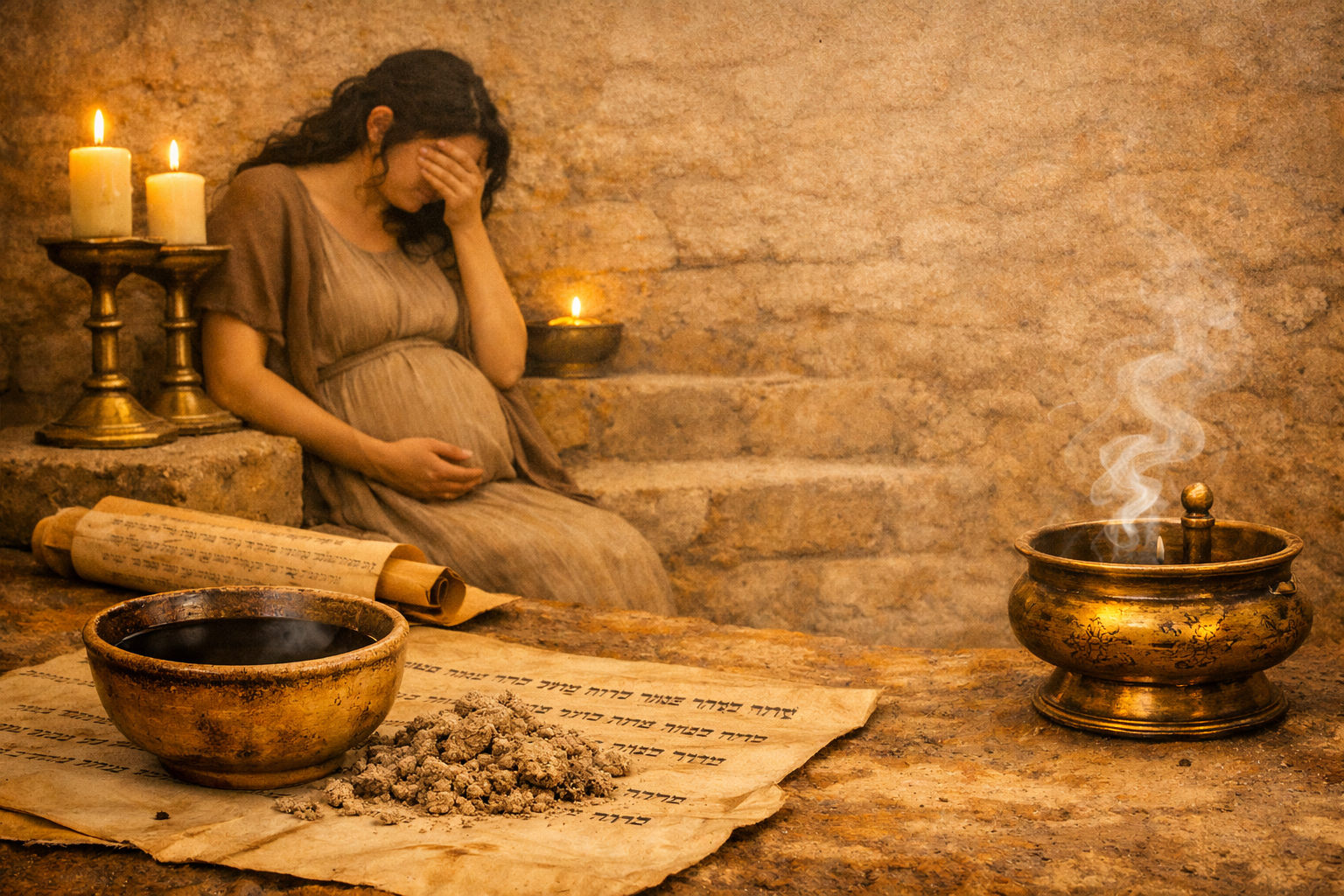
Numbers 5:11-31 presents the law of the sotah, a woman whose husband suspects her of infidelity.[1] The exact circumstances of this episode are unclear in the text. For instance, does the text contemplate specifically a woman who is pregnant, specifically a woman who is not pregnant, or could a woman be brought into the sotah ritual regardless of pregnancy status? Is the result for a woman who is guilty of adultery death, fetal loss, infertility, or something else?
The possibility that the sotah is pregnant during this ordeal, which I will explore further below, raises the possibility that, where the woman is guilty of adultery, the sotah ritual results in the death of the fetus. Generally, the classical rabbinic understanding of the sotah ritual is that if the accused woman is guilty, she will die.[2] To the extent that the accused woman is pregnant, this would mean the fetus also dies, unless we imagine that the woman’s death is delayed until the fetus is born, a possibility that is not at all addressed in the biblical text.[3] If the sotah ritual caused the death of a guilty pregnant woman, it would imply that the death of the fetus is an acceptable cost of the sotah ritual’s investigation of the woman’s guilt. There is also the possibility, as some modern scholarship suggests, that the death of the fetus is precisely the barometer by which the woman’s guilt is evaluated. A review of this scholarship is warranted, as much of it tends to show that the biblical sotah is pregnant, which would make the sotah text relevant regarding the Torah’s attitude toward fetal death regardless of whether the mother dies along with the fetus.
In An Adventure in Torah: A Fresh Look Through a Traditional Lens, Hakham Isaac Sassoon,[4] referencing some supportive texts in rabbinic literature, argues in favor of the understanding that the sotah is pregnant,[5] a pregnancy which has aroused suspicion such that “Husband and society, and perhaps the woman herself, all needed their qualms to be allayed.”
Perhaps the strongest evidence Sassoon offers for this reading is that the result of the ordeal for the woman who is guilty of infidelity is “venaflah yereikhah” (Numbers 5:27, c.f. 5:21 and 5:22), literally “her thigh (yerekh) will fall,” which Sassoon notes is identified by scholars as a euphemism for miscarriage (although other scholars suggest that it refers to other fertility issues). Sassoon notes that the rabbinic adage describing a fetus as a limb/part of its mother is formulated “ubar yerekh imo – a fetus is a thigh of its mother,”[6] which (if the idiom reflects a longstanding convention) supports the possibility that venaflah yereikhah means that the fetus will be lost.
In their article “The Kenite Origin of the Sotah Prescription (Numbers 5.11-31),”[7] Nissim Amzallag and Shamir Yona offer a number of other compelling pieces of evidence in favor of the negative outcome for the sotah being loss of a fetus, although they conclude that, at least in its Kenite origins, the sotah water is a pregnancy test rather than a test for marital infidelity (398-400).[8] Among the evidence they provide for fetal loss being the negative outcome of the sotah ritual is the likely use of copper[9] dust, an abortifacient, in the Kenite precursor to the biblical practice. They also understand yerekh as related to genitalia, citing Gen 46:26, Judges 8:30 and Song of Songs 7:2, which suggests “that the ‘cursing’ effect of the potion addresses sexuality and/or reproduction,” potentially pointing toward either sterility or miscarriage (393). I would particularly note the phrase yotz’ei yerekh (“those who came out of the yerekh”) as a reference to progeny, as found in the first two of those verses. Amzallag and Yona also note that the term nefel, which derives from the same root as venaflah, refers to a stillborn (they use the term “aborted”) fetus (394).
Sassoon also argues that the result of the ordeal for the innocent woman, “venizre’ah zara” (Numbers 5:28), is best understood as suggesting successful delivery of an already gestating fetus rather than conception and subsequent birth. I would add that the notably graphic phrase in Numbers 5:20, “vayitein ish bakh et shikhvato mi-baladei isheikh,” perhaps literally “[if] a man other than your husband placed his copulation in you,” may also suggest that the question is whether or not another man might have impregnated the sotah.[10]
In sum, according to Sassoon’s reading of the text, the sotah has become pregnant. If she has been faithful, she will deliver the fetus successfully, while otherwise the sotah ritual will cause her to miscarry, meaning, essentially, that it would cause an abortion.
If, indeed, the woman accused in the sotah ritual is pregnant, the text would be saying that causing the loss of a fetus, whether on its own or with the death of the mother, is an acceptable way of identifying the woman’s infidelity. It is also noteworthy that the fetus in question would be sufficiently gestated so that the pregnancy could be recognized and arouse suspicion in the husband. The text does not suggest any upper limitation as to when, within pregnancy, the trial by ordeal may occur. Note, however, that Amzallag and Yona suggest that the copper ore they argue was used in the Kenite precursor to the biblical sotah ritual would have been most effective early in pregnancy, which is part of why they see the ritual as a pregnancy test (396). In any event, the result of the pregnancy test is the loss of the fetus, which would still indicate abortion being an acceptable result under the relevant circumstances.
It is not particularly surprising that the Torah might find fetal death to be acceptable in these circumstances. The traditional Jewish read of Exodus 21:22-25 is that the loss of a fetus is not a capital offense (see e.g. Mishna Bava Kamah 5:4, found at Babylonian Talmud 48b, Mehilta Nezikin 8, s.v. “ve-lo yihyeh ason“, Rashi on Exodus. 21:22 and my discussion here). Similarly, Mishnah Arakhin 1:4, found in the Babylonian Talmud at Arakhin 7a, teaches that a pregnant woman liable for execution is not allowed to carry the fetus to term but rather is executed immediately, with Samuel explaining in the Talmud that the court causes the fetus to die first. Also of note, Mishnah Niddah 5:3 (BT 43b-44a), states that killing a one-day-old child is a capital offense, strongly suggesting that killing a fetus is not a capital offense. [11] Even given this backdrop, it is notable that Numbers 5:11-31 might be the only biblical text that in any way directly addresses abortion or otherwise intentionally causing fetal death, indicating that identifying infidelity is an acceptable justification for causing an abortion. Importantly, unless we allow for the possibility that the Torah would sanction executing a child who was the result of marital infidelity, this text would clearly indicate that the death of a fetus is substantially different from the death of a human being already delivered.
In his Lehrhaus article “The Pregnant Sotah: A Case Study in the Ethics of Abortion,” Dr. Yisroel Benporat engages in a similar analysis of commentaries on the baraita in Sotah 26a, which states that certain pregnant women may drink the sotah waters. Benporat notes that, in line with what is probably the plain meaning of the baraita, Rashi, s.v. “o shotot” explicitly indicates that the text is not concerned for the potential result of fetal death. On the other hand, Tosafot, s.v. “me-uberet atzmo o shotah” says that the sotah ritual is delayed until after the birth.
Benporat concludes that Rashi does not consider abortion murder and therefore allows the sotah ritual to continue forthwith, while Tosafot sees abortion as murder and therefore requires delaying the sotah ritual. Benporat notes as well that Meiri, s.v. “kana le’ishto” and Rambam in Mishneh Torah Sotah 2:7 also indicate that the sotah ritual is not delayed for a pregnant woman until she gives birth, which, although Benporat does not explicitly mention this, may imply that Rambam and Meiri do not consider abortion murder.[12] Clearly, Rashi, Meiri, and Rambam are less concerned about the loss of the fetus than Tosafot. However, it seems to me that the conclusion that Tosafot views causing fetal death to be murder is overstated. In fact, Tosafot suggests delaying the sotah ritual because the fetus is mamona de-ba’al, literally the husband’s property, as suggested in Babylonian Talmud Arakhin 7a.[13]
How literally to take the phrase mamona de-ba’al, either as used on Arakhin 7a or as used here by Tosafot, is an interesting question. As it relates to this comment in Tosafot, one might wonder why Tosafot does not consider the possibility of carrying out the sotah ritual during pregnancy at least with the couple’s consent, an issue contemplated by Mishneh Le-Melekh Hilkhot Sotah 2:7 and Netziv in Meromei Sadeh commenting on the comment of Tosafot we have been discussing. These considerations may advocate for a more abstract understanding of the term mamona de-ba’al, which could in turn suggest some moral objection on Tosafot’s part as to terminating the fetus. The sense of this objection may also be suggested in Tosafot’s words “ve-taymah, amay it lan le’miktalei – it is surprising, why should we kill it?”[14]
The use of the phrase mamona de-ba’al regarding a fetus is introduced on Arakhin 7a. There, commenting on the Mishnah’s ruling that a condemned pregnant woman is executed immediately rather than allowing her to first bring the fetus to term, the Talmud first proposes that this ruling is obvious, saying that the fetus is merely a part of the mother’s body (gufah hi). The Talmud proposes that one might instead understand the fetus as mamona de-ba’al, property of the husband. Whether this conceptualization is adopted or rejected by the Talmud is ambiguous. The Talmud’s subsequent language ve-lo lifsedeih mineih (“and don’t cause him financial loss”) tends to indicate that the Talmud quite literally means to suggest considering the fetus as a financial interest of the husband. However, it is possible that Tosafot uses the phrase mamona de-ba’al, and perhaps understands the Talmud to use the phrase mamona de-ba’al, more abstractly to refer to any interest that goes beyond that of the mother. We will see below as well that a discussion of Rabbah and Rav Hisdah on Bava Kamma 49a may advocate for understanding the father’s property rights in a less than classical sense. On the other hand, neither the Talmud in Arakhin nor Tosafot on Sotah 26a suggest that their reference to the father’s property rights is less than literal. Further, the argument from silence is deafening, and Tosafot simply may not have thought of or cared to address the possibility that the husband and wife involved in the sotah ritual would choose to move forward with the ritual immediately if given the opportunity. Additionally, Tosafot may not take for granted that the immediate resolution of the sotah issue would be sufficient cause to permit the mother or father to choose, especially in this charged environment, to risk what might alternatively be considered loss of a limb to the mother or financial loss to the father.[15] Therefore, it seems to me a fairly literal understanding of mamona de-ba’al is still quite possibly supported. In any event, it seems clear that Tosafot’s mention of mamona de-ba’al suggests a concern for something other than murder.
Benporat also notes that some more recent perspectives might undercut the above understanding of Rashi (and possibly Meiri and Rambam) regarding the status of fetal life. While these perspectives offer some reason for pause, I don’t think they gravely undercut the analysis.
Some writers posit that the sotah ritual represents divine punishment. One may argue, therefore, that humans are not responsible for the outcome of the ritual and therefore we may not speculate about the sotah ritual nor extrapolate anything from it to other situations. Other perspectives mentioned by Benporat include arguments that it is significant that the result of the sotah ritual is uncertain. Some even argue that it is near certain that the ritual will result in acquittal and therefore there is no real danger to the fetus, because only an innocent woman would actually go through with drinking the sotah waters. To the sources cited by Benporat, I would add the commentary of R. Yoseph Kapach on Mishneh Torah (note 13 on Sotah 2:7), where he explains Rambam’s holding by arguing (a) that in the case of capital punishment in Babylonian Talmud Arakhin 7a the court directly causes the death of the woman and the fetus; (b) that this fact necessitates the scriptural support provided by the Talmud in that case; whereas (c) in the case of the sotah, the woman testifies as to her innocence and chooses to drink the sotah waters. He also notes that based on the positive outcome for the innocent woman in Numbers 5:28 and expanded upon at Berakhot 31b and Sifrei Zutah 5:28, the woman even likely believes that drinking the waters will assist her in giving birth.
The existence of these different understandings perhaps should give us some pause in extrapolating from the sotah ritual to other cases of terminating a fetus. Nonetheless, even if the fetal death is due to the choices of the mother and ultimately divine judgment, and even if it is a side effect of the woman’s death, however this case is analyzed, the fact remains that ultimately, the ritual, with its risk to the fetus, is endorsed. Further, the ritual could only move forward with the participation of the priest and, as understood by the Talmud, with the participation of the rabbinic court. Therefore, there seems to be strong indication that in the Torah text as understood by Hakham Sassoon, and in Babylonian Talmud Sotah 26a as understood by Rashi, Meiri and Rambam, that the death of a fetus was an acceptable price to pay to suss out a mother’s guilt. Further, the assumption that no guilty woman would drink the sotah waters seems fanciful. At least in the rabbinic conception, the sotah is first warned by her husband and then secludes herself with the man with whom she is suspected of acting inappropriately. It seems reasonable to assume that at least some women who did this might also “take their chances” with the sotah waters. In addition, there is the possibility of a woman having self-destructive impulses which lead her to participate in the ostensibly dangerous ritual.[16] It is also clear that neither the Torah, Rashi, Meiri, nor Tosafot consider acquittal to be the foregone conclusion to the ritual. It seems to me, therefore, that analysis of the sotah ritual potentially sheds significant light on the Torah and Talmud’s perspectives on the significance of fetal death.
It is worth noting that the sotah ritual differs from other abortion scenarios in that in most cases an abortion’s perceived benefits flow to the mother and family, whereas, at least arguably, the sotah ritual provides benefits not only to the particular family involved but also to others who might participate in the ritual at other times. Society at large also benefits by confirming and responding to the woman’s alleged misdeeds. For example, one can argue that the positive effects of the death of the fetus lie in not only identifying the particular woman’s guilt but also in providing reliable evidence of the innocence of other women who undergo the sotah ritual without ill effects. Nonetheless, the fact that fetal loss might be an acceptable price to pay for these benefits is still remarkable and demonstrates a distinction between a fetus and a born child, unless we imagine that the death of a born child would be an acceptable price to pay for these benefits.
Another argument against extrapolation from the sotah is that participating in the Torah laws of sotah is a mitzvah in and of itself that might justify the fetal loss. This analysis is to be rejected, since (a) it would still beg the question of why the Torah prescribes the ritual together with its potential effect on the fetus; and (b) the Torah’s prescribed response to an inherently negative circumstance should logically be viewed as a necessary evil as opposed to a good in and of itself.
Of course, any conclusions drawn based on these texts will have to take into account the various possible interpretations of these texts as well as consider other texts which may have different implications.[17] While I have followed Hakham Sasson’s interpretation of the text in Numbers, which he supports with several rabbinic sources, other rabbinic sources offer different interpretations. Rabban Gamliel at Sifrei Zuta 5:28 argues that the Torah prohibits a pregnant woman from drinking the sotah waters (seemingly disagreeing with Sotah 26a). Strikingly, Rabban Gamliel’s reference to the pregnant woman as an עוברה rather than the more common term מעוברת may suggest that Rabban Gamliel intends to emphasize the Torah’s concern for protecting fetal life.[18]
I have mentioned the Mishnah at Arakhin 7a, which requires immediate execution of a condemned pregnant woman, and the Talmud thereon, which suggests that the fetus is a part of the mother’s body and/or a financial interest of the husband. I have also noted the Mishnah at Niddah 5:3 (43b-44a) which seems to preclude capital punishment for feticide. Other rabbinic sources may suggest a different perspective toward fetal life and understanding of fetal death. For instance, R. Yishmael’s opinion at Sanhedrin 57b that abortion is a capital crime, at least for Noahides, may associate any abortion with murder.[19] On the other hand, on its face, Sanhedrin 57b refers to abortive activity by Noahides. It is possible that the text treats Noahides differently from Jews either as it relates to the permissibility of feticide or as it relates to the severity of the punishment.[20] Additionally, since the term shefikhut damim used at Sanhedrin 57b is generally associated with the unjustified taking of a life, one could argue that the reference to abortion in Sanhedrin 57b applies only where Jewish law would not otherwise permit an abortion.
Another text worthy of consideration regarding rabbinic attitudes toward the loss of a fetus is Bava Kama 49a.[21] There, Rabbah and Rav Hisda argue over the payment due to a husband when a person in a fight causes the loss of a fetus (demei veladot, see Exodus 21:22). Rabbah states that if the husband passed away without heirs before the loss of the fetus, the mother collects the demei veladot. Rav Hisda vehemently disagrees. Taken from different perspectives, the statements of either Rabbah, Rav Hisda, or both may suggest special consideration for the value of a fetus. Arguably, if the fetus were considered literally the property of the husband, upon the husband’s passing without heirs, the fetus might be considered ownerless, in which case no demei veladot would be due. Notably, the Mishnah (appearing at the top of 49a) simply indicates that where the husband died without heirs, no demei veladot are due, and Rabbah introduces the case where the husband predeceased the fetus as an exception to the Mishnah. Rabbah’s declaration that the mother collects demei veladot may thus be a remarkable expansion of the law and an insistence that somebody be compensated for the loss of the fetus as long as any theoretical claimant can be identified. On the other hand, it is possible that upon the passing of the husband, property rights in the fetus simply transfer to the mother. In that case, Rabbah’s statement would be a simple application of the basic laws of property. In turn, Rav Hisda may be objecting to such a mechanical application of property law to the demei veladot. Rav Hisda’s statement, “marei dikhi atu veladot tzerarei ninhu vezakhya behu … Master of this ruling! Are veladot bundles of money which she acquires?” seems to express moral outrage at Rabbah’s conception of the fetus, especially if the term veladot in Rav Hisda’s statement refers to fetuses, as it appears to (Soncino translates “Are embryos packets of money,” ArtScroll translates “Are offspring bundles of money,” as compared to the William Davidson Talmud which translates “Is that to say that compensation for the offspring is like bundles of money”). Even assuming R. Hisda’s use of the term veladot refers to the demei veladot, his language would still seem to suggest some moral consternation.
The above analysis may have halakhic implications. Practically all of the rabbinic texts discussed above are from halakhic discussions in the Talmud and halakhic midrashim which generally have direct impact on halakhic decision making.[22] Clearly, the significance ascribed to a fetus and fetal loss is relevant to the analysis of when and whether an abortion is permitted. Compare, for example, R. Moshe Feinstein, in Iggerot Moshe Hoshen Mishpat 2:69, who sees abortion as murder and therefore restricts abortion to situations of direct threat to the mother’s life, to Hakham Benzion Uziel in Mishpetei Uziel Part 4 Hoshen Mishpat 46, who argues that a fetus is not a nefesh (life) and concludes that abortion is permitted even for “tzorekh kalush – a slight need.”
Our understanding of biblical texts generally does not significantly impact our halakhic analysis. Rather, we analyze how our sages understood and applied the biblical texts halakhically. Therefore, determining the meaning of Numbers 5:11-31 and whether it contemplates fetal loss would not significantly affect halakhic analysis of abortion. However, our understanding of the biblical text may well impact how we understand our sages’ application of that text or the values underlying our sages’ rulings. In any event, understanding the biblical Sotah ritual to involve fetal death is an admittedly speculative understanding. Still, the rabbinic understandings that we have seen to imply that fetal death either is or is not an acceptable result of the sotah ritual, as well as the other rabbinical texts we have examined with regard to rabbinic perspectives on fetal death, are worthy of consideration when determining the halakhah with regard to abortion, taking into account all of the caveats I have introduced in the above analysis.
I emphasize that my analysis is not primarily halakhic, and this article is not intended to imply, let alone state, any conclusion regarding the permissibility of abortion. Rather, my purpose has been to recognize the biblical Sotah text as possibly the one and only Torah text that in any way addresses abortion and to examine several rabbinic texts which discuss fetal life for similar implications. The Sotah text in the Torah is ambiguous but quite possibly implies that fetal death is an acceptable price to pay in order to prove a pregnant woman’s lack of marital fidelity. The rabbinic texts we examined more clearly address fetal life. The implications of those texts are at times unclear and suggest conflicting rabbinical perspectives. In the end, there may be no singular Jewish outlook on fetal life and abortion. However, close analysis of the relevant texts may yield some understanding of which perspectives were more or less prevalent, as well as define the outer limits of Jewish thought on these matters.
[1] Thank you to my wife, Dr. Melissa R. Klapper, for many substantive suggestions on this article as well as her reviewing countless versions with her ever-vigilant red pen in hand. Thank you as well to the Lehrhaus editors, particularly Rabbi David Fried, for their review and contributions to this article.
[2] Based on my review, remarkably few rabbinic sources explicitly reference the death of the accused woman. Further study may be warranted to explore whether there was consensus among the early rabbis that the woman found guilty by the sotah ritual dies.
Among the few explicit references to death I have found with regard to the sotah ritual are a statement of Rabbi Yehudah Ha-Nasi at the end of Mishnah Sotah 3:5, which appears in the Babylonian Talmud at 22b and in Yerushalmi Sotah 1:5, comparing the woman accused in a sotah ritual to a woman whose death is certain, and the story of one sister who drinks the sotah waters for another sister, found at Bamidbar Rabbah 9:9 and parallels. Rashi presumes the death of the sotah at Sotah 9a s.v. umah she-beyadah natlu heimenah and his play on words at Numbers 5:19 s.v. “ve-hishbi’a otah” indicates the same. Rambam in Mishneh Torah Sotah 3:16 explicitly references the death of the mother.
Although I could not identify any rabbinic texts that explicitly refer to a different consequence for a woman found guilty by the sotah ritual, those rabbinic opinions that appear to presuppose that the accused woman is pregnant, discussed below in footnote 4, may be based on an understanding that the biblical text indicates miscarriage as the result of the sotah ritual if the accused woman is guilty.
Interestingly, Mishnah Sotah 3:4, found in the Babylonian Talmud at 20a, says that once the sotah waters begin to take their ill effect, the woman is immediately removed from the Temple in order to avoid potential ritual impurity. The Talmud at Sotah 20b rejects the obvious possibility that the ritual impurity referenced is the impurity that would result from her death. In addition, arguably, the Talmud’s words there, “de-dilma meitah – lest she die” suggests a lack of certainty that the woman feeling the ill effects of the sotah water will die. Although the phrase could refer to her dying before she is removed from the Temple, if the Talmud assumed that a woman found guilty by the sotah ritual woman would die, it might have proposed the reason for removing her with language such as “so that she not die before being removed.”
Among the classical Torah commentators, as noted above Rashi on Numbers 5:19 s.v. “ve-hishbi’a otah” implies that the woman found guilty by the sotah ritual dies (but see Yisrael Isser Zvi Herczeg, The Torah: With Rashi’s Commentary Translated, Annotated, and Elucidated (ArtScroll, 1998), 51, notes 8-9 regarding variant texts). Ba’al Haturim on Numbers 5:31 s.v. “et avonah” and Sforno on Numbers 5:31 s.v. “ve-haisha hahi nisah et avonah” explicitly mention death as the result if the woman is found guilty, while Hizkuni on Numbers 5:21 s.v. “nofelet” and 5:27 “ve-naflah yereikhah” indicates the result is sexual dysfunction.
[3] See Mishnah Sotah 3:5, appearing in the Babylonian Talmud at 22b, and the Talmud thereon, for a discussion of the possibility of a delayed reaction to the sotah ritual, including R. Shimon recognizing significant problems with any possibility that the results of the sotah ritual might be delayed.
[4] Thank you to my teacher, Hakham Isaac Sassoon, for reviewing earlier drafts of this article and providing many constructive comments.
[5] Isaac Sassoon, An Adventure in Torah: A Fresh Look Through a Traditional Lens. (Ktav Publishing House, 2012), 280-281. Hakham Sassoon notes that the Tanna at Berakhot 31b (with parallel at Sotah 26a which reverses the Tanna and his disputant) who understands that the biblical text promises an innocent accused woman an easy birth may indicate that the accused woman is pregnant. In addition, Sassoon notes that Sifre Zuta 5:28 s.v. ve-im lo nitme’ah includes an opinion that the sotah ritual tests the legitimacy of the fetus. In “The Pregnant Sotah: A Case Study in the Ethics of Abortion,” footnote 1, Yisroel Benporat notes that Midrash Tanhuma, Buber edition, Naso 5 suggests the idea that the sotah ritual is intended to determine the source of a pregnancy. Thank you to Rabbi Ezra Cohen for pointing me to that article. Thank you as well to Dr. Benporat for his many constructive suggestions about this article.
[7] Nissim Amzallag and Shamir Yona, “The Kenite Origin of the Sotah Prescription (Numbers 5.11-31),” Journal for the Study of the Old Testament 41, no. 4 (2017): 383-412.
[8] Thank you to Rabbanit Leah Sarna for pointing me toward this article. It may in fact have been a comment of hers based on this article that set me off on this train of thought.
[9] Amzallag and Yona argue that the afar referenced at Numbers 5:17 may refer to copper dust (389-391). Interestingly, Mishnah Sotah 2:2, appearing in the Babylonian Talmud at 15b, specifies that the water used in the sotah ritual comes from the kiyor (laver), which was made of copper. CF Jacob Milgrom, The JPS Torah Commentary: Numbers (The Jewish Publication Society, 1990) on Numbers 5:17 s.v. “sacral water.”
[10] Hakham Sassoon agreed with this support when I mentioned it to him. However, Dr. Gabriel Wasserman noted the similarity of the phrase to Leviticus 18:20 (“ve-el eishet amitekha lo titein shekhavtekha letameah vah”), which may suggest that the phrase is merely a pejorative reference to adultery. On the other hand, Hakham Sassoon noted to me that the preposition bakh in Numbers 5:20 is fairly distinct from the ve’el introduction to Leviticus 18:20.
[11] Some Talmudic sources possibly indicating a radically different perspective toward fetal life are discussed below.
[12] Rambam Laws of Murder 1:9 does not necessarily imply that Rambam sees abortion in general as murder, as his analysis there may only apply after the onset of labor. See footnote 17 below and Mishpetei Uziel Part 4 Hoshen Mishpat 46 section 2.
[13] In an email conversation, Dr. Benporat agreed that the conclusion based on this text that Tosafot see abortion as murder might be overstated, but he also pushed back on understanding the phrase mamona de-ba’al too literally with points I integrate here and in the below discussion of Rabbah and Rav Hisdah on Bava Kamma 49a.
[14] To the extent that Tosafot is expressing some moral concern, I might argue that that concern could fall under the rubric of tza’ar ba’alei hayyim (the suffering of living creatures). I am not aware of any discussion of tza’ar ba’alei hayyim as a factor in regards to a fetus, but it seems to me that if we presume that the fetus is not treated as a human being, it might well be deserving of protection as a living creature capable of suffering. Whether tza’ar ba’alei hayyim provides a reasonable framework for analyzing issues of fetal life may be worth further exploration.
Note that famously, R. Moshe Feinstein, in Iggerot Moshe Hoshen Mishpat 2:69, argues based on Tosafot Sanhedrin 59a s.v. “leikah mida’am de-leyisrael sharei be-davar” that Tosafot see abortion as murder. Tosafot’s reference here to mamona de-ba’al with regard to the pregnant sotah tends to suggest that a fetus is not a nefesh (soul) whose willful killing could be considered murder, which would at least suggest a lack of unanimity among the Tosafists on this point. In addition, Tosafot HaRosh parallel to the aforementioned Tosafot in Sanhedrin 59a explicitly states that a fetus is not a nefesh (soul) until it emerges, which, to the extent Tosafot HaRosh represents a less-edited version of the Tosafot, tends to undermine R. Feinstein’s thesis. This point was raised in a conversation not related to this article by my teacher Rabbi Leonard Levy.
[15] Regarding whether and when one is permitted to cause oneself bodily or financial damage, see e.g. m. Bava Kama 8:6 (at B.T. 90b), Bava Kama 91a-b, t. Bava Kama 9:31 (and R. Lieberman’s comments thereon in Tosefta Kifshutah), Tosafot Bava Kama 91b, s.v. “Ela Hay“, and Yam Shel Shelomo Bava Kama 8:59.
[16] Thank you to Dr. Benporat for raising this important possibility.
[17] I omit from this analysis Mishnah Oholot 7:6 which deals a woman who is in mortal danger during labor, since Mishnah Arakhin 1:4, found in the Babylonian Talmud at Arakhin 7a, indicates that a fetus has a different status after the onset of labor (and hence the execution of a woman in labor is delayed until after the birth). Similarly, Rav Nahman’s ruling in the name of Samuel at Arakhin 7a seems to suggest that the Sabbath is only violated in order to save a fetus after the onset of labor.
[18] Thank you to Dr. Benporat for providing the reference to this text and for providing the tantalizing suggestion as to the significance of the choice of words.
[19] As Hakham Sasson noted to me, this would then constitute a different perspective from the Mishnah in Niddah.
[20] In a conversation not related to this article, R. Leonard Levy noted that at Sanhedrin 57a, Rav Huna, Rabbi Yehudah, and all students of Rav assert that a Noahide is executed for violation of any of the seven commandments applicable to Noahides, including stealing. As Rabbi Levy noted, if Rabbi Yishmael agreed with this notion, then his application of the death penalty for a Noahide who kills a fetus would be consistent with those Talmudic texts we have discussed above which suggest that a fetus is the property of the husband.
[21] As noted above, this text was suggested to me by Dr. Benporat, although we have some differences in how we interpret this text.
[22] Which is not to suggest that homiletical sources do not have any bearing on that process. See e.g. Law and Theology in Judaism (Ktav Publishing House, 1974) by my teacher Rabbi David Novak, particularly the first chapter.






 Site Operations and Technology by The Berman Consulting Group.