

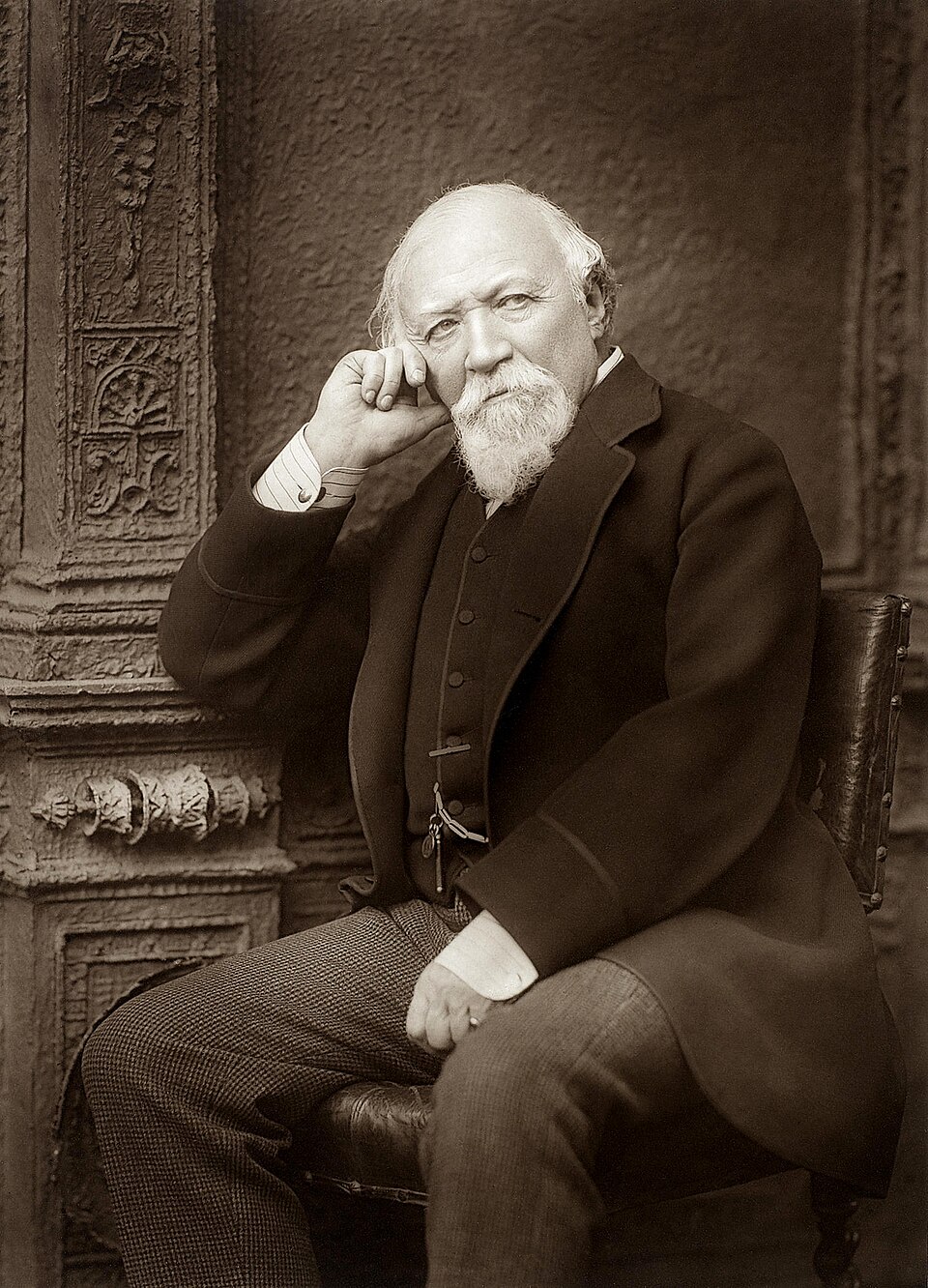
Rowan Williams and Irene Lancaster
The two of us have been working together as conveners of a Jewish–Christian dialogue group for quite a few years, discussing a variety of texts, biblical and contemporary (we’re currently working through a book by Michael Wyschogrod). Rowan is a priest and retired bishop of the Anglican Church; Irene is a Jewish academic who has specialized in the work of Abraham ibn Ezra and taught Hebrew and Jewish Studies in British universities. Among many common interests, we are enthusiastic readers of poetry.
Rowan:
I know we share a deep appreciation of Robert Browning’s poetry—and a recognition also that he has a very distinctive approach to religious questions that manages to avoid some of the worst clichés of Christian antisemitism.
His early poem “Holy-Cross Day” (1855) is a case in point and one that has been frequently misunderstood. It is a fierce satire on the unpleasant tradition that survived in Rome well into the nineteenth century of forcing the Jews of Rome to attend an annual sermon aimed at their conversion.
Browning represents the captive audience of Jews as subversively mocking the process, pretending pious compunction and compliance while recalling the supposed words of “Rabbi Ben Ezra”—Abraham ibn Ezra, your own scholarly specialization—on the eve of his death.
This poem-within-a-poem is sometimes presented as a piece of implicit Christian triumphalism, but it is exactly the opposite. “Ben Ezra” articulates very clearly both the hope of a final return to the land and the immutable vocation of the Jewish people. “God… gave us the word to keep… ’Mid a faithless world.” This is something that cannot be taken away until the end of time: “Till Christ at the end relieve our guard.”
“Christ” here must mean simply the Messiah, the anointed, not the Christian savior. It emphatically doesn’t mean that the rabbi looks forward to a final “conversion,” as some have thought.
The lines that follow offer a “thought experiment.” What if, for the sake of argument, Jesus was the Messiah and the Jews failed to recognize him. Well, let God be the judge of that. “But, the judgment over, join sides with us!”
That is to say, ‘We (the Jews) may have deserved punishment, but that is God’s business. What cannot be God’s will is the centuries-long humiliation, torture, and persecution of an entire people.’ The Jews still “withstand Barabbas”—they refuse to compromise their sense of justice and so, in effect, choose Jesus over Barabbas the robber and murderer. They will not call self-styled Christians who persecute them followers of Jesus, and so they “wrest Christ’s name from the Devil’s crew” and go on resisting the violence of Empire and Church, resisting tyranny and atrocity.
A thought experiment, not a recantation or a conversion. Even if Jesus was the Messiah—which “Ben Ezra” does not in fact grant—the history of Christian anti-Judaism would mean that God was on the side of the persecuted, not the persecutor, and so would be aiding and accompanying the Jewish people on their long journey home.
And in this subtle and powerful idea, I hear some echoes of the more familiar poem, “Rabbi Ben Ezra” (1864). Like “Holy-Cross Day,” it challenges the notion that “it’s all over”—that some new and final revelation has arrived. We are still a “work in progress,” spiritually speaking.
What is unchanging is not the truth that we think we have clarified but the reality of God, a reality that is only ever active, not passive, never there for us to exploit or take advantage of. Our development as physical beings living in time is an essential aspect of what we are.
Body teaches soul just as soul teaches body. “Maker, remake, complete,” prays the rabbi. And we must “work enough to watch / The Master work,” learning discernment through our contemplation of what we have been, our mistakes and frustrations, not our successes.
So I’ll be intrigued to know, Irene, if you think there is anything in either of these poems that echoes anything of the real Ibn Ezra, on whom you have written so well—or is it just a Victorian religious theme arbitrarily put in the mouth of a Jewish teacher?
My own suspicion is that there really is something here of imaginative empathy with Judaism in the awareness of the significance and positive value of the body and its history, and also in the skepticism about “the end of history,” any premature closing down of both the labor and the joy of law-keeping, on the basis that some new dispensation has “relieved our guard,” to use the image in “Holy-Cross Day.” What do you think?
Irene:
When I first embarked on my life’s work, bringing the life and achievements of Abraham ibn Ezra to the general public—first in the form of a PhD thesis, then in the book on the subject published by Routledge[1]—I little imagined the worlds this would open.
The idea of filling a gap in the market first arose at a chance meeting in 1989 with the great Moshe Idel, who was to take up Gershom Scholem’s chair in Jewish Thought at the Hebrew University. A serious study of Ibn Ezra had not yet been attempted, he told me—a bit of an irony, as that year was the 900th anniversary of the birth of Ibn Ezra (1089–1164).
So back in Liverpool I set to this task enthusiastically, helped by members of my university department, who ordered every Ibn Ezra book under the sun. But that was not all. One day, the doorbell rang—another tourist searching out the childhood home of John Lennon? No, a middle-aged lady, unknown to me, who introduced herself as a neighbor from further down the street.
She had heard on the grapevine that I’d embarked on a PhD about Ibn Ezra and wanted to give me a book. It was a miniature edition of Browning’s “Rabbi Ben Ezra,” a gift to help me along, she said. Up until then, I had been aware only of the Browning poems we had learned at school—the unforgettable rhythms of “The Pied Piper of Hamelin” and “How They Brought the Good News from Ghent to Aix.”
But here was something different. In answer to your question, yes, I think that Browning really “gets” Ibn Ezra. So much so that when the doctorate eventually became a book, I prefaced every chapter with a line or two from Browning’s poem.
Browning is a mesmerizing writer, with a huge sense of irony and not averse to depicting the unsentimental dark side of life. But “Rabbi Ben Ezra” was of a different level entirely, introducing a new profundity of philosophical perspective, and—unbelievably for a non-Jewish poet—a true understanding of Jews and Judaism.
Rowan:
It would be quite an undertaking to look at all Browning’s Jewish-related poems—the 1876 “Pisgah-Sights,” for example, or the long and fearfully complex “Jochanan Hakkadosh” (1883), which again seems to celebrate the incompleteness of human justice or holiness, over against idealizing myths of perfectibility.
But we might start with a short work from 1856, “Ben Karshook’s Wisdom.” It isn’t clear whether Browning had any particular Jewish sage in mind or whether it is meant to represent a generic rabbinical figure. The poem takes the form of a typical “aphorism” narrative. An opponent or skeptic asks a question, and the teacher gives a devastating or unexpected reply.
So first the rabbi is challenged about the maxim that a man should turn to God “The day before his death.” Which is all very well, says the questioner, if you know when you’re going to die. But the rabbi replies that if you don’t know this, you should turn to God immediately, precisely because you don’t know.
And then “a young Sadducee” asks if we really have souls. The rabbi responds sharply by saying that I can know I have a soul, but not that we do—which seems to me to mean that talking about the soul is never a “third-person” matter. It is about my unique responsibility as a self before God.
Do these themes strike you, I wonder, as in any way characteristically Jewish? I don’t think they’re completely alien to Christian thinking, but they’re not what you’d call mainstream.
Irene:
I suspect that “Ben Karshook’s Wisdom,” written just a year before “Holy-Cross Day,” owes something to the character of Rabbi Eliezer ben Hyrcanus, a student of Rabban Yohanan ben Zakkai. He features in the popular mishnaic “Ethics of the Fathers” (Pirkei Avot), where he is quoted as saying, “Repent one day before your death” (Pirkei Avot 2:10; and compare Avot de-Rebbe Natan 15:4 and Shabbat 153a). This is because Karshook, emulating Eliezer and unlike the “young Sadducee,” believes in the immortality of the soul, the resurrection of the dead, and the Day of Judgment.
The poem’s opening—“Would a man ‘scape the rod?”—seems to allude to Proverbs 13:24. Karshook echoes Eliezer in advocating treating every day as one’s last and so repenting daily: “Then let him turn to-day!” For the Sadducee, true repentance is unnecessary in the absence of belief in the soul or resurrection. In Ibn Ezra’s day, “Sadducee” was a term of abuse for the literalistic Karaites, who eschewed Oral Torah and presented a clear political threat to its upholders.
The final stanza’s “Hiram’s-Hammer” most obviously refers to the biblical Hiram of Tyre, who helped Kings David and Solomon in building their palaces and the Temple (notice the “Right-hand Temple column” mentioned by Browning and compare I Kings 5 ff., 9:11 ff., II Chron. 2:2 ff).
Here Browning, like Ibn Ezra, connects the building of divine structures with the correct, grammatical teaching of Torah. Ibn Ezra pioneered this approach of concentrating on peshat, the primary and “plain” sense of scriptural language, and popularized it widely in his travels through Ashkenazi Europe after leaving Spain in 1139–40, ending up in England.
But the term “Hiram’s-Hammer” also evokes Jeremiah’s statement (23:29), “Is not My word like a fire… and like a hammer?” God’s word may be “one,” but its interpretation is manifold—a good thing, reflecting the “seventy faces of Torah” (Numbers Rabbah 13:15–16); “seventy” stands for “wine” which, like the Torah, improves with age.
Browning admires old age. The famous opening of “Rabbi Ben Ezra”—“Grow old along with me! The best is yet to be”—has found many echoes, not least in John Lennon’s last (posthumously issued) musical recording, intended to be played at weddings.
Is “Karshook” an amalgamation of Eliezer and Ibn Ezra? Neither suffered fools gladly; both were sticklers for accuracy and rectitude enabled by firm foundations, whether in child-rearing, building construction, or Torah study. Without these, the whole edifice collapses.
Browning has got to grips to an astounding degree with the very essence of Judaism, in a way perhaps never surpassed in the gentile world. But he was not completely alone in his philosemitism. He published “Pisgah-Sights” in the same year (1876) that his friend George Eliot published Daniel Deronda, which has been called the first Zionist novel in the English language.
Here Browning presents Moses reminiscing at the end of his life, looking at the horizon: “Over the ball of it, / Peering and prying.” He sees the earth as it really is, with all its contradictions. “I am earth’s native,” he says, always beginning with the literal and local, wary of assuming a divine view of things. “I would teach no one,” he says—but of course Moses is the teacher par excellence, just because of this starting point.
It is a modest, circumscribed approach, reminiscent again of Ibn Ezra. Common sense, context, historical fact, geography, scientific astronomy—these appeal to Ibn Ezra and Browning’s Moses alike. For Ibn Ezra, peshat trumps allegory, rabbinical flights of fancy, or mysticism. These latter may be used sparingly, but only when required by the nature of the text or if the text’s literal meaning is obviously nonsensical.
Rowan:
Just to interject briefly that this is exactly the position on interpretation taken by Thomas Aquinas in the thirteenth century and by some earlier Christian thinkers too, including at least one—Andrew of St. Victor—who had studied Hebrew. There may be links here…
Irene:
Frank Talmage’s article “Apples of Gold,” in Arthur Green’s edited volume Jewish Spirituality (1986), 319–321, is really helpful on this; Moshe Idel called it “one of the best, if not the best, article that has ever been written on mediaeval Jewish exegesis.”
But to return to the main theme, what Browning is doing in “Pisgah-Sights” is presenting Mosaic Judaism as a faith that observes limit, creatureliness, not seeking timeless perfection or total, final understanding within this world. If the Sadducean perspective is rejected, what remains is the collaborative work of a community of interpreters, the importance of repentance, resurrection, and immortality. If this life is not the last word, then the Faustian pursuit of knowledge, power, and dominance is irrelevant.
Rowan:
That’s a key point. You can read Browning as a systematic critic of the Faustian mindset in all these poems. Moses is “the fixture,” the central point of reference, because he is the well-earthed human being, standing firm against any aspiration to the superhuman. Others struggle around him—some “above” who look back on him as a “precursor,” someone who has helped to make their achievement possible; they “love” him, but perhaps patronizingly. Others are “below,” and they resent what they have not yet seen. But he stands constant, anchored to present and prosaic human existence, but with his eyes on the distant glory of God. The challenge is to be rooted in this present earth, this moment, yet never to reduce God to a “glow-worm,” a little bit of local illumination rather than a burning star in heaven. That imagery, incidentally, has parallels with Browning’s well-known poem, “A Death in the Desert,” about St. John the Evangelist (one of my favorite poems, I admit)—we see a distant star and gradually realize that it’s an entire world of its own.
Irene:
I think we can say of Browning overall that he was a consistent lover of Jews and Judaism, of Hebrew and the “Jewish project,” with a clear understanding of the urge to return to Israel, from which Jews would be able to teach the world. In this he is unlike his contemporary, Charles Dickens, born in the same year. Dickens may have moved away from the gross caricature of Fagin in Oliver Twist (1838) to the dignified figure of Riah in Our Mutual Friend (1864—the year of “Rabbi Ben Ezra” and just a year later than George Eliot’s Romola), but it is a safe guess that for everyone who has read Our Mutual Friend there will be twenty or more who have read Oliver Twist or seen stage and film versions. The damage to the notion of Jewishness in the English psyche and beyond is enormous.
Ultimately, Browning, like Ibn Ezra, was an optimist. Compare “Oh, to be in England / Now that April’s there” with the other Eliot’s—T. S. Eliot’s—line, “April is the cruellest month.” Both lines were written when the poets were 32–33 years old (and both died at 76–77). T. S. Eliot was not in love with life—any more than he was in love with Jews; his appallingly antisemitic lines have been mercilessly mocked by writers like Saul Bellow.
Browning enjoyed a happy and fruitful marriage, and when Elizabeth Barrett Browning died, he returned to England and threw himself into London life, maturing like a good wine, in full Ben Ezra mode.
It’s not just a matter of opposing a positive nineteenth-century mindset to a disillusioned and unhopeful twentieth-century one. This is the spirit of Judaism permeating the soul and spirit of—in my view—our greatest English poet, just as George Eliot is our greatest English novelist.
And the key to both, I’d say, is the incomparable Abraham ibn Ezra, who died at the age of 75 here in England, at the hands of Crusaders en route to the Holy Land, if we are to believe Ibn Ezra’s most respected biographer, J. L. Fleischer, in his brilliantly detailed and well-documented Hebrew-language articles on Ibn Ezra’s travels.[2]
Despite that terrible end, Ibn Ezra lives on in English poetry and prose—and even in the music of John Lennon! Aware of his own mortality, the very human Abraham ibn Ezra has, for many, become immortal through this extraordinary and inspiring legacy.
Rowan:
It’s a legacy whose surface we have only begun to scratch here, I know. We haven’t had a chance to discuss that difficult long poem, “Jochanan Hakkadosh”—though I think we’d agree that much of the same vision runs through that as well: the same Ibn Ezra focus on the fallible and earthbound path to wisdom and even holiness. It too shows Browning’s wide acquaintance with Jewish history (it’s set in what is now Iran—possibly in Shiraz—at some distant but unspecified period) and Jewish thinking. Perhaps this exchange will stimulate someone to have a go at a more detailed reading of that poem in the light of what we’ve been discussing. Thanks for so many insights.
[1] Irene Lancaster, Deconstructing the Bible: Abraham Ibn Ezra’s Introduction to the Torah (Routledge, 2007).
[2] Referenced in Lancaster, 20; full citations to Fleischer’s articles from the 1930s appear on p. 209.





 Site Operations and Technology by The Berman Consulting Group.