


By Michael Kurin
I. The Enigma of the Akeidah: Selection of the Torah Readings for Rosh Hashanah
The association between the Akeidah and Rosh Hashana has become so ingrained in our minds that we hardly bat an eye about its selection as the Torah reading for the second day of Rosh Hashana. The truth is, however, that it was not the obvious choice. By showing why it may not have been a clear candidate for Torah reading on Rosh Hashana, we may be able to understand its selection in a new light.
The Mishna in Megillah 3:5 (Megillah 30b) determines the Torah readings for all festivals, and establishes a clear principle: on each Yom Tov, we read Torah portions that teach the laws of the festival. Accordingly, on Pesach, the reading is from Parashat Emor (Leviticus 22), which details the laws of the Paschal lamb and festival regulations. On Shavuot, the reading is drawn from Deuteronomy 16, focusing on the pilgrimage festivals. On Sukkot, we read Parashat Emor (Leviticus 23), which outlines the commandments of Sukkot. For Rosh Hashanah, the same pattern holds: the Mishna assigns Parashat Emor, the section that includes the brief laws of Rosh Hashanah together with the other festivals (Leviticus 23:23–25). This approach reflects the Mishna’s pedagogical goal: the public Torah reading serves as a vehicle for instruction in the halakhot of the day.
The Gemara (Megillah 31a), however, introduces an additional dimension. It records the opinion that, on major festivals, beyond legal material, we should also read narratives connected to the day’s themes or historical events. Thus, for Pesach, the Gemara suggests reading not only sections about the laws of the festival but also the Exodus narrative itself (Exodus 12–13). For Shavuot, it offers the alternative of reading the story of Matan Torah, the revelation at Sinai (Exodus 19–20). For Rosh Hashanah, the Gemara proposes the story of Sarah’s conceiving: Hashem pakad et Sarah (“God remembered Sarah,” Genesis 21:1), chosen because according to Rosh Hashana 10b-11a, it occurred on Rosh Hashana. Moreover, it emphasizes remembrance through the term pakad, a root that resonates with the day’s designation as Yom HaZikaron (Leviticus 23:24). This choice mirrors the pattern seen on other festivals, where the narrative selected occurred on the festival being celebrated and connects to its themes: the Exodus story for Pesach, the the giving of the Torah for Shavuot.
The Gemara articulates a principle for communities outside of Israel that observe two days of Yom Tov: on the first day, we read the alternative narrative suggested in the Gemara, and on the second day we read what the Mishna prescribed. In practice, this creates a pattern: one day focuses on halakhic material, the other on narrative material. This principle is followed for all festivals, with one exception: Rosh Hashana.
Applying this framework to Rosh Hashana, we would expect that on the first day we would read the halakhic passage from Parashat Emor. On the second day, we would read the narrative of Hashem pakad et Sarah. Surprisingly, the Gemara does not prescribe Parashat Emor at all, and shifts “Hashem pakad et Sarah” to the first day. For the second day of Rosh Hashanah, the Gemara selects the reading of the Akeidah (Genesis 22). This is startling for several reasons. First, the Akeidah is not mentioned in the Mishna’s discussion of festival readings and appears suddenly as a new choice. Second, the inclusion of the Akeidah deviates from one of the principles governing narrative readings for Yom Tov, which are typically stories that occurred on that day. On Pesach, we read the Exodus because it happened then; on Shavuot, we read about the revelation at Sinai because it happened then. The Akeidah violates this logic, as it did not take place on Rosh Hashana[1]. Third, it contains no explicit reference to remembrance—no zachor, no pakad. To illustrate how out of place this is, consider the first day’s Torah reading and the haftarot for the first and second day. On the first day, we read the story of Hannah, who prays for a child and vows to dedicate him to God. Her plea culminates in the words: “And she prayed to the Lord and wept bitterly… and the Lord remembered her” (I Samuel 1:10, 19). The second day’s haftarah, from Jeremiah 31, likewise pulses with the language of remembrance: “Is Ephraim My dear son? … Whenever I speak of him, I surely remember him still (zakor ezkerenu od)” (Jeremiah 31:20). Three of the four readings for Rosh Hashanah—the first-day Torah reading and both haftarot—thus contain explicit references to memory. The sole exception is the Akeidah. How, then, did it become the centerpiece of the second day’s reading?
One suggestion, offered by Rabbi Yitzchak Etshalom[2], seeks to resolve this anomaly by proposing that when the Gemara referred to Hashem pakad et Sarah, it did not mean the short reading from Genesis 21 alone, but rather the entire narrative arc continuing through Genesis 22 and culminating in the Akeidah. According to this view, the original practice envisioned a single extended reading that encompassed both stories. Once two days of Rosh Hashanah were observed, this long unit was divided: the first day featuring the opening section about Sarah’s conception, the second concluding with the Akeidah. On this reading, the Akeidah was not introduced later as a separate idea but was always part of the Gemara’s conception of the festival reading.
However, this explanation is not entirely convincing for two reasons. First, if the Gemara intended the Akeidah as the climax of the reading, we would expect it to name it explicitly, just as it does for other readings, such as the haftarah, referred to by HaBen Yakir Li (Jeremiah 31), even though that phrase does not occur at the beginning of the reading. Second, the thematic inconsistency remains unresolved. If the Gemara’s rationale for including Hashem pakad et Sarah is that the event occurred on Rosh Hashanah and exemplifies divine remembrance, then the Akeidah does not belong: it is not listed among the events that the Gemara in Rosh Hashanah 10b–11a says occurred on Rosh Hashanah, and it doesn’t mention the theme of remembrance. In short, this theory may explain the mechanics of how the Akeidah could have entered, but it does not explain why it should be included in the readings that occupy this place in the liturgy.
As background for an alternative solution, let us examine the Musaf of Rosh Hashanah. Its structure—Malchuyot (proclaiming God’s sovereignty), Zichronot (invoking divine remembrance), and Shofarot (sounding the shofar) (Mishna Rosh Hashanah 4:5)—frames the themes of the day. Each section cites ten verses, and the requirement in Zichronot is that all ten contain the word zachor (“remember”) or a direct synonym. The Akeidah does not qualify and so does not appear among those ten verses. However, it is appended at the very end, just before the concluding blessing, almost as an afterthought: Akeidat Yitzḥak le-zar‘o ha-yom be-raḥamim tizkor. Once again, we must ask ourselves the same question: If the Akeidah was not included in the body of the zichronot because it says nothing about remembrance, how does it gain insertion, almost as an interruption to the flow just before the end of the section. The reason is that the Akeidah is mentioned here as an intercessory plea: “Remember for us the covenant and the Akeidah of Isaac.” Its function is not like the rest of zichronot, verses cited to emphasize God’s historical remembrance of the Jewish people, rather, it is placed here to intensify and focus our plea. It is a prayer: “If You remember one thing, let it be the Akeidah.” The placement is telling. After ten verses reminding us and God that Rosh Hashanah is a day of remembrance, we dare to add a final request: if You are going to remember us, then remember this, our finest historical moment of passionate sacrifice.
I would suggest we can borrow this logic and apply it to the Torah reading as well. Just as the Akeidah is appended to Zichronot even though it does not meet the technical requirements, so too it becomes the Torah reading of the second day of Rosh Hashanah, even though it does not follow the usual pattern. Strictly speaking, it does not belong—but given the stakes of the Day of Judgment, we could not resist the need to highlight it. Here too, its selection as a reading is itself a prayer: an interruption of the standard framework to plead with God to recall the supreme devotion of Abraham and Isaac. It is not didactic but supplicatory. Unlike any other Torah reading of the year, it serves not to instruct the congregation in law or narrative but to stand before God as a communal petition. In choosing to read the Akeidah, we say, in effect: “Study the laws of Rosh Hashanah on your own time; today we use the public platform of Torah reading to recall before God our ancestors’ supreme moment of faith.”
This viewpoint aligns with Rashi’s remark on Genesis 22:14 that the Akeidah serves as an enduring annual petition for forgiveness on the part of B’nei Israel. Rashi on Megillah 31a likewise underscores that the Akeidah is read so that its merit will stand for us, explicitly supporting this understanding of the reading as a plea for God’s remembrance rather than an act of instruction.
II. The Shofar as an Instrument of Memory
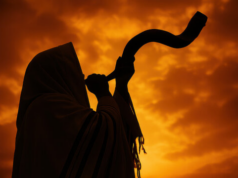
This theme of invoking merit through remembrance leads naturally to the shofar. Rosh Hashanah (16a) explains the structure of Musaf: “Malchuyot—to make Me King; Zichronot—so that I will remember you for good. And through what? Through the shofar.” The shofar is not merely symbolic; it is the medium through which divine remembrance is activated. In truth, the connection between the shofar and memory is already hinted at in the Torah, which describes Rosh Hashana as zichron teruah (Leviticus 23:24), literally meaning remembrance of teruah.[3] While the exact meaning of the phrase is cryptic, an association between memory and shofar is drawn.
Furthermore, it is possible that this property of the shofar preceded the Akeidah and was destined to be discovered there, in order to formally enter into the Jewish tradition. The Mishna in Pirkei Avot (5:6) lists the ram that was present at the Akeidah as one of the miraculous objects that was created at twilight on the eve of the first Shabbat. Bartenura, in his commentary on that mishna, explains that it was decreed at the time of creation that this ram would become stuck by its horns in the bushes at the time of the Akeidah. In other words, the ram was destined to be discovered by Abraham during the Akeidah, and specific mention is made of it being stuck by its horns. While some commentaries suggest this was simply to avail Abraham of an animal to offer without having to steal one,[4] there are several Midrashic opinions that imply a greater significance to the selection of this ram for this task with specific mention of the role its horns will play for the Jewish people. Pirkei deRabbi Eliezer (31:13) states the opinion of Rebbi Hananya ben Dosa that each part of the ram’s body had a future use, either as part of the Temple service, or as garments for future leaders of the Jewish people. The last two parts, likely those of most significance to him, are the two horns, which were to form the shofar that would be sounded at Sinai and the shofar that will be sounded in the World to Come. Second, Yalkut Shimoni (Remez 101) states, “All that day Abraham saw the ram passing from tree to bush, from bush to thicket, continually being trapped, freeing itself and again becoming entangled. Said the Holy One, blessed is he, to him: ‘So will your children be trapped through their sins and entangled by foreign Powers, passing from Babylon to Media, from Media to Greece, and from Greece to Edom’. ‘Is it to be thus for all time?’ ‘No,’ said He to him, ‘They will be redeemed eventually through the horn of this ram.’” These two passages of Midrash suggest that the ram was specifically chosen for its destiny because of the redemptive role its body parts will have for the Jewish people in the future, with specific focus on its horns.
What we have shown seems to represent a fundamental debate about why the ram was destined to appear to Abraham during the Akeidah. Some suggest that any animal might have been chosen, and Abraham simply needed a potential offering freely available. However, the above two midrashim raise the possibility that the ram was specifically chosen for this destiny because of the parts of its body, and most importantly the horns, that will become features of the future Jewish nationhood and redemption.
Should the latter view be accepted, it would suggest a profound reorientation of the meaning of Abraham’s discovery of the ram. We often imagine the causal order like this: Abraham happened upon a ram at the Akeidah, and therefore we blow a ram’s horn to recall that moment. Like the Akeidah’s unnatural insertion into the Musaf prayer and the day’s Torah reading, the shofar serves as another powerful request of God to remember that powerful moment from which the shofar was born. But these passages of midrashsuggest the opposite: the ram with its horns was created from the beginning of time, destined to be discovered at the Akeidah. It is reasonable to suggest that the ram was specifically chosen for this role because God had planned to have its horns introduced into Jewish practice. Recalling that the gemara already describes the shofar as a tool to invoke memory, it is possible that the ram appeared to Abraham precisely in order to provide the shofar for this purpose. The horn was destined from the beginning to serve as the vehicle of remembrance, and the ram appeared in the Akeidah to make that destiny manifest. The Gemara states explicitly: “Why do we blow a ram’s horn?… So that [God] will remember the Akeidah of Isaac” (Rosh Hashanah 16a). The shofar thus merges two layers: its primordial role, established at Creation, as a vessel of remembrance; and its historical role, as the horn of the ram at the Akeidah.
Traditionally, the shofar is seen as a tool to inspire repentance. The Rambam writes: “Even though the sounding of the shofar is a decree, it contains an allusion: ‘Awake, sleepers, from your sleep, and slumberers, arise from your slumber. Examine your deeds, return in repentance, and remember your Creator’” (Hilchot Teshuvah 3:4; cf. Hilchot Shofar 1:1). In this conception, the shofar is God’s call to Israel, summoning us to remember Him. But the sources above suggest a complementary dimension: the shofar is also Israel’s call to God, asking Him to remember us: not only because the shofar is symbolic of the Akeidah, but because the shofar itself is a vessel of remembrance. It inherently invokes memory of our deeds, past and present. Its blasts are therefore bidirectional: from God to Israel, as a wake-up call to repentance; and from Israel to God, as a petition that He should recall our merits.
In this way, reading the story of the Akeidah, inserting it into our Musaf prayer, and commemorating it with the shofar are all desperate appeals to God to remember our merits. Although the Akeidah may be the quintessential example of self-sacrifice in our national memory, it is not the only one. Our generation, like so many before it, has witnessed countless examples of people willing to sacrifice themselves for the protection of the Jewish people, especially in these last few years. Their merit need not be any less inspiration for a favorable judgement for our entire nation than that of Isaac himself.
[1] The date of the Akeidah is debated in rabbinic sources. Pesikta Rabbati 40 associates it with Rosh Hashanah, while Shemot Rabbah 15:11 places it near Pesach. Regardless, it is not listed among the events that occurred on Rosh Hashana in gemara Rosh Hashana.
[2] Accessed 8/28/2025 https://www.yutorah.org/sidebar/lecturedata/1072959/%D7%A2%D7%A7%D7%99%D7%93%D7%AA-%D7%99%D7%A6%D7%97%D7%A7-part-1The-Selection-of-the-Story-of-the-Akedah-as-Keriat-HaTorah-on-Rosh-Hashanah
[3] Although the Rabbis (Rosh Hashana 29b) took this phrase to refer to the times when Rosh Hashana falls out on Shabbat and the shofar is not blown, this does not detract from the simple meaning of the words themselves making a connection between shofar and memory.
[4] See for example the commentary of Yachin on this mishna





 Site Operations and Technology by The Berman Consulting Group.