

Michael Bernstein
I
Every time I go to shul, I bow to objects I consider to be idols.
Like Jeroboam’s golden calves, there are two of them, except these are both in the same locale. They are set up right next to the aron kodesh, so that there is no good way to avoid bowing towards them, to avoid looking at them, or to pretend they aren’t there.
Like a Bizarro version of the seventh martyred son who refused to pick up the pagan tyrant’s ring, knowing it was a ploy to have him also bow to an idol, I bow towards the aron and the objects I view as idols each and every time, unable to stop myself even though I know it’s wrong.
It’s possible to avoid looking at both of them, but at least one is always visible.
As a child, I noticed that the closer I got to the Kotel, the less I could see the Dome of the Rock. The closer I got to the locus of holiness, the less the foreign worship could be perceived. Pray at the Kotel and you can’t even see the al-Aqsa compound, even though it’s right there and you’re facing it.
In the sanctuary of my shul, there is no relief. No matter where I sit, I see the intruding symbols.
It doesn’t have to be this way.
II
The practice of situating the local national flag and Israeli flag on either side of the aron kodesh is a little over 100 years old in popularity. It is largely an American (and Canadian, to some extent) phenomenon. As a comparison: Buenos Aires, Argentina, home to over 175,000 Jews of various denominations, has dozens of shuls and batei midrash, and almost all of them have sanctuary and aron kodesh photos easily viewable online. I went through the photos. I can report that, as far as this photographic evidence can attest in this context, the shuls in Buenos Aires feature neither the Argentinian nor the Israeli flag on display within the prayer space. Stars of David yes, and plenty of them – but none in blue on white. I did the same checking with respect to a long list of synagogues in Australia. No flags in sanctuaries were in evidence as far as I was able to research (though I am told there are a few examples without photos online). The same is true for most shuls in the U.K. with interior photos available.[1]
The history of this practice has been discussed in popular reporting in recent years. Josefin Dolsten wrote a piece for JTA in 2018 that was picked up by The Times of Israel and other outlets, which explains the historical background to the presence of dual flags in shul, but does not address the issue of placement of the flags alongside the aron kodesh as compared to anywhere else in the shul building.[2]
Dolsten explains that the presence of flags in shuls arose from two different situations and started with two different flags. On the one hand, some synagogues and churches in America began hanging banners known as “service flags” during World War I, honoring parishioners’ family members who were serving, or had served, in the military effort. This led to a general comfort with the presence of patriotic banners in shul in many places, and through the 1920s and 30s that trend blossomed into the display of the actual American flag in sanctuaries. It is not hard to understand why the flag of Israel would be set up beside the American one once the modern State of Israel was founded.
On the other hand, many shuls came to have American flags on display only because they first determined that they wanted to display Zionist (after 1917) or Israeli (after 1948) flags, and felt that it would be a bad look to fly only that flag and not also the flag of their own country of residence.
In both cases, however, even where shuls debated whether or not to display flags, it does seem that, once the decision was reached to display, there was generally no hesitation about displaying them in the sanctuary itself (as opposed to elsewhere in the building).
III
This matter has appeared before in the pages of The Lehrhaus as well. R. Moshe Kurtz authored a piece in 2022 asking, “Do National Flags Belong in Our Houses of Worship?,” in which he presents a more extensive and more rabbinical-analysis-focused picture. The issue of Israel’s founding as a secular state is unpacked; the role of flags as divine symbols is brought into the picture. It is overall a more detailed and research-heavy piece of commentary than this present opinion piece aims to be.
I will briefly note some pertinent portions of R. Kurtz’s discussion. First of all, he brings up a (differently reasoned) version of the viewpoint to which I personally subscribe, namely, that there is a concern of idolatry when it comes to placing flags in worship spaces.[3] Mention is made of R. Mordechai Savitsky’s contention that “the Israeli flag represents a form of avodah zarah.” (The opposing viewpoints which R. Kurtz cites include R. Menashe Klein, who says it’s heresy but not idolatry, and R. Moshe Feinstein, who says it’s vanity and silliness but not idolatry.) It is noted further that the American flag has, in some circles, been afforded “near deification.”
R. Kurtz contextualizes this within a broader religious framework, focusing on Christian commentators who have opposed American flag displays in their own sanctuaries, invoking terms such as idolatry and false worship. In remarking on the similar attitude expressed by R. Hillel Posek, R. Kurtz notes with an air of equanimity that while “most people are likely not directing their prayers” to the American or Israeli flags themselves, “the optics convey a certain set of values that some rabbinic authorities find questionable.”
R. Kurtz’s article is valuable for his framing of the factor of placement in his discussion: “While [one] may grant that national flags do not carry the problematic associations of another religion, displaying them in the sanctuary, especially next to the ark, risks conveying an erroneous message. … The Israeli or American flag may not be inherently idolatrous in nature, [but] placing them next to the holy ark might come uncomfortably close to conveying such a message. Appreciation for Israel and America should be encouraged, but… the sanctuary may not be the right place to express [it] – for it is solely the house of God….
[O]ne can maintain a strong appreciation for their country while still believing that the sanctuary is not the most appropriate place for such demonstrations.”
Another passage potentially addresses those of us to whom flags next to the aron kodesh are an automatic source of distress and distraction: “Shulhan Arukh is generally concerned with anything that presents a distraction during prayers, and R. [Aharon Simcha] Blumenthal believes that flags would qualify as such.” However, the ultimate underlying principle of that concern is the distraction that any illustrated, decorated, or ornamental object may cause – not the distraction that a flag per se, as an unwelcome object in the prayer space, may cause. Thus, R. Kurtz’s remark, that “some of the other ornaments” in synagogue sanctuaries might be just as distracting but receive less scrutiny than flags, does not really express anything useful or compelling in this specific context. To many of us, one or both of these flags present(s) a particularly persistent and pointed form of distraction, whether displayed with great ornamentation or not.
R. Kurtz repeatedly displays acute awareness of the distinctions between “in the synagogue,” “in the sanctuary itself,” and “right next to the ark” in his discussion:
“…whether the synagogue, particularly its sanctuary, serves as the appropriate place…”
“…it is forbidden to hang [a mat with an image of scales] in the synagogue – certainly next to the side of the sanctuary…” [quotation from Rosh]
“…displaying them in the sanctuary, especially next to the ark, risks conveying an erroneous message…”
However, he also elides this distinction in some places, using the catchall phrase “the synagogue and its sanctuary.”
R. Kurtz clearly believes that it is more appropriate, if flags are to be displayed, to situate them somewhere outside of the sanctuary. However, he does not discuss specific alternate options for the placement of flags within a shul building outside the sanctuary itself.
IV
R. Moshe Feinstein z”l (Iggerot Moshe OH 1:46), briefly cited in R. Kurtz’s piece, discusses the presence of flags in shul. Though he believes flags have no place in shul, he does not share my conviction that flags are idols and that nationalist chauvinism is a form of false religion, and in fact he ultimately advises that flags that are already set up in synagogue buildings can surely stay if removing them would cause communal rupture and discord. But what interests me, again, is how he speaks about the placement of these flags during his explanation of his rationale.
Even if it is not appropriate to bring flags into shul, which is a holy place – and certainly flags should not be left in shul in a permanent fashion, even the more so not next to the aron kodesh – it is not relevant to speak of a true prohibition that is implicated here, rather it is [just] a worthless and silly thing to do. And if it is possible, in a peaceful way, to remove them from the shul, this would be a good thing to do. But to create controversy in order to remove the flags is forbidden.[4]
For R. Feinstein, the primary calculus is weighing a very real possibility of communal disunity against the possibility of doing something simply worthless and inappropriate that doesn’t actually violate halakhah. He strongly believes that one ought to tolerate the (explicitly stated to be inappropriate) presence of flags in shul for the sake of maintaining harmony within a community.
R. Feinstein says that those who would break off and make a new minyan rather than pray at the shul with flags “are not acting appropriately, and it is merely a matter of political division that comes from the power of Satan.” The flags can stay, but the important solidarity is not the tzibbur coalescing around national pride in America or Israel; the important solidarity is the tzibbur remaining a tzibbur for prayer.
R. Feinstein brings the issue of placement to bear, if only tangentially to his longer argumentation. He stresses that, as a matter of principle, flags inherently have no place in shul (like any other secular symbol[5]), not just in general, but especially when they are permanently placed, and especially when they are set up flanking the aron kodesh, towards which prayers and bowing are directed.
V
Some people reading this will have already dismissed me as pasul le-eidut, unfit to speak impartially, on the matter of flags. It is a matter of some public record that I personally believe national flags are inherently symbols of division, and that I would be glad to see the day when they are all gone forever. This is, of course, a somewhat hyperbolic way of expressing a disdain for hypernationalism in general, and a deep frustration at the boundaries that divide human beings into “usses” and “thems.” I do subscribe to the view that nationalist chauvinism is a form of false religion, with flags as its various convenient teraphim, household idols. The U.S. Flag Code states that the American flag is “itself considered a living thing” (4 U.S.C. § 8(j)), which is an obscene concept vis-a-vis the actual value of actual living people, created in the image of God, who regularly die just because someone else had a different flag. I do, in fact, believe that flags themselves are symbols of the political division that comes from the power of Satan.
(You can understand why these objects would present a bitter distraction to me, even if they are not idols per se in the consensus view of the major posekim. Hopefully you can also infer that it provokes discomfort for those with a similar but much less extreme version of my attitude towards nationalism and national-symbol veneration. Whether we view flags as ideologically repellent idols or just as intruding secular objects, we don’t want to feel those negative feelings when praying or learning in shul.)
So it may surprise you that what I’m arguing for here is not the removal of flags from synagogues – against my own inner voice, I will join with the tzibbur and stipulate their presence. Rather, I am arguing passionately in favor of that which R. Kurtz more gently endorses, and which R. Feinstein urges, if it will not cause communal rupture: that the flags we display in our synagogues should not be visible to people praying in the sanctuary and should absolutely not be permanently set up flanking the aron kodesh towards which we pray and bow. Keep the flags, but move them.
I would argue that the most useful way to display flags on shul premises would be to hang them either outside or in public-facing windows (some congregations already do this!). If we as a community want to show support for Israel and America, then we should be showing it to the world – not facing ourselves with it in our prayer spaces. Indeed, many shuls already hang Israeli flags in one window of the building, and plenty of shuls displayed American flags in one window in the years following the 9/11 attacks.
Another option would be to display the flags in front halls, lobbies, social event spaces, and other non-sanctuary rooms (some shuls already do this, as well). I’m not asking congregations to hide their flags away in coatrooms; I’m just saying that the flags don’t belong inside the prayer space. The average shul is not a one-room shtiebel[6] – there ought to be no problem finding another place to situate these symbols. Shuls could even display them right outside the sanctuary entrances in designated places of honor, perhaps even dedicated in someone’s honor or memory.[7]
VI
When I tried to put myself in the headspace of those who feel about flags the opposite of how I feel, I still could not think of a compelling logic one of them would advance to argue that no, the only proper place for these flags is davka in the sanctuary right next to the aron kodesh, and that anywhere else in the shul building would be an unacceptable downgrade. Perhaps they would believe it is now some sort of minhag, a practice with a formal protocol? ‘The ner tamid goes above the aron, and the flags have to go on either side of it; that’s the rule.’
I hope not.
The fact is, there is no compelling reason to situate national flags beside the aron kodesh or bimah, or have them in the prayer space at all, and there are legitimate objections to this display choice well-attested.
And the fact is that there are more venerable banners and slogans that we display in our sanctuaries that are inherently appropriate and already occupy the space we face, namely, the parokhet curtains on our arks and the words we embroider upon them:
“Know before Whom you stand.” “I have set God before me always.” “Open the gates of heaven to our prayers.”
“God’s Torah is perfect.” “Its ways are ways of pleasantness and all its paths are peace.” “It is a tree of life for those who cling to it.”
“They shall make for Me a sanctuary, that I may dwell amongst them.”
150 years ago, there were no flags[8] next to the aron where we keep our Torah scrolls. In most of the world, in most shuls in countries where diaspora Jews live, there are no flags in the sanctuary to this day.
Service banners gave way to American flags; Zionist banners gave way to Israeli flags. This is a modern practice, with no formal parameters, and it can once again give way, this time to a more refined and thoughtful choice of location. Let’s stop bowing to flags.
[1] United Synagogue in the St. John’s Wood district of London has had a Union Jack and Israeli flag on display since at least the end of 2023, but didn’t have them up in pictures from 2015. Central Synagogue on Great Portland Street in London also displays those two flags. There may be other examples.
[2] The article refers to flags flanking the bimah, but is illustrated with a 1924 photo of a pulpit and aron kodesh. The difference between bimah flags and aron kodesh flags is marginal in my eyes, with the key issue here being their presence in the sanctuary such that praying people cannot avoid facing them.
[3] My take on this concern is a broader halakhic objection, and applies to all symbols of nationalism imbued by their adherents with inappropriate sanctity; in the case of R. Kurtz’s representative cited opinion, it is a more focused halakhic objection deriving from the notion that worshipers who revere the Israeli flag in particular may be venerating the secular State of Israel or the institution of Zionism rather than, as is proper, worshiping God. (For the record, it is not my goal here to convince readers that flags are idols. Let it suffice that they bother some of us.)
[4] This translation was done by R. David Wolkenfeld for his Sefaria sheet and lecture entitled “Religion and Nationalism Points of Conflict: Flags in Shul.” I am very grateful for this translation. I made minor edits for flow. The entire passage is worth reading beyond what I have excerpted here.
[5] That R. Feinstein objects to flags as secular rather than religiously-charged objects is clear from remarks he makes in the course of talking through the issue:
“[A]t the heart of the matter it is not clear what prohibition is truly entailed in setting up flags, for, after all, there is no prohibition against bringing secular items, even those that have no purpose, into a shul.”
“[T]hose who made the flag into the sign of the State of Israel… did not intend it to be something holy… and it is known to everyone that they made the flag into a mere symbol like any other non-sacred thing.”
[6] And in a one-room shtiebel, the community can place them against the wall opposite the aron kodesh, so that the people praying do not face them during services.
[7] An interesting case study is Temple Israel in Dayton, Ohio. This Reform congregation began displaying the American and Israeli flags in its lobby in 2004, and almost immediately one of its members, a veteran of the Marines, began petitioning to have the flags moved inside the sanctuary, specifically onto the bimah itself. The congregation voted down these requests three times: in 2004, 2007, and 2017 (in the latter case, the petition asked for the flags to be next to the bimah, not on it). Finally, in 2019, a fourth vote saw the congregation agree to move the flags from the lobby into the sanctuary. I obviously believe that this congregation had things right the first three times.
Another case worth mentioning is the Central Synagogue in New York. Following the return of the last of the October 7 hostages, R. Angela Buchdahl announced that the Israeli flag that had been on the bimah at Central Synagogue since the attacks would be moved off the bimah. It had been displayed on an empty chair representing those who were not yet recovered. However, rather than move the flag to a display in the lobby or another place in the shul building, Buchdahl chose to have the flag retired from display by being folded up and placed in the aron kodesh itself.
While I appreciate that this instance is not quite the typical case of a national flag in a shul, it bothers me to think of a flag sitting alongside Torah scrolls as a co-resident of an aron kodesh.
(I freely admit that I do not come from a Reform background; a scholar of sociology and/or religion may be better situated to unpack the range of different denominational ideas on the scope of the role of an aron kodesh.)
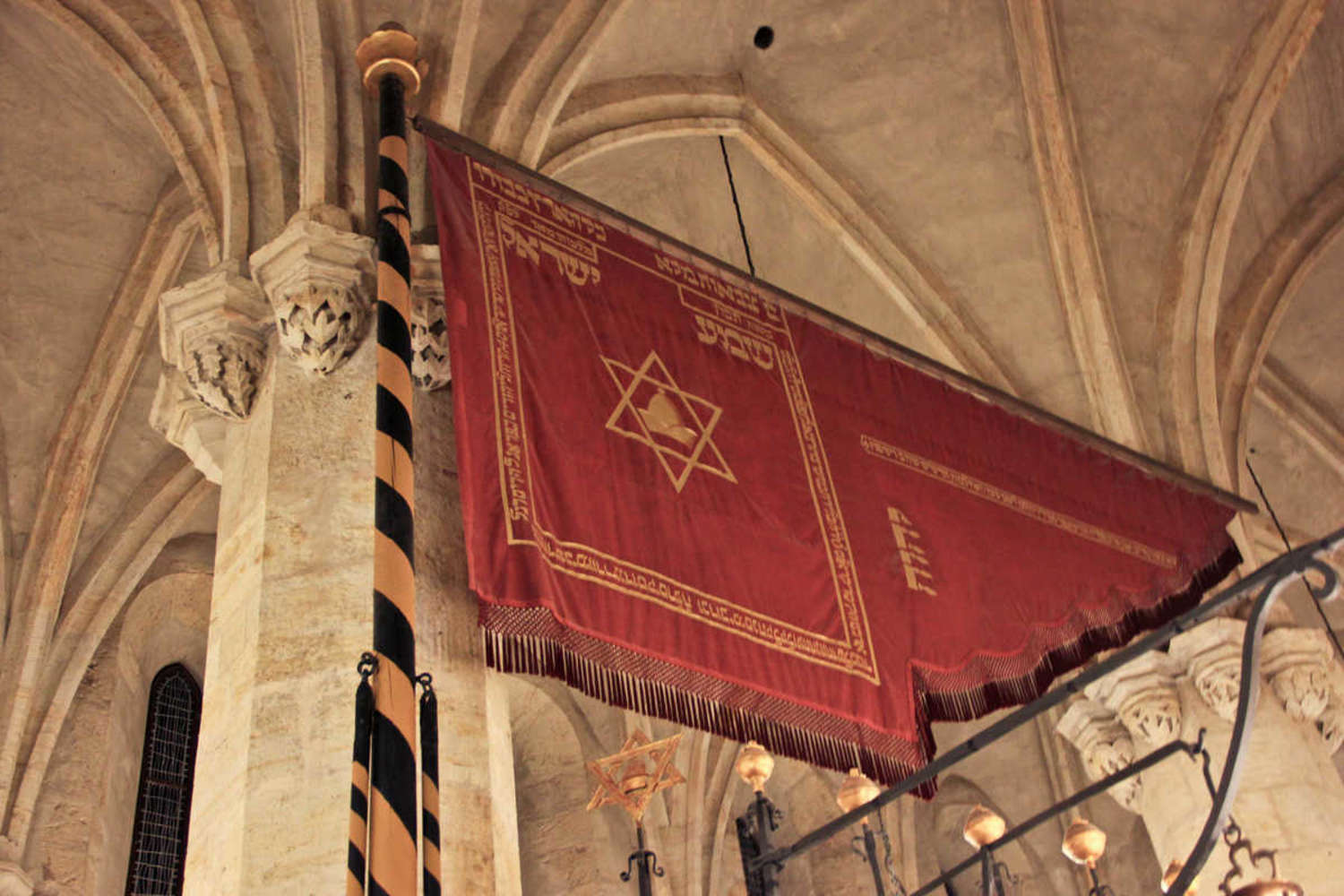
[8] The Altneuschul in Prague features a “flag” that has hung without any controversy in the sanctuary for hundreds of years. However, this banner (now on display as a replica of the original) is not a national flag – it is a gold-on-red irregularly shaped artwork featuring a Star of David, a “Jewish hat,” the words “Shema Yisrael,” the Tetragrammaton, and some other lettering. In other words, though the artwork is popularly referred to as a “Jewish flag,” this example is not historical evidence for a shul sanctuary displaying what we would now mean by a “flag.”





 Site Operations and Technology by The Berman Consulting Group.