

Michael Kurin
Introduction
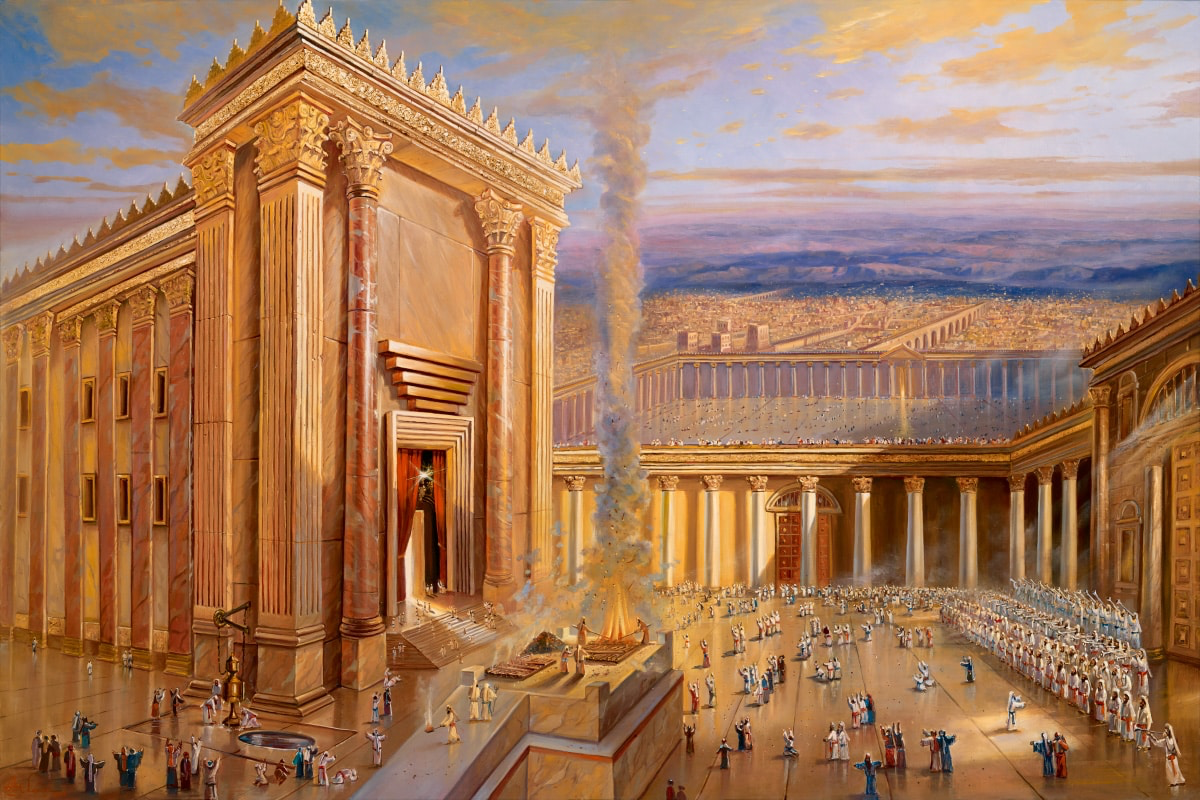
Megillat Esther is, at first glance, the outlier among the literary products of the Second Temple era. Ezra-Nehemiah, Chaggai, Zecharya, and Malachi are all consumed with the return to Zion, the rebuilding of Jerusalem, the restoration of Jewish political life, and above all the construction (and later fortification) of the Second Temple. Esther alone[1] is set entirely outside the Land of Israel and seems, on the surface, to be a diaspora court narrative: banquets, bureaucracy, palace intrigue, and a miraculous national salvation in faraway Shushan. However, by synthesizing the writings of several recent and contemporary scholars, we will suggest that a careful inspection of the text reveals that the Temple is the center around which the entire story revolves, only that it is not named explicitly. Rather than speaking in direct prophecy or rebuke, Megillat Esther conveys its message through omission, irony, and satire. The Temple is not absent from the Megillah; it is the hidden undercurrent of the entire story.
- The Backdrop of the Mordechai-Haman Conflict
In a groundbreaking essay published in 1972, R’ Manfred Lehmann[2] argued compellingly for a hidden backstory between Mordechai and Haman. In the narrative’s “local” frame, Haman is enraged because Mordechai refuses to bow. But Haman’s response is too disproportionate for it to relate to one unknown dissenter[3]. Haman’s own confession underscores it. He possesses wealth, honor, status, and access, yet “all this is worth nothing to me every time I see Mordechai… sitting at the king’s gate” (Esther 5:13) . That kind of fixation reads like the resurgence of a prior rivalry. Lehmann therefore proposes that the two men were already adversaries before Shushan. The Persian court setting is not the origin of the feud; it is the arena where an earlier dispute reaches its climax.
Lehmann explained that the battle between Mordechai and Haman reflected an older confrontation tied to the struggle over the restoration of the Temple. The 4th chapter of Ezra describes a cycle of Jewish attempts to build the Temple against a series of obstructionists who attempt to halt the project. In the only reference to Achashverosh outside Megillat Esther, it is noted here that in the time of Achashverosh, an accusation was written against the Jews of Judea and Jerusalem (Ezra 4:6). Haman, Lehmann argues, was one of the leaders of the obstructionists, while Mordechai was one of the leaders of the Jewish community in Judea. The two had confronted each other in Judea regarding the project of restoring the Temple, and both ultimately traveled to Shushan to advocate for their cause to the King. In fact, Haman’s expansion of his anger at Mordechai to the entire Jewish people is not a symptom of poor anger management but a carefully concocted ploy to permanently obstruct the Temple construction. Mordechai’s obstinance became the excuse Haman was looking for to place the entire Jewish community, and the construction in Judea by extension, on the King’s bad side.
In support of his theory, Lehmann cites a midrash (Yalkut Shimoni on Nach 545:1) that essentially states his thesis outright. The midrash describes Haman (and his son Shimshai the scribe) opposing the Temple-building; Mordechai is then sent “down from Judah to Shushan” as an emissary to support rebuilding, while Haman also goes down to annul it. One should also note that Rashi on Esther 9:10 makes a similar connection regarding Haman’s sons, identifying them as the obstructionists mentioned in the book of Ezra who sought to ensure that the building of the Temple would cease permanently after the death of Cyrus.
Lehmann also notes a textual support for his theory. The obstructionists in the book of Ezra are called “tzarei Yehuda u’Binyamin,” (the adversariesof Judea and Benjamin). They were a coalition that attempted to frustrate the restoration through political pressure and imperial correspondence. Lehmann notes the similarity to the descriptor often repeated for Haman in the book of Esther, “tzorer ha-Yehudim” (the adversaryof the Judeans). He explains that “tzarei Yehuda u’Binyamin” is the name of this coalition, and an individual member or leader of the coalition, such as Haman, would be called “tzorer ha-Yehudim”.
With this in mind, several anomalies about the text can be explained.
A. Mordechai is called both a Judean, though living in Shushan, and a Benjaminite (Esther 2:5). Mordechai was in fact a Judean because he lived in Judea and was among the leaders attempting to reestablish the Temple. He was in Shushan on a political mission, and he descended from the tribe of Benjamin.
B. Mordechai’s persistent placement at the “gate” (Esther 2:21) is intentional political maneuvering in an attempt to gain closeness to and influence in the Persian government in order to advocate for his cause. His insistence that Esther take advantage of such opportunities can be explained in the same way.
C. When tallying the dead after Haman’s supporters were killed (Esther 9:15-16), it is apparent the number killed in Shushan was very low compared to the rest of the Persian territories. This would make sense if Haman’s operational base was not Shushan, but rather Judea. He too was in Shushan on a political mission.
The Mordechai-Haman conflict is not simply a battle over Jewish survival in exile. It is actually a battle over the future of Judea. This already brings the Temple to the forefront of the book of Esther even without mentioning it by name. We can begin to see the book as less an outlier than originally thought. However, what Lehmann did not address is that the prominence of the Temple becomes even stronger when considering the historical time period the events of the book of Esther occurred.
- The chronology of the Persian empire
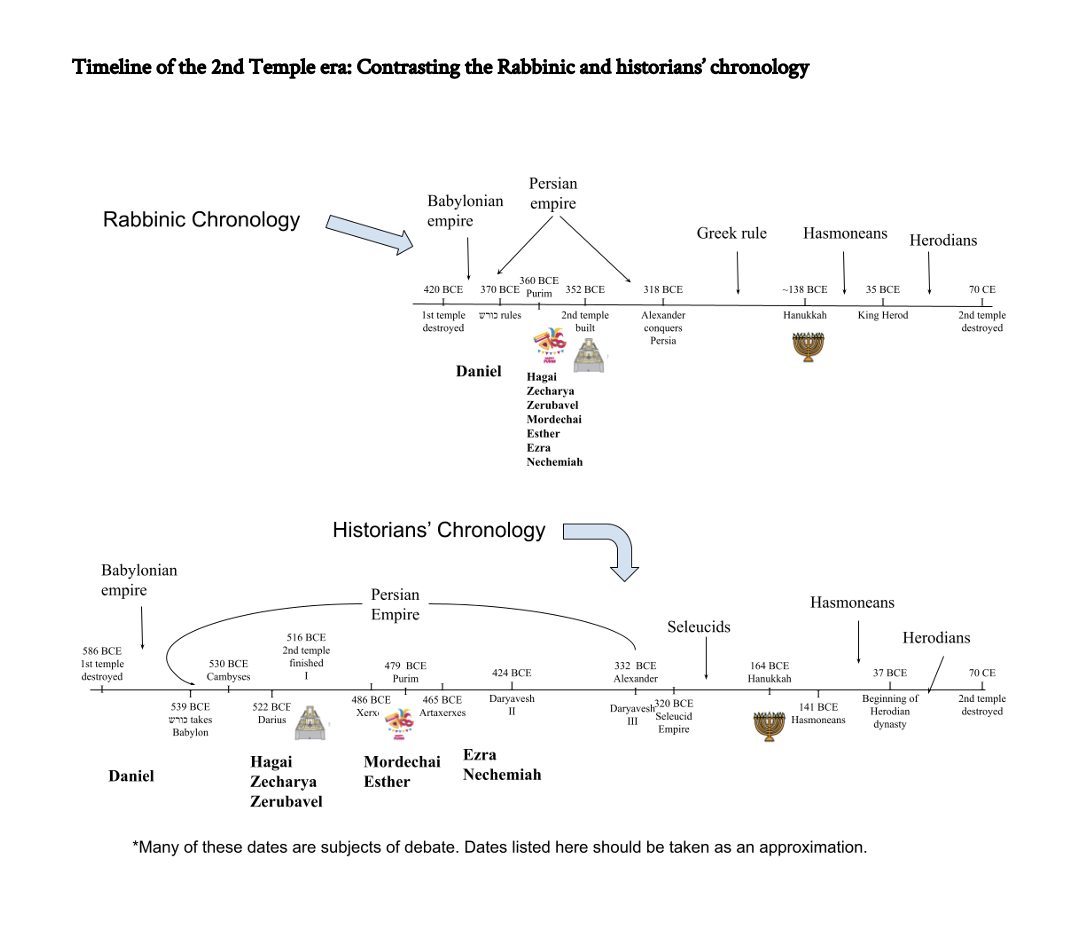
The chronology of the Persian period is contested[4]. Modern scholarship, drawing on Greek historical works, Ptolemaic astronomical tables, and Persian inscriptions, posits a Persian imperial period of roughly two centuries and a longer list of kings (Cyrus, Cambyses II, Darius I, Xerxes I, Artaxerxes I, and so on). Under this framework, Achashverosh is commonly identified with Xerxes I, who ruled after Darius I.
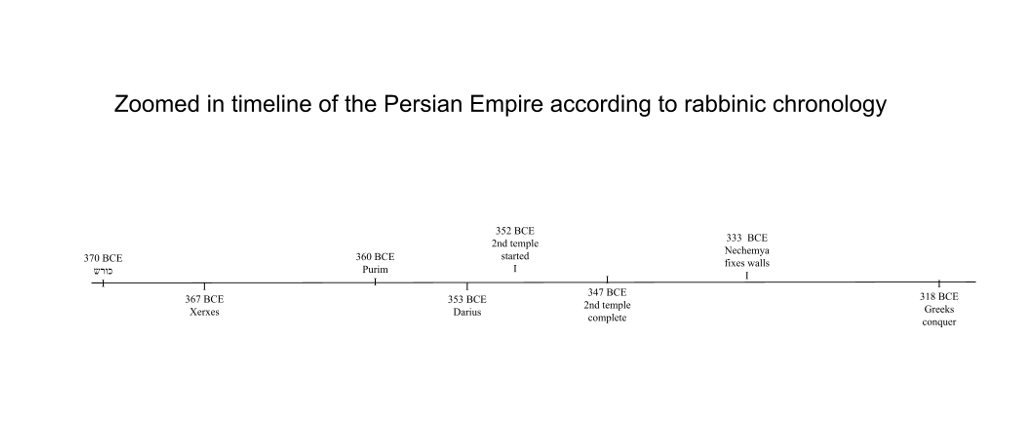
By contrast, the rabbinic chronology, anchored in the tradition that the Second Temple stood 420 years, compresses the Persian period dramatically to roughly 52 years. They therefore must conflate several monarchs and place Achashverosh earlier in the sequence. According to the rabbinic tradition, Darius was the son of Achashverosh.
A visual depiction of this debated timeline can be seen at the end of this essay.
This historical debate is an interesting topic in its own right, but for our purposes, the debate has a crucial ramification for the book of Esther. It is explicit in the book of Ezra that the 2nd Temple was built during the reign of Darius and was completed in the 6th year of his reign (Ezra 6:15). Therefore, according to the rabbinic tradition, the Purim story occurred immediately prior to the building of the second Temple. However, according to most historians Achashverosh follows Darius, and the Megillah unfolds decades after the Temple’s completion.
If the struggle to restore the Temple is a hidden undercurrent of the book of Esther according to Lehmann’s thesis, the historians’ chronology brings the Temple to the fore. Lehmann’s central thesis can work with either chronology. The more consequential point is thematic: if the historians are correct, then Esther is not merely about the politics of building the Temple. It is also about the tragedy of having a standing Temple and still living as though it were peripheral. Under the compressed rabbinic timeline, the Jews of Shushan might be portrayed as living in the aftermath of destruction, with the Temple not yet rebuilt. Under the longer chronology, the Jews of Shushan are portrayed as living in the shadow of a rebuilt Mikdash and yet acting as though Shushan is home.
- The book of Esther as a satire on the Persian Jewish community
With this in mind, several passages in the book of Esther that pertain to the city Shushan, and the King’s palace more specifically, take on new meaning. Each contains descriptors that traditionally referred to the Temple or the Tabernacle, but have now been conspicuously replaced by Achashverosh’s palace[5].
A. Achashverosh made a 180-day celebration (Esther 1:4) followed by a 7-day party (Esther 1:5) for the residents of Shushan. The Tabernacle in the desert took 6 months (180 days) to build (Midrash Tanchuma, Pekudei 11), after which there were 7 days of ordination (Leviticus 8:33). The text even uses the same root word “maleh” to describe the transition from Achashverosh’s 180-day party to his 7-day one as the Torah uses to describe the 7 days of “miluim” (ordination).
B. In describing the King’s palace the lavash materials listed include white cotton, blue wool, fine linen, purple wool, silver rods, and others (Esther 1:6). Similar materials, including fine linen and blue wool, are used to describe the Tabernacle (Exodus 27:16).
C. The Megillah describes Shushan not just as a capital but as “Shushan ha-birah”, a term that in Tanakh is also used to describe the Temple (I Chronicles 29:1; 29:19; Nehemiah 2:8)
D. The procedure around entering the King’s private chambers echoes the entry of the high priest into the holy of holies (Leviticus 16:1-3; 16:12-14). Anyone who enters the king’s “inner court” without summons is put to death unless the king extends his scepter (Esther 4:11). In other words, there is a strict procedure required to enter both the holy of holies and the King’s private chamber. Deviation from either protocol results in death.
E. As Esther comes to meet Achashverosh the text (Esther 5:1) describes the layout of the palace with an outer courtyard and an inner courtyard, each requiring more stringent permissions to enter as one approaches the innermost chamber. This is reminiscent of the Temple’s layout as well, with its azarah, the heychal, and the holy of holies.
If the megillah occurs decades after the Temple’s completion, contemporary scholars such as R’ Menachem Leibtag[6] are inclined to read Esther as satire and castigation of the Shushan Jews for choosing the Persian capital over Jerusalem. The point is not merely literary cleverness. The point is theological satire: Persian Jewry has arranged its life around the palace as though it were the Mikdash. The hidden message of the book of Esther is that the Jewish community in Persia has replaced God’s Temple with Achashverosh’s palace, and Jerusalem with Shushan. The Jews’ vulnerability is intertwined with their comfort. The crisis arises not only because enemies exist, but because life in exile has become sufficiently pleasurable that Jerusalem can be forgotten. The Megillah is not merely about survival under threat; it is about what kind of life produces the threat in the first place, and what kind of life is implicitly demanded afterward.
- The Convergence Towards the Temple as the Multilayered Theme of the Book of Esther
At this point the strands can be braided into a single argument: Megillat Esther is a Temple book because it narrates both (a) the political struggle against forces seeking to weaken Judea’s restoration and (b) the spiritual struggle against a Jewish community that has grown comfortable in a world where the Mikdash can be treated as peripheral.
The first strand is illuminated by Lehmann’s central insight: Mordechai and Haman are not merely political rivals who met in the Persian court but adversaries primarily fighting over the future of the Judean province and its Temple. Haman’s obsession, the lexical bridge from Ezra’s “tzarei Yehuda u’Binyamin” to Esther’s “tzorer ha-Yehudim”, and the explicit Yalkut Shimoni that frames them as rival advocates regarding rebuilding, together suggest that the Purim story is embedded in the same historical-political world as Ezra, Nehemiah, Hagai and Zechariya.
The second strand becomes far sharper once the chronology of the historians is embraced. If Achashverosh follows Darius, the Megillah occurs decades after the Second Temple is built. In that setting, the satirical critique of Persian Jewry becomes not an ancillary theme but a conceptual key. The Jews of Shushan are not merely living in exile because they must; they are living there even though a Temple stands, even though prophets have pleaded for return, even though Jerusalem requires human investment to realize its potential. The Temple is not merely a hope. It is a living center that demands support: financial, demographic, political, and spiritual. Yet the Persian Jewish community can throw lavish feasts, circulate within imperial prestige, and treat the palace as their sacred center. Thus, the book of Esther also contains the same religious message as the books of Ezra, Nehemiah, Hagai and Zecharya.
Taken together, they reclassify Esther as perhaps the most Temple-saturated text of its period, precisely because it portrays a Jewish world in which the Temple has been functionally replaced. Lehmann’s reconstruction shows how Purim participates in the Judean struggle against external obstructionists. The historians’ chronology allows the Megillah to deliver a second message simultaneously: even after the Temple stands, the primary obstacle to redemption may be internal: complacency, comfort, and the ease with which Jews can acclimate to exile.
The two strands converge around the opening banquet. Lehmann argued that participation in the banquet is “collaboration” with a regime that agreed to obstruct and delay the Temple project. The veiled references to the Temple frame the banquet, and the entire megillah as an encoded rebuke of the Jewish preference for Shushan over Jerusalem and their willingness to celebrate in the palace rather than orient their joy toward the Mikdash.
This convergence also allows certain rabbinic lines to be reread with new clarity. The Gemara’s claim (Megillah 11b-12a) that Achashverosh used the Temple’s vessels at the banquet can be understood in this light. Whether the Temple’s vessels were actually used or not is less important than the message that attendance at the banquet was a betrayal of the Judean cause both in terms of political advocacy and in terms of spiritual priority.
Conclusion
On one level, Esther tells of external danger and miraculous reversal. On another level, it offers a window into the political reality of the early second Temple era. With Judea as a Persian province, the lack of complete autonomy and self-determination means that sometimes the success and future of Judea and its Temple may depend on political advocacy in Shushan.
Under this reading, Mordechai arrives in Shushan as a Judean advocate in a time when the Temple exists but lacks security and splendor. He confronts Haman, the obstructionist with deep roots in the anti-Judean coalition, and through providence and political skill he rises beyond anything he could have planned. Mordechai’s political ascent is not merely personal vindication; it is the establishment of Judean leverage within the imperial system. This may not have led to the completion of the mission during Achashverosh’s reign, but it bore fruit in the longer term when the mission reached fulfillment under Artaxerxes, Achashverosh’s son who allowed the Temple project to be brought to completion under the auspices of Ezra and Nehemiah (Nehemiah 2:5-8).
Additionally, it offers a rebuke to a people with a rebuilt Temple who nonetheless find themselves drawn to Shushan more than to Jerusalem. Perhaps the end of the book, with its focus on Jewish brotherhood throughout all the provinces of the Persian empire, offers a temporary solution to the misplaced focus of the community of Shushan and their insufficient attention to their brethren in Judea. Ultimately though, this latter issue is one that recurred and continues to recur throughout Jewish history.
In that sense, Esther fits perfectly into Second Temple literature. Like Chaggai and Zechariah, it is concerned with the unrealized potential of the restored community and rebuilding and fortification of the Temple. Like Ezra-Nehemiah, it is concerned with imperial politics and the vulnerability of the Judean project to hostile forces. Like all four of these books, it is written in opposition to the spiritual and political complacency of the community both in Judea and in the diaspora. But unlike those books, Esther is written for an audience that may no longer respond to direct prophetic rebuke. It therefore adopts the tools of irony and satire, crafting a narrative in which the palace is described with Temple-language so that the reader will feel the inversion, and in which the Jews’ festivities in Shushan become the subtle mirror-image of the worship that ought to have been central.
Lehmann’s reconstruction demonstrates that behind Haman’s decree stands a struggle over Judea, with Mordechai and Haman emerging as figures whose enmity predates their encounter near the palace. Leibtag’s reading demonstrates that behind the Megillah’s lavish palace scenes stands a critique: Persian Jewry has “replaced the bet ha-mikdash with the palace of Achashverosh.” The Megillah’s prophetic message is delivered by forcing the reader to notice that these readings render Megillat Esther no less Temple-centered than the other Biblical works of its era. In the end, Esther is not the exception to Second Temple literature. Instead, it is the diaspora mirror of it: a Temple story told from outside the land, exposing the spiritual danger of living as though the palace has replaced the Mikdash. And the holiday it births becomes, in this framework, not only a celebration of survival, but a yearly confrontation with misplaced centers. It serves as an invitation to reorient Jewish joy, Jewish loyalty, and Jewish future back toward Jerusalem and the rebuilding project that defines the era.
[1] Daniel also takes place in the diaspora, but as the book of Daniel primarily takes place during the Bablyonian exile and stretches into the early years of the Persian empire, prior to the rebuilding of the Temple, I do not include it as Second Temple literature.
[2] Lehmann, Manfred, A Reconstruction of the Purim Story, Tradition, Vol 12, 1972, accessed here: https://traditiononline.org/a-reconstruction-of-the-purim-story/
[3] This was noted by Hazal as well, who proposed a different backstory for the two characters in Tractate Megillah 15a-b, with Haman as the former slave of Mordechai.
[4] In my opinion the most succinct, accessible and relevant summary of this debate can be found here https://etzion.org.il/en/tanakh/ketuvim/sefer-ezra/kings-persia-and-missing-years
[5] Much of this section is an adaptation of an influential essay by R’ Menachem Leibtag found here: https://tanach.org/special/purim.txt, as well as R’ Yitzchak Etshalom’s lecture series on Megillat Esther found on YUTorah.
[6] Ibid





 Site Operations and Technology by The Berman Consulting Group.