

Rabbi Jonathan Sacks, Z”L, noted many times that Judaism, traditionally, was not a visual culture. The Shema — which he translated as ‘Listen’ rather than the usual ‘Hear’ — reflects that ‘Judaism is the supreme example of a culture not of the eye but of the ear.”[1] The primary value of the Revelation at Sinai was not the visual experience, but that it created the start of a process of transmission of Torah: we listen, we learn, we understand. Rabbi Sacks roots this in the idea that Judaism is a “person-centred civilisation — and persons communicate by words, language, speech, what we hear rather than see… God created the world with words (‘And God said… and there was’) and His greatest gift is Torah, His word to humankind.”
Words — readings, recitals, discussions — are perhaps the key to the Pesach experience. The Seder is the axis from which everything else emerges: an evening of storytelling, of oral transmission of national, communal and family memory: “all who expand (or expound) in the telling of the story of Yetzias Mitzrayim — they are praiseworthy[2]….”. Some of the mitzvot are ‘cheftza’ — object-oriented: eating matzah, drinking the four cups — but many are duties incumbent on the gavra – a personal responsibility to expand orally the key ideas of the evening: Hallel, publicising the miracle, as well as the meta-themes of faith, Providence and history.
The Haggadah was a notable exception to this heavy emphasis on oral transmission. As discussed in studies such as Adam Cohen’s Signs and Wonders, “No book in Jewish history has been illustrated more often than the Haggadah.”[3] Many of my childhood memories of the Seder are based around our old illustrated Haggadot, debating who at the table most resembled which of the various illustrations of the four children, or drowning the Egyptians in the moveable sea in the pop-up Haggada from my parents’ childhood. I was genuinely disturbed by Gadi Pollak’s depiction of Jewish suffering in his Haggadah[4], just as I found his double-spread of the splitting of the sea inspiring. Koren’s Graphic Novel Haggadah — a collaboration between Israeli artist Erez Zadok and Batman illustrator Jordan B. Gorfinkel — is another example of how we can be taken on a visual journey through the Seder to create an experience that goes beyond the text. These highly visual Haggadot — mixing midrash, medieval and modern commentary, and artistic interpretation — form part of the blend of many of our Seder experiences. Far from being a distraction from terse divrei Torah, these images form the basis for discussion, a mirror for self-reflection, and part of the giddy exhilaration of the blend of food, family, wine and exhaustion that the Seder entails.
Rabbi Joshua Berman, professor of Bible at Bar-Ilan University, has written extensively on how deepening our understanding of the ancient world in which the Bible emerged can profoundly enrich Torah study. His central thesis is that the Torah presents itself as a sustained protest against the great empires of the ancient Near East — and in particular against the Egypt of the Pharaohs. Without a keen sense of that broader historical context, alongside sensitivity to its finer cultural and literary details, we risk missing both the Torah’s grand themes — freedom, egalitarianism, covenantal responsibility — and its more subtle narrative strategies.
Such an approach is not without precedent. Berman invokes Rambam’s extended discussion in Guide for the Perplexed (3:49), where he suggests that many rationales for the commandments remain opaque to us precisely because we lack sufficient knowledge of the ancient practices they sought to counter. “If we knew all of the particulars of Sabean worship… we would clearly see the reason and wisdom in every detail of the sacrificial service… the object of which I am unable to state.” Historical distance, in other words, can dull theological clarity.
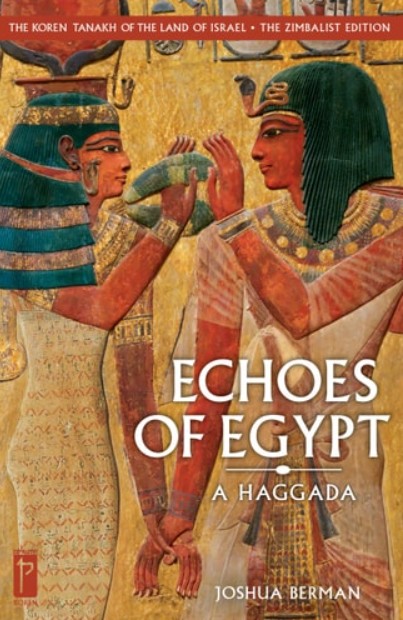
It is against this backdrop that Echoes of Egypt emerges. Berman brings his expertise in Biblical history and Egyptology to the Haggadah not merely as commentary, but as visual argument. Each page pairs a phrase from the Haggadah with images drawn from Egyptian art, architecture, sarcophagi, maps, hieroglyphs and stylised reconstructions, accompanied by a concise and accessible reflection. The result is a visual tapestry that allows the familiar words of the Haggadah to be heard against their ancient imperial setting.
Primarily designed for use at the Seder table, the layout is spacious and inviting. The comments are brief enough to be shared without disrupting the evening’s flow, yet substantive enough to provoke discussion. The images are large and clear, easily visible to those around the table. Far from competing with the text, they sharpen it — restoring the world against which those words first sounded.
To balance the brevity of the comments inside the body of the Haggadah, there are two longer essays that serve as introductions to the underlying premises. The first is more thematic: key elements of the Torah’s egalitarianism are a protest against what was perceived to be the natural order. “Although the account of the revelation at Sinai is usually conceived in religious terms, its political implications are no less dramatic. Elsewhere, the gods allegedly communicated only to the kings and had no interest in the masses. At Sinai, God spoke to the entire people, without delineating any role whatsoever for kings and their entourage. In light of archaeological findings now available to us, we can now grasp how the Sinai narrative transformed the entire people of Israel into a collective of king-like individuals.” Details such as the Revelation at Sinai insisting on direct communication with the people, the reiteration of the Sinai covenant in different forms, and the script being kept in the possession of every person as well as the king, all form a narrative aimed at upending assumptions about social order, responsibility of leadership, and God’s concern for the poor and weak of society as much as the privileged and mighty.
Some of these may be more well known: Berman contrasts the colossal temple at Abu Simbel (p.56) with the concluding line of Dayenu: “Had He brought us to the land of Israel without building for us the House that He chose…” Four 65-foot statues of Ramesses II “are far more than mere monumental tributes to the king who commissioned the temple’s construction… the depictions of the king communing with the gods take centre stage…”. Rather than celebrating a bond between god and monarch, the temple envisioned by the Torah embodies a covenant between God and Israel. As articulated in Exodus 25:8, the focus shifts from individual rulership to Divine Presence among the people as a whole.
Other ideas may be less well known. Reflecting on the phrase in Nishmat, “the spirit and soul You breathed into our nostrils” (110), he refers to the Egyptian mythology of creation, in which the divine potter Khnum shaped the body of humans and Heket, the frog-headed goddess of fertility, imbued the form with breath. By contrast, the Torah emphasizes that God alone both formed us and breathed into us the breath of life; “God is both the artisan and the life-giver”.
Whilst the first introduction is more thematic, the second is predicated on the belief that the Torah can be best understood with knowledge of its contemporary context, and that an appreciation of the commonalities and contrasts helps bring out further depth in the Torah’s words. The construction and operation of the Mishkan take centre stage in the Torah, with much of Shemot, Vayikra and Bemidbar describing its construction, operation and movement alongside the Israelite encampment. It turns out that the Mishkan compound very closely resembles illustrations of the camp of Ramesses II in reliefs of the Battle of Kadesh: the proportions of the split between the inner and outer sanctuaries and the outer courtyards show a striking resemblance. However, whilst the inner chamber of the Egyptian camp is reserved for Pharaoh, the Mishkan places the key vessels of the Divine Presence at centre stage.
Other comments focus more closely on historical facts that reflect details of the Haggadah or the Seder, including depictions of offerings of romaine lettuce in Egyptian tradition (8), and the earliest documented observance of Pesach, found in a letter from fifth-century BCE Elephantine Island, requesting matza for the Jewish community (63).
Any Haggadah organised around a single thematic lens faces a structural challenge: the Haggadah is itself a composite text, spanning Torah, rabbinic midrash, medieval piyyut and later custom. Not every passage lends itself equally to an Egyptological frame. As a result, some early sections receive relatively brief treatment, and certain themes — such as the plagues — might have supported more extended historical exploration.
One occasionally wishes for greater elaboration: the Torah’s seven-day week and Shabbat are discussed, yet the Egyptian ten-day week goes unexplored; a fuller treatment of bread culture in Egypt might have sharpened the contrast with matzah. Whilst there are some occasional departures from Egyptology, such as the occasional ‘traditional’ devar Torah (e.g. the history behind the words of ‘Sh’foch Chamatcha’, 91), I am sure that Berman has much to say about other time periods covered by the text of the Haggada. After all, the authors of the various strata of material — from Mishnah, midrash, or piyyut — worked with their understanding of Egypt based largely on tradition or the Biblical text, and there is surely much to say about the world in which they lived that would further enlighten us. However, these are questions of expansion rather than objection.
The most challenging phrase of the Seder is that “a person is obligated to see himself as though he personally left Egypt.” We can never truly grasp what decades of intensive slavery meant so many years ago; the granular human experiences of those individuals have largely been lost to time. Berman’s Haggadah, by presenting the apex of Egyptian civilisation — its grandiose building projects, its perverse theologies and political philosophies that demanded the subjugation of Benei Yisrael and others — renders this mandate more achievable. It makes the command not merely rhetorical but experiential: easier to envision, more palpable, and more immediate.
[1] https://rabbisacks.org/covenant-conversation/vaetchanan/listen-o-israel/
[2] Haggadah
[3] As reported at https://www.utoronto.ca/news/700-years-passover-haggada
[4] Gadi Pollack, The Katz Passover Haggadah: The Art of Faith and Redemption



 Site Operations and Technology by The Berman Consulting Group.