

Asher Oser
In contemporary Orthodox life, modesty has become one of the most visible markers of religious observance. For married women, and to a lesser extent for men, hair covering—and even the style of that covering—serves as an index of religious commitment. The communal logic, if somewhat crude, is that the more comprehensive the covering, the greater the piety. Other dimensions of religious life, such as what one eats and how one spends leisure time, can remain largely private, even invisible. Modesty, by contrast, is broadcast.
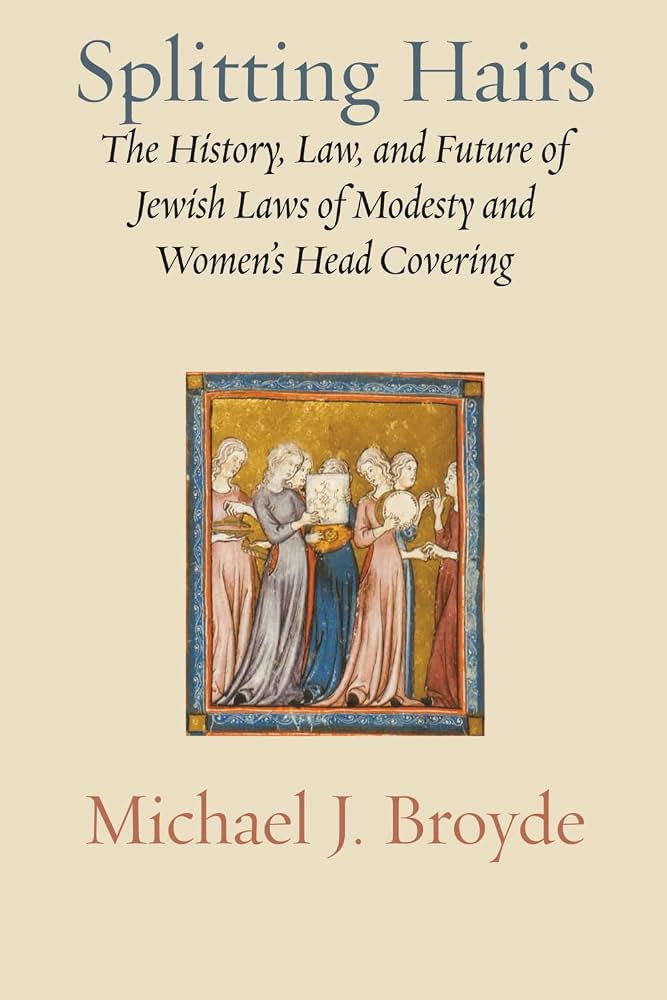
Splitting Hairs is a bold, well-researched, and paradoxical book. It is bold because it argues, against the grain of much contemporary Orthodox practice, that the laws of modesty are not fixed but contingent on time and place. It is learned because it marshals an impressive array of sources—biblical, Talmudic, medieval, and modern—in support of that argument. And it is paradoxical because, after hundreds of pages of sustained halakhic argument, the author concludes that his own analysis should not be adopted in practice. The result is a work that rewards careful reading while leaving the reader with reservations about its textual methodology and the extraordinary gap between its theoretical conclusions and its practical advice.
Several recent works on modesty cautiously acknowledge that not all of a married woman’s hair must be covered—even as they are quick to pronounce that this view is not universally understood or accepted—and that regardless of one’s position, the subject calls for great sensitivity. Rabbi Manning, in the book on tzniut he coauthored with Bracha Poliakoff, writes:
I have been asked many times concerning women in different communities who clearly uncover more than a square tefach of hair, whether there is any basis for this. First, head/hair covering is a complex halachic topic, and men or women who are in doubt as to the halachic boundaries must be prepared to ask a sh’eilah to their rav or posek, just as they should on any other halachic issue. What people wear on their heads is very visible, but whether a sh’eilah has indeed been asked is much less obvious. It goes without saying that no one may ever judge a woman negatively if she appears to be uncovering more hair than permitted, neither can we assume that person asked a she’eilah and is acting halachically correctly, having asked a sh’eilah.[1]
Compared to other treatments of this topic, Rabbi Manning’s formulation is subdued. Other writers tend to present the obligation as fixed and unambiguous, only allowing debate over technicalities such as which coverings suffice and whether the requirement extends into the home.[2] Against this backdrop, Rabbi Broyde’s thesis introduces a destabilizing question: If Halakhah is, in principle, immutable, and if the categories of prohibited labor on Shabbat, for example, remain constant across time, why should the laws of modesty prove sensitive to shifting social norms?
Rabbi Broyde approaches the problem with the authority of a legal scholar and a seasoned halakhist. A professor of law at Emory University and former dayan on the Beth Din of America, he writes with both analytical rigor and pastoral awareness, qualities that lend the book its distinctive tone. Splitting Hairs, which he describes as both “new, yet old,” gathers years of prior scholarship into a single, sustained argument.[3] It is a broad survey of material, from biblical texts through contemporary responsa, and also advances a distinctive conceptual account of how the laws of modesty operate. At the same time, the historical record will show that Rabbi Broyde’s later career has been shadowed by controversy; his decision to address the topic of hair covering has neither lessened that controversy nor benefited from it.[4]
Rabbi Broyde’s central claim is not that unrelenting societal pressure has abrogated the laws of modesty. Rather, he argues that from the outset, these laws are designed to be flexible. Prevailing norms and lived practices form the very fabric of these laws. This is not a reluctant concession to modernity but a reclassification of the category: modesty, in this account, operates according to a distinct jurisprudence.
The idea that these laws are formed around existing social norms is not new. In one place, Rabbi Broyde turns for support to the eighteenth-century Galician authority Rabbi Yehoshua Heschel Babad (the grandfather of the author of the Minhat Hinukh), who observes that Tur, in his discussion of modesty, repeatedly uses the term darkah/darkan, meaning the way women actually conduct themselves. Whereas Halakhah usually lays out an abstract route that must be taken, the laws of modesty are an evolving path that unfolds through the lived practices of Jewish women and men. In that sense, modesty is not imposed on its practitioners but defined through them.[5]
What Rabbi Broyde does not address, and does not seem to want to address, is this: If, in practice, the conduct of Jewish women and men were to become so egregious that any meaningful sense of modesty effectively disappeared, would the halakhic obligations of modesty fall by the wayside? In his opening overview, Rabbi Broyde sidesteps this question:
…the basic thrust of this book is the argument that if one defines modesty in a non-circular way (modest people are people who are committed to confining sexuality to marriage), then many, many Jewish law authorities—Talmudic, Geonic, medieval, and even modern—are inclined to rule that one needs to look at the community that seeks to confine sexuality to marriage and dress that way without a need to provide detailed and objective descriptions of rules of modesty.[6]
This question is not merely theoretical. The corollary of Rabbi Broyde’s definition is that a community where people do not confine sexual activity to marriage is precisely one that stands in need of “detailed and objective descriptions of rules of modesty.” That the book does not immediately grapple with this question is enough to put the critical reader on guard.
A classical source for the requirement that a married woman cover her hair is the ritual of the sotah, the suspected adulteress. In that ceremony, a woman whose husband questioned her fidelity was brought before the priest in the Temple, and he carried out a set sequence meant to test his suspicions. Among these acts was the command that the priest uncover the woman’s head. Rashi cites this as evidence that Jewish women have long regarded an uncovered head as degrading.[7] Rabbi Broyde, however, draws attention to the following baraita:
[The sotah] covered her hair with beautiful ribbons; therefore, the priest removes the covering from her hair… She coiffed her hair [for her illicit lover]; therefore, the [priest] undoes her hair.[8]
The baraita portrays the priest’s actions as a measure of poetic justice. According to Rabbi Broyde’s reading, the spotlight falls on the woman’s adorned and carefully styled appearance, not on the exposure of her hair. If, as Rashi suggests, uncovering her hair was degrading in itself, one would expect the baraita to highlight the fact that the woman had previously exposed her hair. The baraita’s focus on ribbons and coiffure indicates instead that uncovered hair is unremarkable, implying that it is not, in and of itself, problematic.
A flaw in this reading is that the phrase “beautiful ribbons” can just as easily be taken to describe an ornate head covering rather than exposed hair decorated with ribbons, and “she coiffed her hair for him” can likewise be understood as referring to grooming done in private. On this understanding, the baraita accords neatly with stricter standards: the problem lies in cultivating a seductive appearance even while the hair remains covered. Indeed, proponents of more exacting norms invoke this passage to argue that a head covering on its own does not suffice; its style must also be restrained, and any eye-catching display, even when the hair is covered, is to be avoided. Rabbi Broyde’s interpretation is defensible, but it is by no means the only tenable one.[9]
In other places, Rabbi Broyde’s readings are more difficult to sustain. Tur rules: “Jewish women may not go out with uncovered hair in the marketplace, whether unmarried (penuyah) or married” (Even Ha-Ezer 21:2). This formulation is straightforward, yet in practice the Orthodox community observes only part of it: married women cover their hair, while women who have never been married do not. The issue becomes more complex when we consider Tur’s treatment of hair covering in the context of reciting Shema:
…The hair of a woman which it is her way to cover—it is forbidden to recite [the Shema] before it. However, for virgins whose way it is to go with their hair undone, it is permitted. (Orah Hayyim 75:2)
Here Tur explicitly permits reciting Shema in the presence of never-married women (betulot) with uncovered hair, since it is “their way” to leave it loose. This sits uneasily alongside his ruling in Even Ha-Ezer, which categorically forbids unmarried women (penuyot) from appearing in the marketplace with uncovered hair. Rabbi Broyde resolves this tension by suggesting that Tur is addressing different communities in different sections—Sephardic custom in Even Ha-Ezer and Ashkenazic custom in the laws of Shema—with later codifiers (Shulhan Arukh, Rema, Levush) preserving the same pattern. This supports his thesis that the norms of modesty are shaped by local practice. On what basis, however, should one assume that Tur is silently shifting between communities across two sections of his code without any indication that he is doing so?
The two main commentators on Even Ha-Ezer, Beit Shmuel and Helkat Mehokek, offer a more plausible reading. They suggest that in Even Ha-Ezer the term penuyah does not mean “every unmarried woman” but specifically a woman who is currently single but was previously married—a widow or divorcee. On this reading, Tur’s two rulings are entirely consistent: the stricter prohibition applies to any woman who is or has been married, while the passage in Orah Hayyim permits uncovered hair only for those who have never been married at all.
Rabbi Broyde concedes that his reading runs against the standard commentators, yet he defends it on the grounds that Tur’s very next line (Even Ha-Ezer 21:3) uses penuyah to include women who have never married. To read the same term in two different ways within such a brief passage, he argues, “seems very unlikely.”
This argument, however, cuts both ways. Precisely because penuyot carries a narrower meaning in the first clause, Tur is compelled to explicitly broaden it in the second. If penuyot in the first clause already included every unmarried woman, no such clarification would be needed in the second clause. The fact that the explicit expansion appears only in the second clause strongly suggests that the definition in the first clause is the narrower one. The traditional commentators’ reading is at least as coherent as Rabbi Broyde’s and has the additional advantage of not requiring us to posit that Tur silently shifts between communities without notice.
It is hard to know whether Rabbi Broyde is consciously laboring to reach lenient conclusions or whether his readings, taken on their own terms, simply lead him there. In his 2010 exchange with Rabbi Eli Baruch Shulman, he describes the arguments he advances as a limmud zekhut for the many married Orthodox women who do not cover their hair.[10] When a posek offers a limmud zekhut, he will, almost by definition, lean on more lenient readings and opinions. How much leeway he allows himself is ultimately a matter of personal discretion, and here, one senses that the leeway is generous.
In one responsum, Hatam Sofer contends that the prohibition against committing the Oral Law to writing is suspended only when one is acting purely for the sake of Heaven and not when other motives intrude.[11] In his conclusion, Rabbi Broyde states candidly that he has three reasons for writing this work, and one of them amounts to a limmud zekhut. Hatam Sofer’s standard is therefore worth bearing in mind. To be sure, a limmud zekhut can be an act of religious devotion; but when it shapes the methodology of an entire work, a reader is entitled to ask whether the book’s conclusions would look different had the author not defined his goal as finding merit for existing lenient practice.
Readers hoping to find that one of his motives is to “turn back the clock” and reverse practices now widespread in many Orthodox communities will be disappointed. As the book draws to a close, a more nuanced position emerges: while he believes that communities adopting more lenient standards have a basis in Halakhah, he nevertheless maintains that embracing such leniencies is ill-advised.
The book’s afterword, titled “A Concluding Letter [to My Daughters] About This Book,” may be its most powerful section. In it, Rabbi Broyde addresses his daughters directly and explains why he counsels questioners not to act on his conclusions. He argues that a shared dress code for men and women serves as an anchor in a rudderless world. Earlier generations of observant Jews, he suggests, could still look outward and discern an ethic of modest restraint in the broader culture; such an aspiration is no longer realistic:
…with the onset of the sexual revolution, Modern Orthodoxy began to drift. This deprived the Modern Orthodox community of one of the pillars to validate its conduct on matters of modesty… if you define modesty in a non-circular way—modest people are people who are committed to confining sexuality to marriage—then halakha can easily say, “Look at the community that seeks to confine sexuality to marriage and dress that way.” Sadly enough, that community hardly exists in our modern American world, leaving us with little secular anchoring to validate our conduct…[12]
After hundreds of pages, and many years of labor, Rabbi Broyde ultimately concedes that, however confident he is in the correctness of his analysis, it fails pedagogically and should not be adopted. Despite telling his daughters that “nearly all of the rules related to tzniut that you both were taught in day school and yeshiva are wrong,”[13] he nevertheless insists that abandoning this framework would be unwise; on the contrary, “it is wiser to have some uniform rather than none.”[14]
This unexpected conclusion makes the book one of the more remarkable works of Halakhah to appear in recent years. Its framing as a letter to one’s daughters, published as an afterword, aligns with the longstanding tradition of responsa written le-halakhah ve-lo le-ma’aseh, intended for study rather than practical reliance. A reader may still ask whether a work of such originality might have been better served by following the example of Rabbi Shimon Sofer’s Hitorerut Teshuvah, which not only cautions readers in its introduction about the theoretical nature of its rulings but reiterates that warning on every page.
Even if one is dissatisfied with the book’s inconclusive afterword or takes issue with some of its readings, it remains a commendable and significant achievement. The sources are carefully assembled in one place, presented in historical sequence, and provided in the original Hebrew alongside an excellent English translation. For anyone who wishes to engage seriously with this area of Halakhah, it is an indispensable point of departure.
[1] Bracha Poliakoff and Rabbi Anthony Manning, Reclaiming Dignity: A Guide to Tzniut for Men and Women (Mosaica Press, 2023), 491–492. In his careful presentation of the laws of hair covering, Rabbi Manning implicitly pushes back against Rabbi Broyde’s thesis, without mentioning him by name, even in a footnote. Nevertheless, he includes Rabbi Broyde’s work on this topic in his bibliography. See Reclaiming Dignity, 572.
[2] For an example of this approach, see Rabbi Doniel Neustadt, “Married Women With Uncovered Hair, Weekly Halacha, Parshas Naso 5756, Torah.org, https://torah.org/torah-portion/weekly-halacha-5756-naso/.
[3] In Fall 2009, Rabbi Michael J. Broyde’s monograph, “Hair Covering and Jewish Law: Biblical and Objective (Dat Moshe) or Rabbinic and Subjective (Dat Yehudit)?,” was published as a special supplement to the Rabbinical Council of America’s journal Tradition: A Journal of Orthodox Jewish Thought, vol. 42, no. 3. This was followed by an exchange between Rabbi Eli Baruch Shulman and Rabbi Broyde in the Summer 2010 issue of Tradition (vol. 43, no. 2), in which Broyde’s article was described as containing a “rather startling thesis.”
[4] This review avoids the unfortunate episode that erupted some years ago and was closely tied to Rabbi Broyde and his interpretation of this topic. For those who are interested, the internet has a long memory.
[5] Splitting Hairs, 361.
[6] Ibid., xxxiii.
[9] Y. Zaidner, Tevorah Mi-Nashim (5779), 102.
[10] R. Shulman and R. Broyde, “Exchange: Hair Covering and Jewish Law: A Response,” 73.
[11] Hatam Sofer, Orah Hayyim 208.
[12] Splitting Hairs, 447–48.
[13] Ibid., 445.
[14] Ibid., 448.






 Site Operations and Technology by The Berman Consulting Group.