

Marina Zilbergerts
The Book of Jonah, read on Yom Kippur, Judaism’s Day of Atonement, is treated as the quintessential tale of repentance. But there is only one problem: Jonah himself never repents. Not really.
God tries everything. He summons Jonah, sends a tempest after him, and has a great fish swallow him. Jonah is affected, he is afflicted, and he ultimately complies. But that is only on the superficial level. Though he carries out his mission, his convictions, and his heart, do not ultimately change. By the end, Jonah remains bitter as before and continues to wish for death. His final words remain defiant: “I am right to be angry, even unto death” (Jonah 4:9).
But this is precisely the point. The reason we read the Book of Jonah on Yom Kippur is far more compelling than it would be if the book were a simple morality tale of repentance after punishment. We read it because it is precisely Jonah’s lack of repentance that reveals the power of human free choice. Theologically, the book shows that although God has power over all of nature, He refuses to wield that power over the human heart, making a radical case for human freedom.
A Conscientious Objection to Free Will
In the Midrash, Jonah is sometimes portrayed as a narrow nationalist who resents Nineveh because it is Israel’s political enemy and wishes to deny its inhabitants the possibility of repentance. Yet the book itself offers little evidence that Jonah harbors any personal or national animosity toward the city. His problem runs much deeper. What troubles Jonah is the way God governs the world.
Jonah finds the entire drama of human agency somewhat absurd: Since the transgression of Adam and Eve in the Garden of Eden, God Himself seems to have granted human beings the capacity to transgress His will; yet, at the same time, He wants to hold them accountable for it!
And if that is not perplexing enough, when human beings do transgress, God does not always seem eager to punish them. Instead, He sends prophets like Jonah to call them to repentance, and when they repent, He relents. But what is the sense in all this?
Why create free beings only to plead with them to use their freedom well? Why threaten judgment only to withdraw it later? The entire enterprise strikes Jonah as a farcical and terrifying cosmic game, and he wants no part in it.
And so, like Adam and Eve, Jonah tries to hide from God’s presence. Rather than travel to Nineveh, he boards a ship bound for Tarshish. When he discerns that he has not successfully avoided his assignment, and that God is endangering the whole ship as a result, he asks its sailors to cast him into the sea.
Jonah’s recurring death wish suggests a deep-seated exhaustion with life’s burden of freedom. Death, to him, represents an escape from its risks and uncertainties. And so he begs God repeatedly: “Take, I beseech You, my life from me, for it is better for me to die than to live” (Jonah 4:3; repeated in 4:8).
But what does Jonah really want?
Perhaps it might comfort him to rest, undisturbed, beneath the shade of his plant; to live in a quiet and beautiful world in which we are all robots.
Machines who do not have to make choices and fail.
Machines whose actions do not lead to the moral demise of an entire city.
Machines for whose sins God need not send a prophet to chastise them, and so inefficiently at that.
Above all, Jonah wants to escape the burden of being responsible for what becomes of himself and others. And we, modern readers, can sympathize with him, for the burdens of our personal and collective responsibility are terrifying indeed. Our lives and the world depend on it.
But what, then, does God want?
He wants Nineveh’s repentance, and that is no doubt the success story of this book. But God also wants Jonah’s. God wants Jonah to recognize the value of the human capacity for free choice. Yet He cannot compel Jonah to do so, for that would contradict the very freedom He wishes him to embrace.
And so, instead of granting Jonah’s wish for death, God subjects him to unrelenting irony.
It is only under great physical duress in the belly of the big fish that Jonah turns poet and offers one of the greatest expressions of prayer humanity has ever seen. Poetry is beautiful and moving, but it does not last. As soon as the crisis passes, he returns to his earlier conviction. Jonah remains untransformed in his distaste for the implications of freedom.
God then eases Jonah’s task. A journey that should have taken three days takes Jonah one day. Unlike Jeremiah and many of the other prophets, who endured humiliation, imprisonment, rejection, and danger, Jonah remains safe and respected. He utters only one short sentence: “Forty days more, and Nineveh shall be overthrown!” (Jonah 3:4) and, in an almost surreal fashion, the entire city springs to its feet. The inhabitants of Nineveh put on sackcloth, fast, and become new people almost overnight.
The literary quality of the narrative is undeniable. The pathetic fallacy of the storm, the summoning of the great fish and the anthropomorphization of the animals of Nineveh, who, like the humans, must fast, wear sackcloth, and cry out to God, and the use of symbolic numbers, such as the warning that in forty days the city will be overturnees ( echoing the forty days of Noah’s Flood), all suggest that the story is not a historic account but a parable about the human heart. Yet, ironically again, the lesson that we readers see is one that Jonah, its protagonist, does not wish to learn.
Witnessing Nineveh’s transformation, Jonah’s reaction seems to mirror the behavior of Cain in the language used to describe his anger. Cain “was greatly angered, and his face fell,”va-yichar le-Kayin me’od (Genesis 4:5); Jonah likewise falls into “great displeasure:” va-yichar lo (Jonah 4:1). God reinforces the parallel by asking both why they are angry (Genesis 4:6; Jonah 4:4) in an attempt to reach their inner world. The text never tells us precisely what passes through Jonah’s mind, but if we follow the logic of his protest, we can imagine it unfolding something like this:
If repentance is real, then agency must be real. If agency is real, responsibility is real. And if responsibility is real, then God will hold us accountable. But we human beings are too frail for such a calling. If even the greatest among us cannot sustain a life of perfect virtue, then the effort is futile. Life itself is futile. Death seems preferable to life because in death there is no responsibility.
We see here that Jonah is not a determinist; he is a conscientious objector to free will.
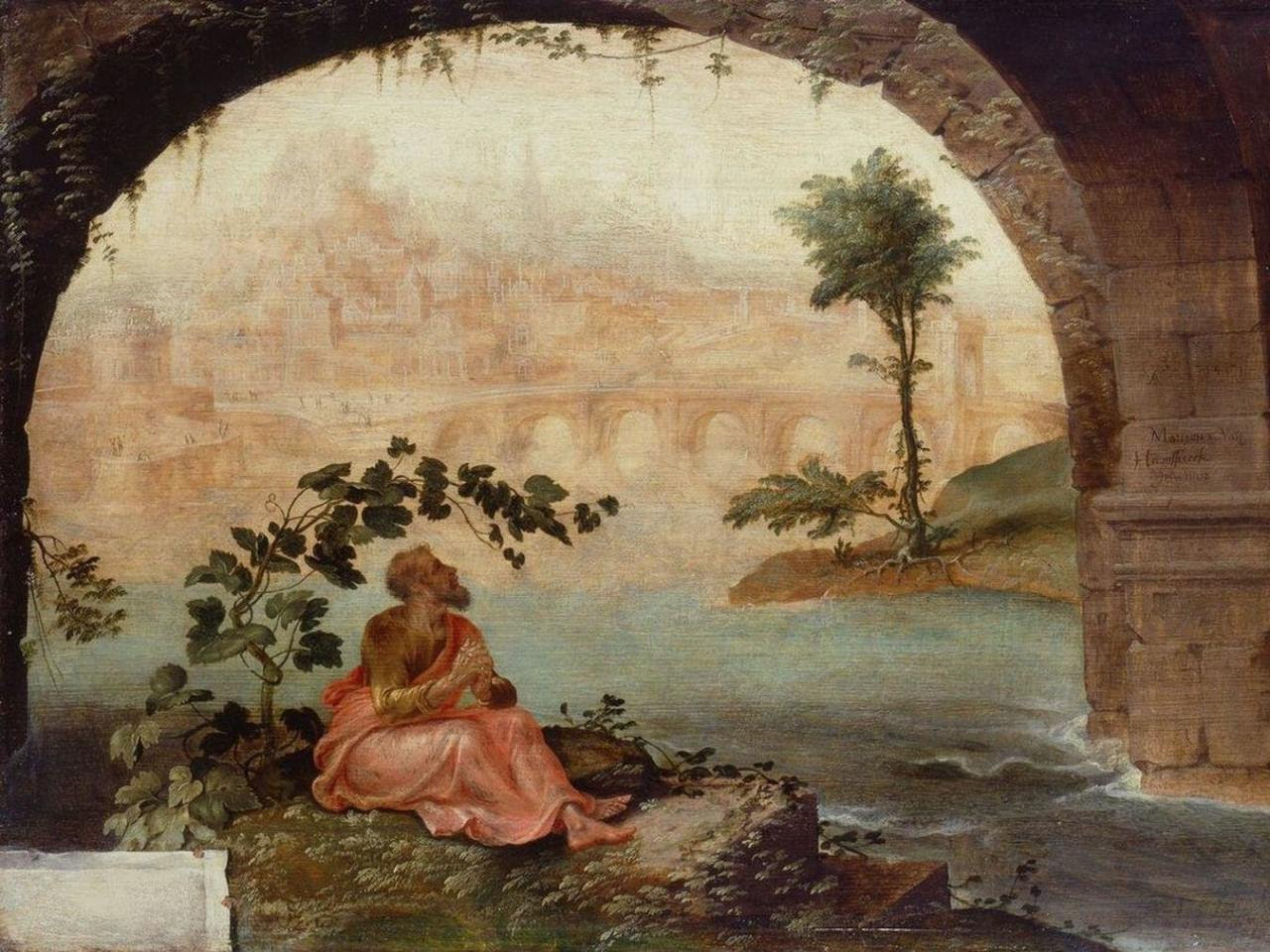
God enacts the final irony through the withering of Jonah’s plant, beneath whose shade Jonah had sought refuge from the blazing sun, a fitting symbol of God’s existential demands upon him and upon humanity at large. Bereft of its shelter, Jonah prays for death with even greater force. Yet God responds with a final revelation:
Then the Lord said: “You cared about the plant, which you did not work for and which you did not grow, which appeared overnight and perished overnight.
“And should not I care about Nineveh, that great city? – in which there are more than a hundred and twenty thousand persons who do not yet know their right hand from their left, and many beasts as well!” (Jonah 4:10–11)
In trying to reach Jonah’s inner world one last time, God lays His own inner world bare before him. He shares with Jonah His pity, His compassion, and even something of His tenderness. Compared to Jonah’s attachment to the plant, God’s investment in humanity is infinitely greater in both magnitude and meaning. God empathizes with humanity’s fallen condition and moral confusion. Yet despite these shortcomings, He remains willing to risk disappointment and failure for the possibility of the voluntary devotion of human beings.
The final irony is that the narrative ends without a resolution. We are never told whether Jonah accepts God’s lesson; Jonah does not get to record a response. The book offers no assurance that knowledge, suffering, or even a powerful spiritual experience will transform a person unless they want to change.
And that is what makes the Book of Jonah so compelling. God’s apparent failure to transform Jonah serves, for the readers, as the greatest endorsement of the reality and value of human agency: our power to transform ourselves, or to refuse transformation. Faith in that power is the prerequisite of repentance. And that is what we need to remember most on Yom Kippur.





 Site Operations and Technology by The Berman Consulting Group.