

Zoe Jick Fertik
The Jewish calendar consists of eight holidays which are, in fact, two sets of four holidays.
Organizing the holidays into these two groups reveals the underlying theological structure of the Jewish year. Once this structure is apparent, a person traveling through Jewish time will better understand the holidays’ intertwining themes and how a year of Jewish celebration creates a distinctly Jewish worldview.
Before I describe the two groups of four holidays each, let me concede that perhaps there are a few ways to group Jewish calendrical observances into categories. For example, one hears of the “High Holidays” of Rosh Hashanah and Yom Kippur. There are also the “pilgrimage holidays” of Sukkot, Pesach, and Shavuot. There are the “fast days,” including the major fasts of Tisha B’Av and Yom Kippur and the minor fasts of Tzom Gedaliah, Taanit Esther, and others. Other categories are available, too, and these groupings are helpful. In assembling the Jewish holidays into types, certain important aspects of a holiday are revealed. These aspects serve to distinguish particular categories of holiday from the rest of the yearly festivals, adding to any holiday group’s religious meaning.
Yet none of these tempting classifications provides a comprehensive analysis of the calendar’s structure as a whole. The fact that Sukkot, Pesach, and Shavuot were once agricultural pilgrimage holidays in the land of Israel does add to our understanding of these holidays’ origins and development, and can certainly provide layers of meaning to the holidays’ theological resonance. But it does not offer insight as to how these holidays fit into the calendar as a whole, and how each category of holidays relates to another whole category.
A different organization is needed; a complete classification of the entire annual holiday set can offer a new understanding of the Jewish calendar as a whole, and offer new insight into the experience of celebrating a full cycle of Jewish holidays year after year.
The eight annual holidays of the Jewish calendar are Rosh Hashanah, Yom Kippur, Sukkot[1], Chanukkah, Purim, Pesach, Shavuot, and Tisha B’Av. These are the eight holidays designated by Leviticus, by other books of Tanakh, or by other Second Temple literature. Any other holidays in the Jewish calendar are later additions.[2]
These eight holidays can be divided into two sets of four each. The first set of four holidays, which I’ll call the “Tishrei Movement,” begins at 1) Tisha B’Av, and then seven weeks later, is followed by three holidays in quick succession: 2) Rosh Hashanah, 3) Yom Kippur, and 4) Sukkot. The Tishrei movement lasts just shy of three months.
The second set of four holidays spans the remaining nine months of the year. These holidays are 1) Chanukkah, 2) Purim, 3) Pesach, and seven weeks later, 4) Shavuot.
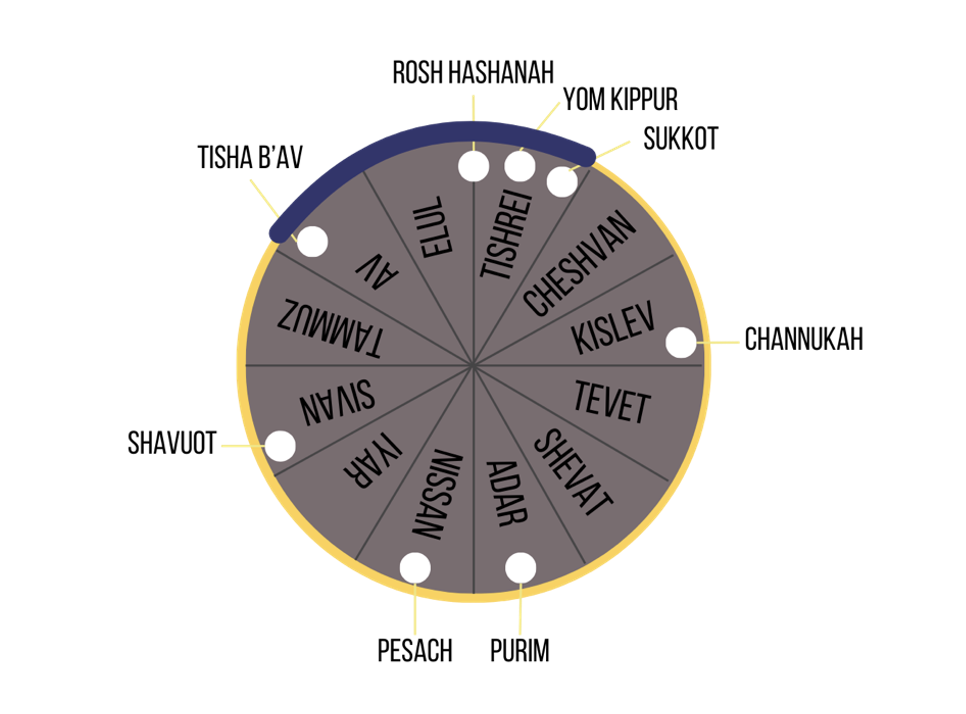
Let the parallelism of each holiday set containing a “7 weeks” serve as a hint: there is a purposeful symmetry to the Jewish year.
Each holiday in a set can be matched to a holiday in the other set. There are four perfect pairs between the two sets of four holidays. Rosh Hashanah matches Pesach; Yom Kippur matches Purim; Sukkot matches Chanukah; Tisha B’Av matches Shavuot. Each pair of holidays is matched in terms of theme, and sometimes also in terms of ritual.
Each pair of holidays is matched in order of when they occur. The holiday sets are continuous and uninterrupted by any holiday in the second set. Across each set, the holiday pairs do not refer to each other diagonally across time, but are matched in chronological order.
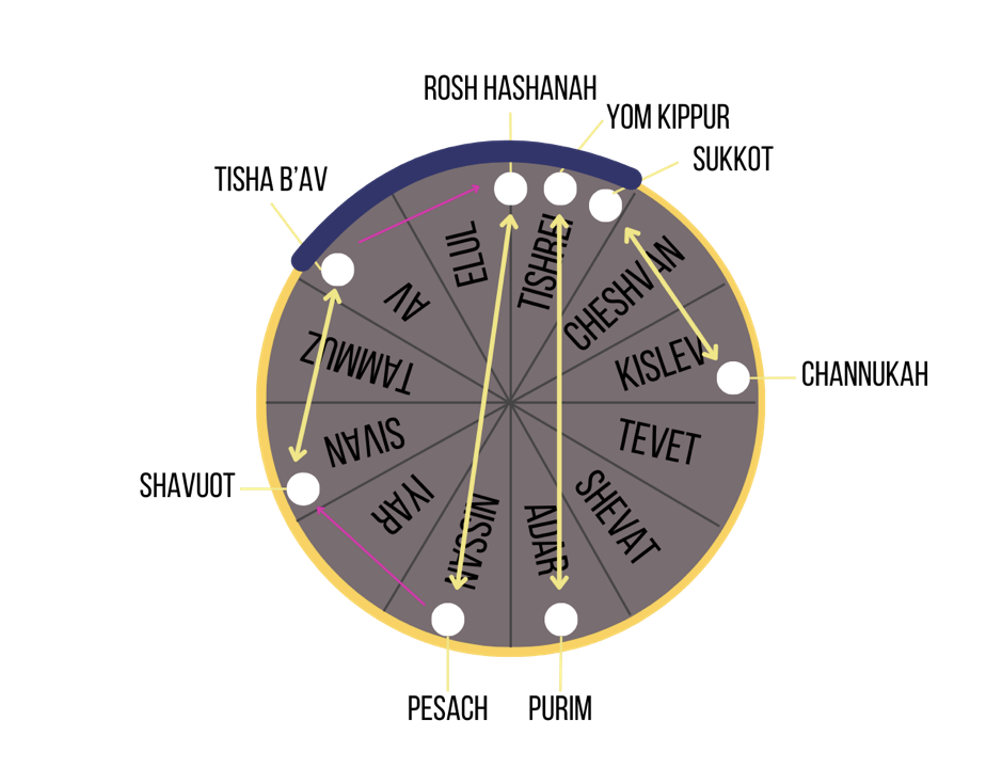
In this rendering, the blue line represents the Tishrei Movement, and the yellow line represents the rest of the year. The yellow arrows show the pairs between the two holiday sets. The pink line shows that each set contains a counting of seven weeks.
Once the calendar is visualized in this way, it is impossible not to see the purposeful organization of the Jewish year. The Jewish calendar is structured so that every holiday operates as a perfect mirror image to another holiday.
The question is: why?
***
To uncover the purpose of this mirrored structure of the Jewish year, I compare four sets of paired holidays: 1) Rosh Hashanah and Pesach; 2) Yom Kippur and Purim; 3) Sukkot and Chanukkah; and 4) Tisha B’Av and Shavuot. Comparing these holidays reveals how each pair operates around a shared theological question, and how the pairing offers two contrasting visions of some of religion’s most profound topics. These shared theological themes are often also accompanied by similar rituals between the two holidays.
- Rosh Hashanah // Pesach
Is Jewish time universal or particular?
Let’s start at the beginning.
Rosh Hashanah is the Jewish New Year. It is a celebration of creation, the birthday of the world and the beginning of all time. Its paired holiday is Pesach. Pesach commemorates the Exodus from Egypt, and celebrates the particular story of Jewish emancipation, freedom, and self-actualization. Pesach is also a holiday of new beginnings. Both holidays are commemorated through sequences of hands-on rituals performed in a special order.
The dates of the two holidays underscore their intrinsic relationship. While Rosh Hashanah is considered “the Jewish New Year,” it is, in fact, Pesach which occurs in the first month of the year. Pesach occurs in the month of Nissan, and Rosh Hashanah occurs in the month of Tishrei. Tishrei is the seventh month of the Jewish calendar, and it is curious that the Jewish New Year should happen on the first day of the seventh month of the year. (As opposed to, say, the first day of the first month, as the secular calendar does with January 1!)
Indeed, the first month of the Jewish year is the month of Nisan. The ordering of the months is stated clearly in the Torah: “The LORD said to Moses and Aaron in the land of Egypt: This month shall mark for you the beginning of the months; it shall be the first of the months of the year for you.”[3] This verse comes at the momentous occasion of the Jewish people standing at the precipice of the Exodus from Egypt.
In designating this particular day as the first day of the first month, there is a significant theological implication: the Exodus from Egypt is the beginning of Jewish time. This implication is so significant, in fact, that Rashi’s first comment to the first verse of the Torah raises this exact predicament. Rashi specifically asks:
| IN THE BEGINNING — Rabbi Isaac said: The Torah which is the Law book of Israel should have commenced with the verse (Exodus 12:2) “This month shall be unto you the first of the months” which is the first commandment given to Israel. |
Here, Rashi offers his own candidate for what could have been the Torah’s first verse: instead of beginning with the beginning of all time, the Torah could have started with the beginning of Jewish time. Wouldn’t the establishment of Jewish time be a better beginning for this book that is ostensibly for the Jews and about the Jews? Rashi imagines that the Torah could have started with the Exodus from Egypt instead of the creation of the world. In offering this alternate draft of the Torah’s first verse, Rashi points out two contrasting visions of how to understand the beginning of time. Creation emphasizes the beginning of all time, while Exodus accentuates the beginning of Jewish time. The holiday that celebrates the former is Rosh Hashanah, and the holiday that celebrates the latter is Pesach.
As such, Rosh Hashanah and Pesach are both New Year holidays.[4] They each celebrate a certain theological understanding of the beginning of time. The Pesach season marks the beginning of Jewish time, the first day of the first month of the Jewish calendar. Six months later, halfway through the year, situated in direct opposition, we have the first day of Tishrei, Rosh Hashanah, the remembrance of the moment when all time began.
The first of Nissan marks the beginning of Jewish time. It is in Nissan that we were freed from slavery, that we left Egypt, that we were free to be our own people. We started on the journey toward our own land. There we’d be able to establish our own culture. Our calendar and our sense of time would be a centerpiece of that culture. As Rashi’s comment astutely points out, Exodus 12:2 is not a descriptive statement; it is a mitzvah, a commandment, to begin marking time. The opportunity to be Jewish begins NOW, with the opportunity to observe mitzvot. Pesach is, in some sense, a celebration of this opportunity to be a people with mitzvot, the most particularly Jewish thing of all. This is what we are celebrating: the beginning of the time of mitzvot. The beginning of time for us was our first chance to behave in our particular way, the first day of becoming ourselves.
The first of Tishrei, on the other hand, marks the beginning of all time. There is evening and there is morning for everyone who lives under the sun. Days end and begin again; time moves forward for all life. Another year is infinitely added to the count. The Jews may have their own particular calendar cycle, but even so, the Jews also exist in universal time. We too were created along with everyone else. As Rashi’s opening comment on Genesis 1:1 goes on to say, our Torah begins with this story so that neither we nor anyone else ever forgets the origin of all existence. God created us all, all at once.
Rosh Hashanah and Pesach offer two opposing ways to understand Jewish existence. Either we are inherently part of a universal story, or we are inextricably part of a particular story that is ours alone. Jews live with both world views in tension.[5] Pesach celebrates our freedom and the beginning of our destiny as a nation of our own, but we can never take that special independence for granted. Seven months after Pesach, Jews face a yearly reminder that we come from the same place as everyone else.
And we will end up in the same place as everyone else, too. The book of life is now open – just in time for Yom Kippur.
2. Yom Kippur // Purim
Is fate determined by chance, or can we change our destinies?
The Yom Kippur and Purim pairing is the most explicit of the four holiday mirrors. Yom HaKippurim is often translated as “The Day of Atonement.” Articulated with a different – homiletical – emphasis, the holiday name can be rendered as Yom Ke-Purim: “The Day That is Like Purim.”
It might appear that no two Jewish holidays are more different than Yom Kippur and Purim. Yom Kippur is a solemn day; Purim is a day of rejoicing. Yom Kippur is marked by fasting; Purim by feasting. Yom Kippur is a day when sins are recited in a clearly organized list; Purim is a day when the distinction between good and evil is blurred. The two holidays are exact opposites.
In their opposition we find that the two holidays are each grappling with the same existential question: is destiny determined by chance or is it shaped by human action?
The Jewish story that is most obviously about chance versus human action is the Purim narrative found in The Book of Esther. In this story, Haman, advisor to the Persian king Ahasuerus, plots revenge against the Jewish people. Haman decides when the day of vengeance will fall by drawing purim – lots. The plan is set in motion by a game of chance. And yet, through the coordinated human action of Esther and Mordechai, nahafoch hu! – the opposite happened.[6] The improbable crescendo of the Purim story is that a destiny determined by lottery can indeed be overturned. Purim shows that these existential lotteries need not always be final.
On the other hand, Yom Kippur is the day when fates are sealed. The process of teshuva, repentance, that began on Rosh Hashanah reaches its dramatic conclusion on Yom Kippur as a person’s fate for the upcoming year is finalized. “On Rosh Hashanah it is written and on Yom Kippur it is sealed,” we recite in the U’Netaneh Tokef prayer. The day of reckoning is here:
| You open the Book of Remembrance and it reads itself; every man’s signature is in it. The great shofar is sounded, and a still, soft voice is heard; the angels tremble, fear and dread seize them, and they exclaim: the Day of Judgment is here!
-Unetaneh Tokef, from the High Holiday liturgy |
Yom Kippur’s rituals demonstrate the severity of what is at risk. There is no eating, no drinking, no life affirming actions. The decree is being decided and “sealed” during this fast, so this is the last moment to avert a bad fate.
These are the rituals familiar from today’s Yom Kippur, and they are obviously connected to the holiday’s big questions about a person’s ability to affect existential outcomes. But Yom Kippur’s biblical origins as described in the Torah make the connection even more plain. The biblical Yom Kippur was a day when atonement was made for the Jewish people by the high priest, not by the Jewish people on their own behalf.[7] The process by which expiation was made for the Jewish people by the high priest is laid out in detail in Leviticus 16. To summarize, the high priest chose two goats. He designated one goat for God, and one goat for “Azazel.” The goat for God was offered as a sin offering, whereas the goat for Azazel carried the people’s sins into the wilderness.
Which of the two goats was offered for expiation and which was sent to the wilderness was determined by drawing lots. The game of chance is played here too with existential consequences. Who will live and who will die? Both options are available.
Purim and Yom Kippur are both holidays that pay tribute to the fact that death is utterly possible, just awaiting its details. In the narratives of these holidays, the details would be determined through lots, purim. Fate is, on every level, out of our control. Paradoxically, even against the odds, both holidays offer hope. Yom Kippur offers a chance for atonement which will avert the bad decree. Purim remembers a time when the decree was indeed overturned. The Jewish people do, indeed, live.
Fate is out of our hands and yet there is always something that can be done to effect change. Both holidays put our vulnerability on full display because death can be drawn from the lottery. But indeed one must cope with this inherent vulnerability. The holidays offer hope that somehow, death still can be overturned. Yom Kippur and Purim demonstrate that fate is a game of chance, but at the same time, encourages the religious imperative to survive nonetheless.
3. Sukkot // Chanukkah
Can the House of God ever be permanent?
The first need of survival is the building of shelters. Shelters guard from the elements and defend against outsiders. These are the homes that protect people. At later stages of development, communities erect physical structures to buttress their social institutions and to showcase their stability. These are the homes that keep a people intact. With all of this charge built into their walls, houses are erected to be permanent. A house’s inevitable vulnerability is the foundational concern of both Sukkot and Chanukah.
Chanukkah celebrates the Hasmonean victory over the Seleucids in the 3rd century BCE. The Seleucid Greeks brought havoc upon Judaea, abolishing Jewish customs and defiling the most important Jewish place: “… [Antiochus] entered proudly into the sanctuary, and took away the golden altar, and the candlestick of light, and all the vessels thereof, And the table of the shewbread, and the pouring vessels, and the vials, and the censers of gold, and the veil, and the crown, and the golden ornaments that were before the temple, all which he pulled off.”[8] The Temple in Jerusalem was ravaged and ruined. Therefore, upon their victory, the Hasmoneans focused on restoring the Temple to its rightful state as the ever-lasting home of the Jewish people. They rededicated the Temple and proclaimed a new annual festival: Chanukkah.
On that first Chanukkah, a mighty celebration was had! Not only did the Hasmoneans declare a one-day festival but, in fact, Chanukkah would be celebrated as eight days of rejoicing. As we read in the Book of Maccabees: “They celebrated a festival to Hashem for eight days, just as the days of the Sukkot festival.”[9]
In creating their new holiday, the establishers of Chanukkah immediately embedded within Chanukkah a connection to Sukkot. The Midrash tells us that this connection was an effort to make up for some of the Greeks’ harshest assimilation efforts:
| According to a Midrash, the Greeks issued a decree forbidding the Jews to observe the Sukkot festival, and they were unable to bring the sacrificial offerings of Sukkot in the Beit Hamikdash. Hence, Hashem said, “You wanted to abolish the eight days of Sukkot; I will therefore give them an additional festive period of eight days — Chanukkah.”[10] |
While living under the Seleucid policies, The Jewish people had been forbidden from performing the sacrificial offerings of Sukkot. So, the midrash tells us, God provided a correction: not only would Sukkot return to the cycle of Jewish holidays, but there would also be an additional holiday added to mirror Sukkot and amplify Sukkot’s prominence.[11] Chanukkah is this extra eight-day festival.
When the Maccabees reclaimed the Temple, they made up for the Sukkot celebration that they had missed. The Book of Maccabees describes how the rededication of the Temple was celebrated in a manner reminiscent of what had been forced to be skipped. Into the Temple they brought Sukkot-like plants: “willows of the brook” and “branches of the palm.”[12] Chanukkah was a redo, a pseudo-Sukkot at the first opportune moment. The eight day festival of Chanukkah was indeed an eight-day festival of Sukkot – the full celebration of both Sukkot and Shmini Atzeret – performed in the rededicated Temple as the ultimate Sukkah.
And yet there’s a deep contradiction at play when the Hasmoneans reconsecrate the Temple modeled after a sukkah. For, of course, the main conceit of Sukkot is the building of temporary structures. The Sukkah is a tribute to the booths erected by the Jewish people immediately following their exodus from Egypt. These booths were the Israelites’ first dwelling places but certainly not their final ones! One can imagine that the act of mimicking a sukkah inside the newly rededicated Temple could have one of two very different implications. Either the celebration was an insistence that the Temple itself becomes the final permanent sukkah, or perhaps, the celebration is an admission that all houses are like a temporary sukkah. Even the Eternal House itself.
This powerful question, and indeed the entire connection between Chanukkah and Sukkot, has been muted over time. Without the Temple in Jerusalem still standing, the original relationship between Sukkot and Chanukkah becomes less plain. One does still find traces of the original connection between these two holidays in Rabbinic literature. For example, in the famous debate between the schools of Hillel and Shammai about how to light the holiday candles, Shammai argues that the candles should be lit in descending order to mirror the descending number of bull sacrifices offered on Sukkot. This is a fine idea, and yet it does not win. The tradition of lighting ascending amounts of candles does nothing to remind us of Sukkot’s themes amid today’s Chanukkah celebrations.
Yet the underlying religious concern remains. Jews long for a home base: a house, a synagogue, a Temple, a land. Sukkot and Chanukkah celebrate these home structures despite the fact that all our houses are inevitably vulnerable, temporary and ever-changing. A sukkah only stands for seven days, but tradition commands the sukkah to be beautified nonetheless. The Chanukkah candles are kindled to remember the rededication of the Temple even in a world without the Temple. It is all we can do in a world where shelters are temporary, and those that cannot be rebuilt need to be reimagined.
And so these two holidays prompt a challenging proposition: Which elements of our tradition need to be unrelated to place in order to last?
- Tisha B’Av // Shavuot
How do we experience nearness to God?
Tradition holds that both the First and the Second Temple were destroyed on the 9th of Av. The commemoration of these catastrophic destructions, as well as many other preceding and subsequent catastrophic events in Jewish history, is marked by the fast of Tisha B’Av. Tisha B’Av is a day of mourning. The Book of Lamentations, which depicts the destruction of the Temple, is recited yearly on this day. Chanted in a unique elegiac tune, the book’s words of sorrow pierce the ears of the congregation: “Zion’s roads are in mourning, Empty of festival pilgrims; All her gates are deserted. Her priests sigh, Her maidens are unhappy— She is utterly disconsolate!”[13]
With the destruction of the Temple, Jerusalem was emptied of “festival pilgrims.” There were three Biblical holidays which required pilgrimage to Jerusalem: Pesach, Sukkot and Shavuot. In the wake of the destruction of the Temple, these three holidays were forced to adopt new rituals and new narrative significance. No holiday went through this transformation more acutely or more famously than Shavuot.
Shavuot is originally described in the Torah as a holiday of the wheat harvest: “You shall bring from your settlements two loaves of bread as an elevation offering.”[14] Once it became impossible to “bring” anything to the Temple, Shavuot was at risk of losing its meaning. The biblical Shavuot was a festival which relied fully on place. A Judaism without place – without Jerusalem, without the Temple – is a Judaism which cannot uphold the rituals of Shavuot.
Therefore, in post-Temple Judaism, Shavuot was transformed. Shavuot became a holiday that celebrated the Revelation at Mount Sinai and the giving of the Torah. This reconfiguration was possible because of a creative adaptation of Shavuot’s date. Shavuot comes as the very next momentous occasion after Pesach and the Exodus from Egypt. Counting 7 weeks from Pesach, Shavuot’s timing was perfect. Instead of a pilgrimage festival based on the agricultural calendar and reliant on bringing offerings to Jerusalem, the updated Shavuot imagines a new form of religious worship centered on Torah. In so doing, Shavuot proposes that closeness to God does not rely on physical proximity at all.
Adapting Shavuot as a celebration of Revelation was not only calendrically convenient, but it was also theologically astute. In a world without Jerusalem and without the Temple, Jews had to imagine a religion that could be observed anywhere and whose center of worship could be portable. As opposed to the Temple, the Torah is not connected to any one place. The Midrash teaches that the Torah was given to the Israelites in the wilderness, instead of in the Land of Israel, intentionally:
|
וַ “The Lord spoke to Moses in the wilderness of Sinai” – it is, that anyone who does not render himself like a wilderness, accessible to all, is unable to acquire wisdom and the Torah. That is why it is stated: “In the wilderness of Sinai.” |
The Torah is revealed in the wilderness, in no place, in any place. One might have thought that Torah should be revealed in the Temple, or in Jerusalem, or in the Land of Israel, at least! But, in fact, the wilderness location comes to teach that wilderness is itself a metaphor for revelation. The giving of the Torah cannot occur in a defined place because one cannot receive its wisdom when there are any boundaries between oneself and revelation. Therefore, Torah can only be received in open space. Not only no Temple walls needed: no walls allowed at all.
Shavuot is an answer to the mourning of Tisha B’Av. In a world where the Temple is physically demolished, Judaism’s center became spiritual. In this way, a relationship to God can never be destroyed even when all the obvious mechanisms to reach God are torn down. The celebration of Revelation could not exist without Tisha B’Av, or at least, would not hold the same significance. Shavuot’s theological power relies on Tisha B’Av because the ritual prominence of Torah occurred in the wake of the destruction of the Temple.
The connection between these two holidays is woven into the fabric of Jewish practice. A few examples jump to mind. First, Shavuot is a metaphor for the marriage between God and the Jewish people. At every Jewish marriage, a glass is broken to commemorate the destruction of the Temple. This is to say: the revelation and the destruction are part and parcel of the same experience. One must never forget, even in joy, about the ever-present possibility of danger. Second, Tisha B’Av is the only holiday of the year where the study of Torah is forbidden. This too comes to teach about the inextricable qualities of revelation and destruction: the two experiences are so interlinked, that one must make special effort to disentangle them for the one day a year in order to fully simulate the devastation of Tisha B’Av.
These ritual connections are a bit dismal, but they do not symbolize despair only. There is a message of hope in this holiday pairing. The Jewish people received revelation at Mount Sinai in the middle of the Book of Exodus, chapters 19 and 20. The rest of the book of Exodus details the instructions for the building of the mishkan. The giving of Torah is directly related to the structure that the Jews are meant to erect. The mishkan is the original, transportable dwelling for God – a dwelling which eventually turns into the Beit HaMikdash in its fixed place in Jerusalem. If Tisha B’av tells the sad end of this house-building story, then perhaps one can understand that the permanent Beit HaMikdash has not yet been erected. Perhaps we are still in the Torah-giving moment of revelation, still learning how to read the instructions for how we are supposed to live and create the world where the Beit haMikdash can stand.
In this way, the destruction commemorated during Tisha B’Av is as loaded with possibility as revelation itself. A holiday which commemorates destruction requires the religious response of grappling with what destruction reveals. After Tisha B’Av comes the reckoning. This is the order of events: Tisha B’Av is not only the day of mourning the Temple, it is also the long beginning of the “Tishrei Movement.” After Tisha B’Av, the calendar counts 7 weeks until Rosh Hashanah. Rabbi Alan Lew writes in his book about Tishrei, This Is Real and You are Completely Unprepared, that the destruction of the walls of the Temple can be seen as a metaphor for the 7-week process that Tisha B’Av initiates. The process of Teshuva that occurs in Tishrei starts at Tisha B’Av because “The walls of our soul begin to crumble and the first glimmerings of transformation – of Teshuva – begin to seep in.”[15] The Tishrei Movement begins with Tisha B’Av as a day of mourning that lays one bare, leaving a person spiritually unguarded and without walls, ready to repent.
For a Jew to experience Teshvua, to be a person oriented toward the world the Torah describes, to be really engaged with the Torah at all, one has to experience Tisha B’Av as a kind of Shavuot experience: to make oneself into one’s own Wilderness of Sinai, ready to receive. Only through destruction can revelation ensue.
Tisha B’Av opens the possibility to receive for all the revelations that Tishrei has to offer, making Tisha B’Av into a pseudo-revelation holiday: the Tishrei Movement’s own version of Shavuot.
***
In observing[16] the full Jewish calendar cycle, one will experience the following:
- Eight annual holidays: Tisha B’Av, Rosh Hashanah, Yom Kippur, Sukkot, Chanukkah, Purim, Pesach, and Shavuot.
- A rapid bunching of four holidays in short succession from Tisha B’Av to Sukkot. This “Tishrei Movement” is then followed by four stand-alone holidays that span the rest of the year. These are two holiday sets of four holidays each. One might consider the Tishrei Movement to be a “mini” year, a three-month microcosm of the rest of the Jewish calendar.
- Each holiday in the Tishrei Movement is matched by a “mirror holiday” in the rest of the year: Rosh Hashanah/Pesach; Yom Kippur/Purim; Sukkot/Chanukkah; Tisha B’Av/Shavuot.
- Each holiday is matched according to theme, raising similar theological questions as its pair does.
Each partner in a holiday pair offers a different theological possibility.
Rosh Hashanah and Pesach ask the question: “When does our story begin?” Rosh Hashanah answers, “on the day we were all created.” Pesach rebuts: “For Jews, time starts when we became a nation.”
Yom Kippur and Purim press the issue: “How is our fate determined?” Yom Kippur offers a humbling response, “our deaths can come this very year.” Purim replies loudly, “death can be averted.”
Amid this existential vulnerability, Sukkot and Chanukkah proclaim the value of building protective structures. And yet both holidays are celebrated against the awareness that these structures are temporary. Sukkot admits: Everything is fleeting,[17] even our homes. Chanukkah rededicates the hope of erecting an everlasting House.
Tisha B’Av and Shavuot face the challenge of building a relationship with God without the boundaries of physical structures. We mourn on Tisha B’Av for the destruction of our holiest place. We celebrate on Shavuot for our holiest gift, the Torah, given to us in no place at all.
Each holiday in the annual Jewish calendar cycle elicits a theological investigation. Performing holiday rituals brings each holiday’s big question to the forefront of our minds at particular moments throughout each year. Then, at another point in the year, the calendar circles back on the same question via a “mirror holiday,” this time providing an opportunity to engage with an answer opposite to the first holiday’s supposition. In any given year, the religious observer might find greater meaning in one of the holiday pair’s solutions to each theological dilemma. In another year, the opposite might feel more fitting. In a whole year, either theological reality is available for meaning-making and for shaping a world view.
For every action there is an equal but opposite reaction. The calendar provides two solutions to Judaism’s big religious questions. Two possible answers are available, and through the holidays, engaging with either answer is at our disposal. Two religious truths are revealed cyclically through time each Jewish year. Travelling linearly forward in one’s chronological life, either answer might be better suited to one’s current religious disposition. With a calendar system that constantly repeats, infinite possibility is exposed.
This paradox is woven into the fabric of the Jewish concept of the calendar year. The word for year in Hebrew is shanah. Shanah is a Hebrew contranym – a word which means both itself and its opposite.[18] Shanah means both change and repetition. Changing and repeating are two opposite concepts which are so inextricably linked to each other that they can only be signified by identical grammatical roots. Living out the repeating Jewish year over the course of an ever changing life, different theological options are made available. One year, one might possess a world that aligns with the Pesach theology of particularism. Years later, one might believe something more closely aligned with Rosh Hashanah’s universalism. Both are available in any given year.
This is a comforting idea, I think. It is intellectually interesting that two opposites necessarily exist in tension with each other and, in fact, that no one thing is complete without its converse.[19] There is great virtue in such pairings: pairs enrich and explain each other. The way we know good is through the absence of evil; this is how we see light and dark; change is only relevant in the context of repetition. We need both, and in fact, can’t have one without the other. The Jewish calendar is complete by offering paired answers to Judaism’s great religious questions.
And yet.
One cannot ignore that there is imperfection in this necessity.
Two is, in fact, not better than one; one is the perfect number! In perfection, duality would become unnecessary. One should be able to understand things phenomenologically as they are without needing an opposite to clarify the issue. Thesis and antithesis need only exist until we can reach synthesis! At the point of synthesis, opposites would fade away. True perfection lies in the effort to consolidate the world into oneness.
This world is not perfect. We cannot pull off perfect oneness. The time we experience in this world is full of unknowing. The Jewish calendar hedges our not-knowing by providing two options, two avenues into experiencing different possible religious truths.[20] We need these avenues because, in this world, we do not know the truth. In this world without answers, we need a year that offers both Rosh Hashanah AND Pesach, both Yom Kippur AND Purim, both Sukkot AND Chanukkah, both Tisha B’Av AND Shavuot.
The “twoness” of the Jewish calendar was built on purpose. We are meant to experience the Jewish holidays as the constant navigation between two answers. This is an ongoing effort to eventually work toward one answer that would transcend current reality. There should be a balance between the two mirrored holidays or, maybe, one of the pair ends up standing alone. We experience both mirror holidays each year in the here and now, but in another more perfect reality we would understand better.
The Jewish calendar contains glimpses of this other reality, too. In fact, it is the most common, regular, and important element of our calendar. Our most frequent holiday. It is Shabbat.
Shabbat is the first[21] and the ultimate Jewish holiday. It is the only original part of our calendar which stands alone. Shabbat has no pair. It stands for an enactment of perfect time, when all is complete and oneness is real. This is why we learn in the Talmud that Shabbat is a microcosm of the world to come.[22] Shabbat is a glimpse of perfection. We are gifted the opportunity to experience that perfection on repeat, once a week, even as we travel through a full year of imperfection.
Shabbat is a weekly reminder that oneness is possible. Throughout the year, the holidays still stand in twos. But in future time, all the mirrored holidays will disappear.[23] Eventually, answers will be revealed to the great theological questions and paired holidays will no longer be needed. The baseline of the Jewish sense of time is the hope to return to one. Unity will be achieved. Shabbat will be all time.
Until then, we exist with two versions of reality holding itself in fragile balance. And since this is all we have, we celebrate.
[1] I am including Shmini Atzeret, which is indeed a Torah holiday, as part of the Sukkot holiday. My reasoning will be elaborated in the Sukkot section of this essay.
[2] There are, of course, other holidays that occur during the Jewish year. These too are indispensable parts of Jewish religious life and modern Jewish identity. However, these are not the original holidays; they are later additions to the calendar. Two holidays that fit this description are Tu B’Shvat and Simchat Torah. The modern Jewish calendar also includes other recent additions like the Israeli holidays Yom HaShoah, Yom HaZikaron, Yom HaAtzmaut, and Yom Yerushalayim. These holidays have gained prominence over time, but they are not part of the original calendar.
[4] By the Mishnaic age, the sages propose that there are in fact four dates that could be considered a “New Year,” adding the first of Shevat and the first of Elul. This is not relevant to the Rosh Hashanah and Pesach connection I outline here, but worth mentioning nonetheless!
[5] The debate over these two theologies is captured in the Kiddush, which switches without warning between sanctifying Creation and sanctifying Redemption.
[6] Esther 9:1 – “…the very day on which the enemies of the Jews had expected to get them in their power, the opposite happened…”
[7] Leviticus 16:30: “For on this day atonement shall be made for you to purify you of all your sins.”
[8] First Book of Maccabees 1:23
[9] Second Book of Maccabees 10:9
[10] https://www.chabad.org/library/article_cdo/aid/2829847/jewish/The-Chanukah-Sukkot-Connection.htm
[11] Indeed, the importance of the parallelism of “eight days” between Sukkot and Chanukah indicates that indeed Sukkot and Shmini Atzeret are considered one eight-day long holiday in the structure of the Jewish calendar.
[12] Second Book of Maccabees 10:10
[15] Alan Lew, This is Real and You are Completely Unprepared. (63)
[16] When I say observing, I do mean both senses of the word: observing in terms of following the holiday rituals, and observing in terms of really paying attention.
[17] Traditionally, the Book of Ecclesiastes is read on Sukkot. The book begins: “Utter futility!—said Koheleth— Utter futility! All is futile!”
[18] Hebrew is rife with contranyms. Other good examples: gimmel/resh, which can mean both being at home and not being at home; ayin/resh/mem, which can mean both nakedness and shrewdness.
[19] I am reminded here of God’s earliest piece of advice: “It is not good for the Human to be alone; I will make a fitting counterpart for him.”
[20] There are other ways that Judaism provides two ritual options when one truth is not available. For example, there are two Seders in the diaspora where we cannot know the true start date of Pesach. There are two Shabbat candles to represent our not knowing whether God instructs to “observe” or to “remember.”
[23] Midrash Mishlei 9:1 hints that the sages said that in the world-to-come “all of the holidays are to be nullified in the future.” This, obviously, deserves fuller treatment!




 Site Operations and Technology by The Berman Consulting Group.