

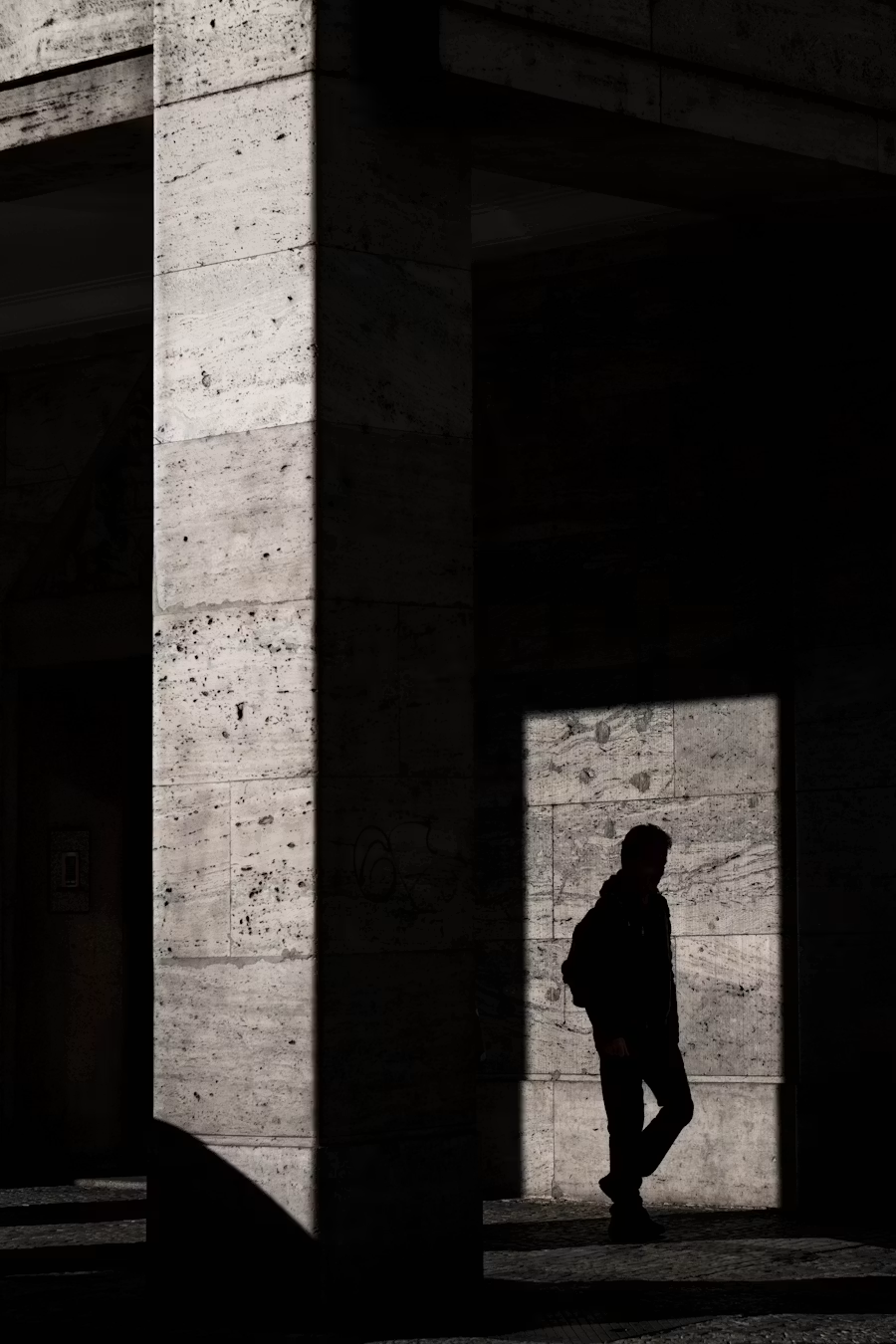
Matt Brandstein
I am 54 years old. I have never been married. I have no children. My brother, my only sibling, has no children. When we are gone, that particular branch of the tree simply ends, not with drama, but with silence. No heirs. No one to say kaddish. No next generation to carry anything forward.
There is a particular kind of loneliness that grows in the space between a Jewish life genuinely lived and a communal framework that doesn’t always know what to do with it. I have been living in that space for a long time. It has no name. It rarely gets spoken about. And I have spent years becoming very good at pretending it doesn’t exist.
Pretending is only half of it. The other half is retreat, a pull away from shul, the shiurim, the rooms full of highly functioning people who keep effortless time with the Jewish rhythm of life, while I hold my place a half-beat behind, out of sync in a way that only stokes my insecurity. With age, the discomfort has hardened into something less negotiable. The possibilities feel smaller, and the fear of being pitied, irrational but no less real for that, leaves the door harder to walk back through.
An unconventional path does not mean a broken connection. Every Jew has a neshamah that is always bound to the whole, but it is the practiced consciousness of that connection that sustains us, even when the observance itself might appear obscured.
I am not frum from birth. I came to Torah observance later in life, imperfectly, incrementally, with my own particular combination of earnestness and bewilderment. What I wanted was simple to say and hard to live: a closer relationship with Hashem. I did not have the tools for it, so I went looking for the people who did. Chabad became my touchstone, and so did Jews from every walk of life, each of them further along than me, each willing to let me learn by standing near. I am still learning. But somewhere in all of that trying, the decades slipped past me like a train I kept meaning to catch.
Orthodoxy is my baseline. Not a destination I’ve fully arrived at, but the standard I hold myself to, the compass I navigate by, even when I’m a somewhat disheveled traveler. I try to keep Shabbat, even in the stretches when keeping it means staying home, unplugged, alone, the parshah and a cold lunch conspiring against any serious intention to stay awake. I keep kosher. I put on tefillin on all permissible days. I daven. I learn. I give tzedakah, even when I can’t afford it. And when I fall, consciously or otherwise, I know about teshuvah.
My conviction as a Jew is not in question. What falters is never the belief. It is the showing up, the standing among others as one of them, the ordinary confidence that the room is mine to enter. Walk in and the old monologue starts, cataloging every way I have fallen short of the life I was supposed to be living by now. So sometimes I stay home, and not just occasionally. There are stretches, long ones, where I stay away entirely and the world outside continues without me.
What matters is that I always find my way back. The pull to return is a divine directive wired into me like an alarm, an insistence to be present among my people. I always hear it. I do not always answer. The pull the other way is just as real, and some days it wins, and the loneliness throbs. This loop between seeking community and retreating from it, never resolved, only tolerated, is the shape galut takes in me.
* * *
Jewish communal life is built around milestones and family. The brit. The bar mitzvah. The wedding. The Shabbat table crowded with children. These are the scaffolding of our calendar, our conversation, our sense of Divine blessing made visible in the world. And underlying all of it is the concept of family as the living vessel of Jewish continuity. It is a beautiful idea. It is also, for those of us whose families gave us love without always giving us the stable ground on which to stand, something that can be quietly complicated to be around.
My beloved mother, who is with us today, B”H, was raised in an American home caught between two worlds, the shtetl her parents had left and the country they were still learning to call their own. They had gotten out in time. The ones who stayed in Tykocin did not.
What the family could not hold in person they held across the ocean. For years the letters kept everyone current, both sides woven into a single life conducted in two places. When my mother was born, the mazal tovs came from across the sea, from her grandparents, her aunts and uncles, the older cousins she would never meet, all of them rejoicing over a baby they knew only from a photograph. For a while the letters carried their lives too. Then they began to carry something else:fear, and then word of conditions worsening, and then the unthinkable. They stopped. Nothing ever came after them. An entire branch of the family had been closed off in silence.
Her parents moved through American life like people who had learned to occupy the present while remaining, in some essential way, unreachable. They had never been able to mourn, not their parents, not the nearly twenty siblings between them, not the nieces and nephews beyond counting, not the whole shtetl where everyone was mishpahah. There were no graves to visit, no dates to mark. What they could not speak taught them to function without feeling, to keep the machinery of a household running while everything that asked for the heart stayed shut. My mother was raised inside that, in a home where the inner life was too dangerous to show. What she handed down to me was not the grief itself but the knowledge of what it does when it has nowhere to go.
The love my mother carried for her two children during our formative years was filtered through an extreme emotional containment, where distant pleasantness was the permanent surface and the unspoken tension beneath it moved in carefully managed currents. We became expert at decoding her highly controlled system of subtle signals, learning to find tenderness in what sometimes read, on the surface, as extreme reserve, and in other moments as something closer to its opposite.
My father, of blessed memory, was a simple man who spent much of his life convincing himself and everyone around him that he was something more. Beneath all of it was the frum world of Lawndale he came from, the truest thing he ever was. He inherited something whole and set it aside in search of something he imagined was greater.
He came to my mother already practiced at starting over. Three marriages before hers, each brief, no children from any of them, or so he always said. He did not arrive at my mother so much as land on her, and once he had, he decided the marriage was the one he had finally gotten right, settled rather than examined. That would have meant facing the pattern, and his own place at the center of it, the one role he could never step out of.
He loved my brother and me, of that I have no doubt. His moral compass bent under the weight of ambition and ego in ways that eventually cost him everything, including his freedom during my teenage years. The children were collateral in a story he was telling himself, caught in the crossfire. Our mother was something closer to a casualty.
Shalom bayit, the peace and wholeness of the home, was never something that existed between them. Not in any sustained way, not in any hidden way, not even in the beginning. My mother stayed because she was afraid to leave. My father saw to that, controlling the terms of her life and using whatever force it took to keep her inside the one he had chosen, never seeing the woman he was keeping there. Love between them was never possible. It was not that they failed at it. The conditions for it had never existed.
What they had instead was volatile, conducted under duress, a facade of partnership that masked the absence of the real thing. The love for their children was genuine. Everything else was held together with effort and appearances.
And yet, despite all of it, my parents helped me honor a Jewish identity that was always mine, passed down through both what was said and what could only be absorbed from the unspoken layers.
My mother was raised in the deliberate assimilation so many of that generation fell into, yet the mitzvot survived in her, not as ritual or knowledge but as instinct: kindness, generosity, a love for her fellow Jews, the countless things she had always done without ever knowing halakhah asked them of her. It lived in her the way her parents’ thick Yiddish accents lived in them, innate and unmistakable.
My father spoke of the frum world he came from with a warmth he directed at almost nothing else: the heder, the Shabbat table, the grandparents who were Lubavitchers, who helped establish the Anshei Lubavitch Shul in Chicago and fundraised to bring the Frierdiker Rebbe to the city, whom he had met in person. He could not give me that world, but he handed me its memory, and the memory had weight.
What my parents could not offer me was the felt sense that stability was not just a performance. They labored to keep the appearance of it intact, even as everything beneath it was always coming apart, and I never learned to trust calm. The drop back into chaos always hurt more than the chaos itself.
None of that stayed behind when I left the house I grew up in. I know, intellectually, that I am as deserving of belonging as anyone in the room. But knowing a thing and being able to inhabit it are not the same.
When I find myself at a simhah surrounded by people who are deeply rooted in one another, in a multigenerational sense of belonging that seems to come as naturally as breathing, something shifts in me that I cannot always manage. The recognition of a security I never learned from the inside can, on the harder evenings, move from wistfulness into something more physical, a tightening, a need to leave, the particular panic of a person who can only hold the warmth of other people’s normalcy for so long before the body begins to tell him he doesn’t belong there. I always know I do. I don’t always feel it. That gap is its own kind of exhausting.
Coming to observant Jewish life later meant climbing a ladder whose rungs assumed a social and familial infrastructure I was building from scratch. For those for whom this life is wired into the circuitry of childhood, it is organic, the water they swim in. For the person who arrives later, it is a language learned in adulthood: the vocabulary comes, the grammar follows, but the native ease of someone who has always lived inside it remains just out of reach.
The warmth of a Shabbat table is something I have learned to receive without fully knowing how to inhabit. I arrive, I am welcomed, I am seated and fed and sung to, and something in me recognizes the beauty of it. And then the conversation turns naturally to children’s schedules and a nephew’s upcoming bar mitzvah, and I smile and nod and grow quiet. Not from bitterness. From the specific ache of a person who is genuinely glad to be there and doesn’t entirely feel that he is.
* * *
Ask me how I’m doing. I will tell you I’m fine.
I have become extraordinary at fine. Fine lets you off the hook and lets me off the hook simultaneously, and we can both return to the Torah discussion without navigating the awkward geography of what it actually means to be at this table, at this age, without a wife by my side, without children to wrangle.
The full answer to how I’m doing is a document, not a conversation. It covers the cancer and the PTSD and the OCD and the depression and the particular loneliness of being a Jew without a next generation, and it would take longer to read than most people have time for standing at a kiddush. I have learned to carry it quietly. It is heavy, but it is mine.
So: fine. Always fine. Baruch Hashem.
I suspect I am not the only one living this way, inside the community and at its edge at once. There is a whole cohort of Jewish men and women who have aged out of the young-singles conversation without aging into any other framework, who exist in the uncharted space of a Jewish life that doesn’t follow the expected sequence. Not because we gave up. Because life, with its illnesses and losses and wrong turns and late arrivals, wrote a different story than the one we intended.
It is knowing, somewhere you can’t quite name, that Hashem loves you, and feeling, in the hushed hollow of a Shabbat afternoon alone, completely unseen. Both things are true at once. Living in that contradiction is its own kind of spiritual practice, unrequested and unrelenting.
* * *
I had thought of what my grandparents fled as belonging to their century, not mine, a hatred that had done its worst and receded into memory. October 7th, 2023 made it present. The massacre fell on Simhat Torah, carried out with genocidal intent: the brutality of it, the scale, Jews murdered at a music festival, in their homes, in their communities, tortured, raped, taken hostage, the youngest infants and the oldest survivors of the camps among them.
The scapegoating did not end with the massacre. Much of the world turned its back, the oldest slanders rose again, the blood libels reworded for a new century, the murdered recast as the guilty. The hatred that emptied my grandparents’ world was spoken aloud again, in the streets and on the campuses, made ordinary, made sayable, an old hatred dressed as justice in places where common sense had given way.
The horror did not land all at once. It came in pieces, and each piece took something different: a night of sleep, an ordinary happiness interrupted, a prayer that began as routine and turned, without warning, raw. The grief did not replace what I was already carrying. It settled on top of it, and what was underneath, pressed hard enough, turned to resolve.
What followed was less a feeling than a summons, toward a Yiddishkeit along a dimension it had never shown me before. Teshuvah stopped meaning frumkeit alone and took on an urgency. This was not the old feeling of being out of sync with Jewish life, the one I had carried before I committed to observance and after. That was my own static. This came from beyond it, and I could not talk myself out of it. It is a process I am still working out, and working out with determination: to take up what my mother was never given and what my father spent his life outrunning, and to make it mine in a way it had never quite been.
None of this feels like an accident. The road has not been a straight one, and I have stopped believing it was a wrong one. Hashem has His reasons, and this was never outside them.
Because what October 7th made undeniable was Klal Yisrael, that we are not a scattering of individuals but a single body. The head has its work and the foot has its own, and no part is so small that the rest can do without it. I do not know which part I am. But I have come to believe that a mitzvah done in my corner reaches places I will never see, that it can mend something in a body I am bound to.
I still don’t always make it through the door. But on the days the retreat wins, I reach for the mitzvot that ask no audience, and I hold the line there. And on the days I cannot even do that, I trust that the body holds me anyway, that somewhere a Jew I will never meet is keeping the line I dropped.
* * *
Le-dor va-dor. And then there’s me. Still showing up, even when no one can see it.





 Site Operations and Technology by The Berman Consulting Group.