

Alter Yisrael Shimon Feuerman
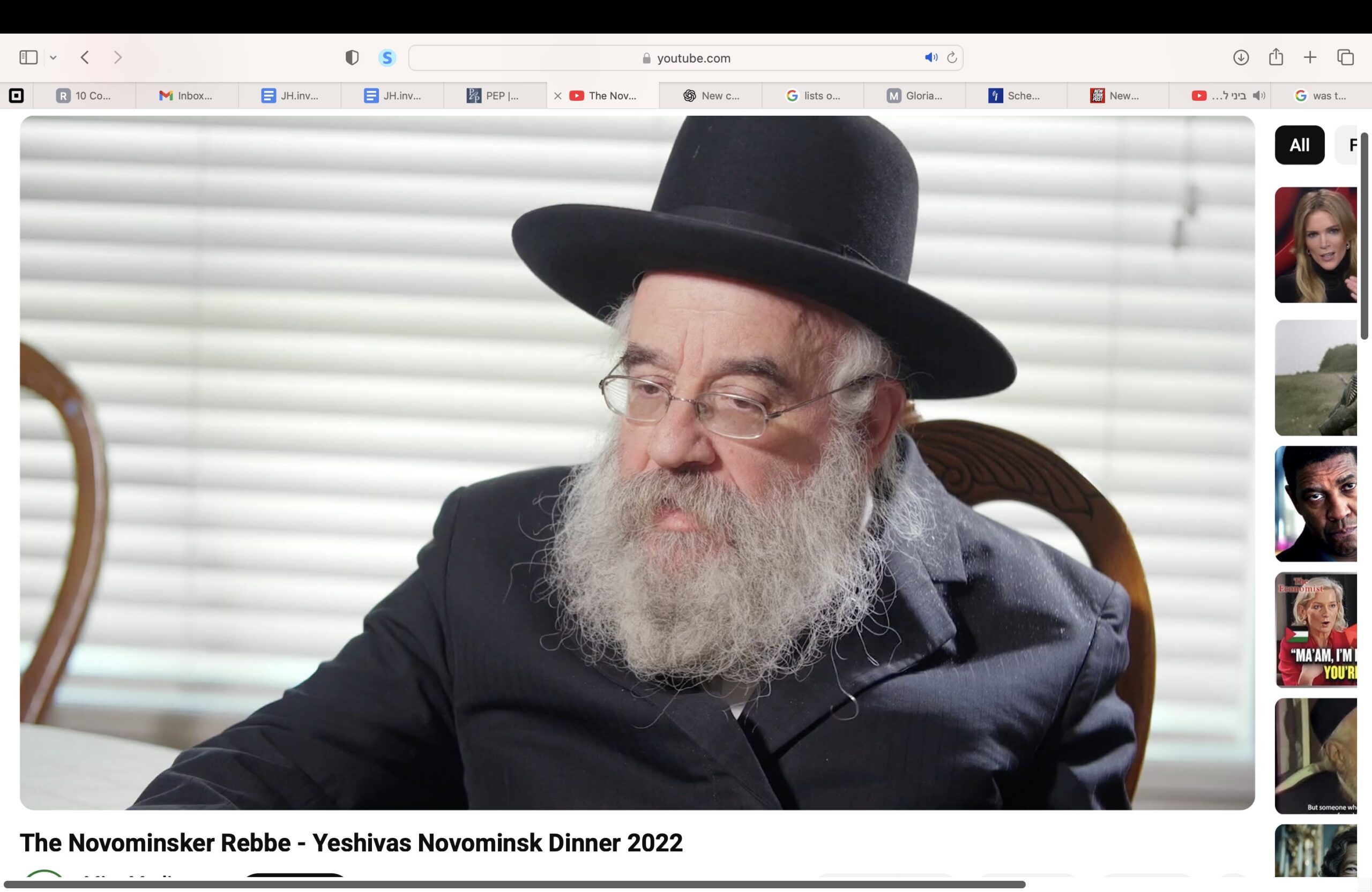
I visited a cousin recently in Boro Park, Brooklyn, where he lives in a small flat. We share a great-grandfather: the Rebbe of Novominsk, the grand rabbi of Warsaw, who died in 1933 at the age of sixty. The mantle passed from him to his son, then to his grandson, and now rests on my cousin and his twin brother—handsome, slight men in long frocks, their gray beards softened into gentle bristles. When I look at them, I still see the children they once were—the children we once were—in the dimness of their grandfather’s study on 47th Street.
The Rebbe, Reb Alter Yisrael Shimon, welcomed me simply, warmly.
“We have the same name, don’t we?”
“Yes,” I said.
“Alter Yisrael Shimon”—the Rebbe’s name.
Our namesake was a tiny mystic who carried the secrets of the entire Torah on his lips. Before breakfast he would memorize 21 chapters of the Mishnah—some 20,000 words. My grandfather, both the Rebbe’s son-in-law and his nephew, would farher him each morning, testing him informally.
They were dirt poor and oppressed by the people around them, but they had a sustaining story because they were direct descendants and followers of the Baal Shem Tov, the miracle worker who wandered the frozen Ukrainian steppes in the eighteenth century, lifting up the poor with words, wonders, and the word of God. We, by contrast, grew up in American safety and abundance.
God had chosen the Jewish people for both suffering and love. Exile would be endured with song and hope, through persecution and upheaval. These, the Rebbe taught, were the birth pangs of the Messiah. Even the persecutors—the czars, the Polish landlords, the peasants—were agents of God, sent to push Jews closer to Him through Torah, good deeds, and goodness itself. “The Jews are like a cholent,” the rabbis in Poland said—the Sabbath stew that cooks all night. We are cooking, cooking.
But as the nineteenth century waned and the shtetl modernized, this story began to fray. People stopped waiting for God to make things better. The Messiah needs our help to come, they said. Some became militant Zionists, seeking to force redemption; others embraced secular messianisms—Marxism, socialism. Warsaw became a cauldron of radicalism, secularism, Zionism, and the last embers of Hasidism, all smoldering atop a desperate search for a life and a livelihood.
The last living person who had seen my great-grandfather was the noted Rabbi Fabian Schonfeld of Queens, who died in 2020 at the age of 97. He was our rabbi and knew my grandfather from the days of the London Blitz in World War II. “Your great-grandfather was not a man of the twentieth century,” Rabbi Schonfeld told me at my mother’s shivah twenty years ago. “He belonged to an earlier world. It is impossible to understand him.” My father said something similar: “Holy—but for a regular person, impenetrable.”
My grandmother Shifra yearned for a better life than squalid Warsaw and reached London’s East End with my grandfather in 1935. Her sister Sure’le told me that in Warsaw they hid novels under their pillows, out of their father’s sight. Whatever paths the sisters took, they could not shake the sparks of holiness they had absorbed from the rebbes.
I knew the Rebbe of Warsaw’s son—the Novominsker Rebbe of New York, Reb Nochum Mordechai—in the late twentieth century. He once told my father and the others that they were worthless: “You will not reach the level of the behemos, the livestock of the Rebbe of Kotzk,” he said in Yiddish to the relatives that had gathered at the yahrtzeit meal of his father. I was seven years old. “What did he say?” I asked my father. “The Rebbe said we are worthless.” Worthless, that is, when compared to the kadmonim—the previous generations.
My father considered it a great honor to hear this from a Varshaver, a man from Warsaw who had been raised and braised firsthand by the fires of Kotzk (the Rebbetzin was the Kotzker’s granddaughter). Nor were the remarks directed at him, but all the men around the table. In Kotzk, truth was not sacrificed for warmth, but here with the Rebbe, there was both: truth and warmth. “Knowing one’s worthlessness can be very valuable—if we accept it with love,” my father seemed to say. Puffed up and cast down—this has been the arc of my life as well.
“I have come for no reason,” I told my cousin, the Rebbe, that recent Sunday afternoon, the light thinning toward winter. We sat in a small room off the kitchen.
“Let me at least bring you something to eat,” he said.
I demurred, but he coaxed out orange juice and cake. He had inherited his father’s genius for kindness, and that Hasidic gift for understanding nothingness—for making room for nothing so that something might emerge.
Novominsk had never been a large Hasidic movement. Even in Warsaw it was a ragtag kingdom without tricks: modest dress, decorous lectures, little taste for the esoteric, and only extravagance for scholarship and a fierce concern for others. No pomp. No theatrics. A house of study with a benkel, a tisch. A felt fedora. A pocket watch was placed before the Rebbe during services so he would not delay the worshippers.
A modest kingdom— a kingdom of modesty.
My son is named for the Rebbe’s grandfather, Reb Nochum, one of the earlier leaders—a man known for his humility and hasmodo—a perseverance in study.
To an outsider in modern America, it might have seemed almost make-believe. But to me, a boy longing to belong, it was a kingdom where words and thoughts mattered. There was nothing to belong to, really. This was not a grand chassidic court in the way of Chabad, or Satmar. It was blood, but conferred on me no obligation of thought or manner of dress other than an inclination toward Talmudic rigor, and a spiritual softness. For example, the famous thinker, Abraham Joshua Heschel was our cousin, a Novominsker as well—a nephew of the Rebbe.
My grandparents were refugees of the twentieth century—the pogroms, the Holocaust—but also refugees of the eighteenth. Part of them had had enough of being God’s “chosen” ones. Maybe, at last, they could enjoy a little success? Maybe a child could become a doctor? Maybe my grandfather could finally earn a living?
When my grandfather arrived in America, he was offered a lucrative newspaper-delivery franchise for The New York Times. The obstacle was the five-and-a-half-pound Sunday edition, delivered on the Sabbath. He arranged to subcontract the Saturday route to a non-Jew and keep the rest. Was it allowed?
“It is permissible,” the Rebbe told him, “but it is not for you, Avrohom. There must not be even a whiff of dishonoring the Sabbath.”
So my grandfather refused and took a lesser job instead as a small-time caterer for a while.
Even as they were devout, they carried in their bones the deprivation of exclusion from the wider world, the cloistered holiness that kept them poor. They hoped their children might find redemption not only through Hasidism but through a profession.
But my father had other plans. He brought me, as a child, to the Rebbe—Reb Nochum, who was the rebbe first in Crown Heights then in Boro Park from 1953–1977.
“Will you come to my bar mitzvah?” I asked.
“What would keep me away?” he said.
He had stomach cancer; it was his final year. Yet he climbed a ladder to fetch for me a book he had written about his father’s teachings. I remembered this as I sat before his grandson.
“A kingdom of nothing”—nothing that is related to the material of this world—when you were in their presence you could smell the next world, yet it was something here too.
I held the Rebbe’s frock for a moment—humble man, great man.
“I know I can’t be Novominsk,” I said. “But I want a part in the way things were. In the way things are.”
He listened gently.
“You can’t wear what we wear,” he said, gesturing to his caftan and the hat nearby. You live in Passaic. Just be regular. Learn like a regular Jew. Study. Then you will be Novominsk.”
It seemed he was saying that the outward extremism of Novominsk—its simplicity, its refusal of spectacle—was itself a hidden path toward being regular. Perhaps all of Hasidism is a way of becoming regular. Who can say what “regular” looks like?
I asked if he remembered my grandfather, Reb Avrohom. Of course he did. My grandfather was his great uncle.
“A big personality,” he said.
“I mistreated him,” I whispered. The shame rose slowly, unexpectedly. This was not a confession but a realization—of who I am. A coarse young man, an Esau, a pretender to goodness. The antithesis of Novominsk. Goodness has always been used to defend against badness for me, as a way of not being accountable for the badness I did. Identification with a holy man is a great way to avoid one’s self. For example, there was tension in the family between the adults and I would (inappropriately) side with my father and ridicule my grandfather and his ways. I was young but it was coarse and sadistic of me. It wasn’t for the first time that I would be ashamed and then bury it in “good” and goodness of an exalted pedigree. I was crap and I knew it.
“I want to make up for it,” I told the Rebbe.
I braced for rebuke. Instead he said:
“Learn Mishnayos. Come back and see me again. We can talk anytime.”
At first, it seemed to me that this was simply another form of avoiding accountability: learn the right teaching, recite the proper incantation, and all would be well. But eventually I understood that a person cannot open himself by an act of will—or even by self-knowledge alone. One must submit, and submit to experience. That, I came to see, was the heart of Novominsk. Do not become self-obsessed, even in contrition. Experience might be bigger than you.
Not long after that visit, I began studying Mishnayos Peah, which opens:
“These are the things that have no measure… the corner of the field for the poor, acts of kindness, and the study of Torah.”
It teaches what we must give away: what falls from our hands while harvesting belongs to the poor; what we forget in the field belongs not to us…
In my Passaic beis medrash, even surrounded by a hundred people, there are moments of profound aloneness—einzamlkeit. When I was young, I wondered why I had to endure such arduous study alone, without my mother, without my sisters. They were free to read leisurely, to read what they wanted, to follow their interests on a wider path. Why not me?
And beyond that—what if all our striving leads nowhere? We learn and forget. Millions came before us; millions will come after. Does God even want our Torah study?
A friend came over to me in the beis medrash. He had heard me saying it by heart.
“This is your olam haba mesechta,” he said—a piece of learning that one knows by heart. It is said that is so close to him that he “owns” it in this world and carries it into the next.
“Let me show you something,” he added, with quiet affection.
He opened a book by a sage of the last century and told an old tale: a man died unknown, yet a woman wept for him. When asked why, she said, “He knew the tractate Chagigah by heart. He repeated it constantly. He was a scholar.”
After the burial they searched for her, the story tells, but she had vanished. They understood then that the tractate itself had come in the form of a woman to speak on his behalf.
A man spends his life with a tractate, and the companion he longs for—the one who truly knows him—is the tractate, the study itself.
Absurd? Perhaps. Yet we study the Torah of a God who seems distant, fantastical, inscrutable—and somehow also deeply near, perhaps even within us.
My grandparents are buried in the Novominsk section of a cemetery in Iselin, New Jersey. My parents are buried in Queens. In my circles, one is buried with one’s parents in the family plot, but I have asked my children to bury me with my grandparents—with the people of Novominsk. Would there be a corner of the field left for me? Just as the mishna in Peah describes, the corner, what is left, has no limits—could be everything.
To be placed again inside that small kingdom—
that discipline of diminishment,
that inheritance of almost nothing—
from which, somehow, something will continue.



 Site Operations and Technology by The Berman Consulting Group.