

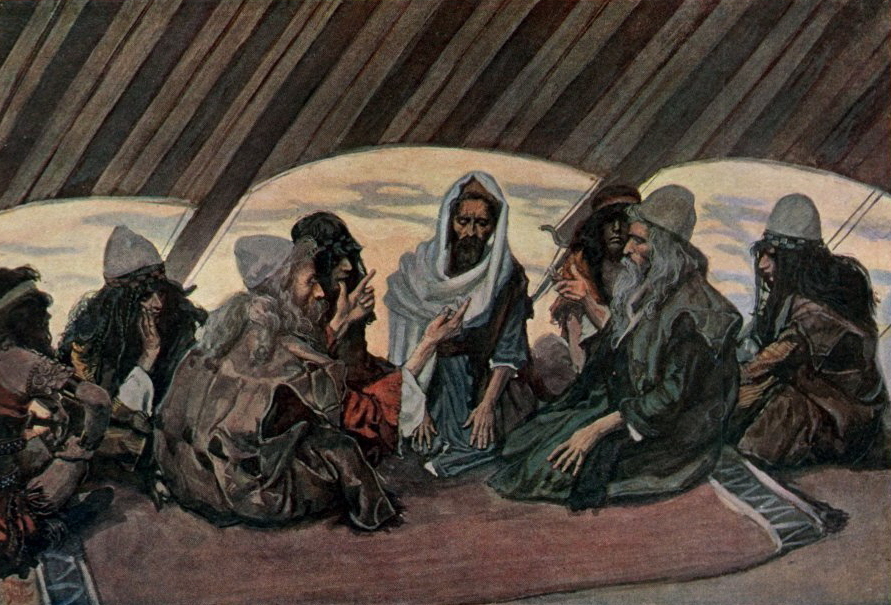
Whose idea was Sinai?
More specifically, who thought it would be a good idea for a people to have a direct, collective encounter with a deity? Who thought that in this encounter, the people should be given a set of principles for organizing their lives, the basis for a legal code? Who indeed thought this code should be the basis for an ongoing, “covenantal” relationship whereby the deity would build upon His intervention in history on their behalf by conferring a special status upon them – “treasured” by God “among all the nations,” “a kingdom of priests and a holy people” – as long as the “people hearken to (God’s) voice and keep (their side of) the covenant” (Exodus 19:4-5)?
At first blush, this question seems ridiculous.
After all, Sinai has no precedent or parallel in history– as an idea, let alone as an historical reality. Who could conceive of Sinai? Indeed, if we review the prophetic revelations in the Torah that precede Sinai, none of them seem to give any indication that a legal code is to be given or that a collective, covenantal encounter with God is to be expected. When Moses first encounters God at the burning bush (s’neh), on “the Mountain of Elohim (“gods,” “God,” or “authorities”), in the vicinity of Horeb” (Exodus 3:1) – a mountain he eventually learns is also called Sinai – he is told only that the people would “worship Elohim on this mountain” (3:12).[1] And when he and Israel sing in response to their miraculous deliverance at the Sea of Reeds (with God having drowned Pharaoh and his pursuing cavalry), they look to a future that includes great military victories, arrival at a mountainous homeland, and the construction of a holy sanctuary (15:12-17). But they seem to have no inkling that Sinai is coming.
Conversely, if humans had conceived of Sinai, that would seem to imply that it was a contingent historical development, one that might never have happened if its human progenitors hadn’t imagined it as a solution to their needs. But this implication is in tension with an important strain of rabbinic thinking suggesting that Sinai was a necessary one time-event – for Israel and for the entire world, without which the world would be purposeless and meaningless – the very reason the world was created.[2] It seems to follow that Sinai is an idea that must originate from God alone, one that precedes creation. To be sure, a second strain of rabbinic thinking sees Sinai as a moment of choice rather than coercion.[3] Yet even this tradition does not describe Sinai as a contingent event given Israel’s history up to that point.
And yet a Midrash included in the compilation Lekah Tov (Tobiah ben Eliezer, 11th-12th century, Mainz) suggests that Sinai was first conceived of by a human being, one who worried about the very real prospect that Israel might move forward in its travels through the wilderness without experiencing something like Sinai. Remarkably, this person was not Moses or any other Israelite. Shockingly, he is someone the Torah introduces as a pagan priest! I am referring to the man who welcomed Moses into his household and whose flocks Moses was tending when he turned aside to gawk at the bush that was on fire but would not be consumed. That man was Moses’s father-in-law, Jethro.
In what follows, we will see good reason to take this Midrash very seriously. Although the scriptural support it adduces is minimal, it is hinting that when we read the biblical text closely, the possibility that Jethro conceives of Sinai prior to its occurrence is the most straightforward reading.
To be sure, Jethro does not anticipate Sinai in all of its details. He never mentions the words “mountain” or “covenant” or even “God” – at least not as the four-letter name of the God who intervenes in history and who begins the Decalogue with “I am God your Elohim.” Most crucially, Jethro seems to be suggesting a more human-scaled version of Sinai; even Jethro cannot truly conceive of Sinai.
At the same time, the Torah seems to go out of its way to present Jethro – and only Jethro – as having the necessary insight to anticipate key aspects of the Sinai experience, and to articulate why something like Sinai would be a good idea. Thus, while on the one hand, Sinai goes well beyond what even a wise mortal like Jethro can imagine – thus reinforcing the impression that it was not contingent but necessary – on the other hand, Jethro’s idea of Sinai seems important for unlocking the puzzle as to why Sinai was necessary. Indeed, I will suggest that by giving us a glimpse into how Jethro proposed a scaled-down version of Sinai before it occurred, the Torah is inviting us to reckon with the necessity of Sinai and to consider Jethro’s argument for it.
We have our work cut out for us.
First, we must clarify how Lekah Tov proposes that Jethro is the source of the idea of Sinai, and how this interpretation emerges from a careful reading of Scripture.
Second, we must see how acceptance of Lekah Tov’s proposal helps to resolve and clarify various other textual puzzles.
Third, we must explain why Jethro is the appropriate vehicle for providing the rationale for Sinai.
Finally, we must consider the implications of the possibility that Sinai could be anticipated by a human being, and that Sinai might be addressing a perceived problem. How can Sinai be a theological, moral, and even metaphysical necessity while also being a contingent development?
I will suggest that the Torah invites us to imagine a world in which Sinai never occurred precisely to clarify why such a world – under the conditions represented in Israel’s history – would be untenable. And it has a non-Israelite priest recognize this lack of sustainability because the problem that Sinai addresses is actually a general problem in human society, albeit one that occurs in its most acute form in the context of a mass population of former slaves under highly challenging conditions: How to accept – and even embrace – the rule of law and morality.
One piece of advice implemented, or two?
Let’s zero in on the heart of the textual puzzle, by quoting from the advice that Jethro gives Moses and seeing how Moses follows up on this advice. For now, it is sufficient to recall that this occurs right after Jethro has traveled with his daughter Zipporah (Moses’s wife) and her two sons to meet Moses and Israel, at “the Mountain of Elohim” (18:5). This was about six weeks since Israel had left Egypt, having since crossed the Sea of Reeds, begun to live by the weekly manna rhythm, been provided a perpetual source of water (from a rock located at Horeb/Sinai), and emerged victorious from a clash with Amalek. Upon Jethro’s arrival, Moses relates all that God had done for Israel since Moses had returned to Egypt from his exile at Jethro’s household in Midian. Jethro responds by extolling God as the greatest of “all the Elohim” (18:10), and he joins Moses and Israel’s leaders in a thanksgiving festival (18:12).
What happens next (Exodus 18:13-27) is excerpted (with emphasis added and one element omitted for the moment) and translated[4] here:
- Now it was on the next day that Moses sat to judge the people, and the people stood before Moses from morning until evening.
- When Moses’s father in-law saw all that he was doing for the people; he said:
What kind of practice is this which you engage in for the people: Why do you sit alone, while the entire people stands over you from morning until evening?
- Moses then said to his father-in-law:
When the people come to me to inquire of Elohim.
16.When it has some issue, it comes to me — I judge between a man and his neighbor and make known the laws of Elohim and His instructions.
17. Moses’s father-in-law said to him (in response):
Not good! This practice that you are doing (is not good)! 18. You will surely become degraded/hollowed out[5] – you along with the people; for this matter is too heavy for you; you cannot do it alone. 19. So now, hearken to my voice: I will advise you, so that Elohim (singular) will be with you…
21. And you – you should appoint from all the people men of valor, holding Elohim in awe, men of truth, hating gain; And you should set [them] over them as chiefs of thousands, chiefs of hundreds, chiefs of fifties, and chiefs of tens. 22. Thus they may render judgment for the people at all times. So shall it be: every great matter they shall bring before you, but every small matter they shall judge by themselves. Make [it] light upon you, and let them bear [it] with you. 23. If you adopt this practice, [when] Elohim (singular) commands you [further], you will be able to stand, and also this people will come to its place in peace.
24. So Moses hearkened to the voice of his father-in-law; he did it all as he had said. 25. Moses chose men of valor from all Israel; he placed them as heads over the people, as chiefs of thousands, chiefs of hundreds, chiefs of fifties, and chiefs of tens. 26. They would render judgment for the people at all times: the difficult matters they would bring before Moses, but every small matter they would judge by themselves. 27. Then Moses gave his father-in-law leave, and he went home to his land.
At first blush, this story is straightforward. Jethro is offering Moses and Israel the benefit of his experience about procedural justice. He is suggesting that even the wisest, fairest judge cannot manage a justice system on his own. Justice delayed is justice denied, as the saying goes. And so Moses must delegate his judicial authority, by appointing a hierarchy of judges, with lower-level judges referring “davar” (translated above as “issue” but literally “statement” and in context, also translatable as “dispute” or case”) up the chain depending on the difficulty of the cases. Surely this is good advice; after all, virtually every judicial system works this way. And it is also a good idea to appoint judges of unimpeachable character and reputation to better fulfill the dictum Justice is blind.
Jethro’s advice seems excellent, if rather obvious. Indeed, the reader may be struck by the implication that Moses needed someone to offer these obvious pointers. But perhaps it makes sense that a society of former slaves who have no experience running their own legal – or political or economic, etc. – system might not have good instincts when it comes to setting up such a system. And Moses is an amateur in the business of leadership, and in institution-building in particular. It is thus to Moses’s credit that he seems to recognize the wisdom in Jethro’s advice and moves to implement it right away.
But a puzzle begins to emerge as we review this story. Observe first that the Torah’s description of Moses’s implementation of Jethro’s advice in verses 25-27 seems extraneous. If the Torah had left off this description and included only the bolded words in verse 24 – telling us that Moses “did all as (Jethro) had said” – it would be a straightforward inference that Moses had set up the judicial system according to Jethro’s guidance. In the text I excerpted, Jethro gave Moses one piece of advice. As such, there seems to be no need to spell out how Moses implemented Jethro’s advice. After all, Moses seems to follow his father-in-law’s advice to the letter.[6]
In fact however, there was a second piece of advice that preceded the suggestion of the judicial system. As such, by informing us that Moses moved immediately to implement the second of Jethro’s piece of advice, right after informing us that Moses implemented “all” that Jethro advised, it raises the question of when and how Moses implemented the first piece of advice. Put differently, this chapter – the one that is prelude to Sinai – ends on a cliffhanger: When will Moses implement the first piece of advice?
But what was that first piece of advice?
We find it in the full opening of Jethro’s response to Moses’s description of what he was up to, now including the part I deleted above (in bold):
17. Moses’s father-in-law said to him (in response):
Not good! This practice that you are doing (is not good)! 18. You will surely become degraded/hollowed out– you along with the people; for this matter is too heavy for you; you cannot do it alone. 19. So now, hearken to my voice: I will advise you, so that Elohim will be with you: You should be (or: position yourself), for the people, mul (opposite) Elohim; and you should bring the devarim (matters/disputes/cases) to Elohim. 20. Ve-hizhartah et’hem (And you should warn/radiate them) the laws and instructions, and make known to them the way they are to follow and the practices they are to enact. 21. And you – you should appoint…
Setting aside for a moment the specific meaning of the first piece of advice, which is presented in verses 19-20, let’s first note that this piece of advice is distinct from the second piece of advice (beginning with v. 21) regarding Israel’s judicial system. Indeed, while various commentators offer interpretations of verses 19-20 in light of Jethro’s advice regarding the judicial system, there is nothing in those verses that hints at a judicial system composed of (a hierarchy of) human judges. Judges are not mentioned at all; they appear only in verse 21, when Jethro seems to introduce a new topic: “And you – you should appoint…”. The focus in verses 19 and 20 is rather on the people. What are the people doing in these verses? After their cases are brought to the Elohim, they are instructed in laws and norms.
But what does Jethro’s first piece of advice entail?
Here is the Lekah Tov’s answer, focused on verse 20:
“Ve-hizhartah et’hem”: These are the Ten Statements (i.e., the Ten Commandments or Decalogue).[7]
The Lekah Tov – and other midrashic compilations[8] – go on to suggest that the rest of the verse is alluding to guidance that (according to rabbinic tradition) Israel was given at Sinai after the Decalogue: “laws” refers to the laws of incest and sexual immorality; “instructions” refers to the laws of judicial malpractice; and “the way to follow” refers to Torah education; to elucidate “the practices they are to enact.” Lekah Tov quotes various Tannaitic (2nd-3rd century) rabbinic sages offering various ideas: “good practices” generally; “visiting the sick”; “acts of charity”; and “going beyond the letter of the law.”
Remarkably, this midrashic tradition describes Jethro as anticipating the giving of the Torah – not just the Decalogue, but the wide array of laws and guidance that were given (according to both the text and tradition) at Sinai.
Scriptural Support for Jethro as Sinai-Conceiver
The Lekah Tov does not provide much textual support for his suggestion that ve-hizhartah et’hem refers to the giving of the Decalogue. Indeed, the only such support provided seems to be a rather thin reed: Since each of these words has an extraneous/ungrammatical letter hey in it, and the numeric value of hey is five, this phrase is hinting at the Ten Statements.
But as I have argued, following the work of Simi Peters,[9] it seems to be a general strategy of midrash to provide weak “scriptural anchors” for its interpretations so as to encourage the reader to examine the text more carefully and thereby uncover the much stronger textual evidence it is (likely) relying on. And that evidence is quite strong. Indeed, whereas the Lekah Tov can be read as suggesting only that Jethro anticipates the need for the people to receive legal and moral instruction independent of case adjudication, the text of Jethro’s advice also seems to anticipate central elements of the experience of Sinai.
Consider first Jethro’s imagery of Moses positioned “for the people mul (opposite) the Elohim” (18:19). While not couched in the exact same language, this seems to anticipate how “the people encamped neged (opposite) the mountain” (19:2), whereupon Moses began his ‘shuttle diplomacy’ between God (alternatively as Elohim and as the Tetragrammaton) on the mountain and the people at the foot of the mountain.
Next, after the initial covenantal compact brokered by God and Israel is settled (19:3-8), consider (in 19:9) the rationale God provides for the upcoming theophany and how Moses responds to this rationale:
Behold– I am about to come to you in a thick cloud so that the people will hearken when I speak with you, and so they have eternal faith in you. So Moses related the people’s devarim to God [as Tetragrammaton].
Two puzzling aspects of this verse are resolved if we understand it through Jethro’s first piece of advice. First, it seems odd that God depicts Sinai as an effort to bolster the people’s faith in Moses rather than in God. After all, the people were described – with the very same words – as having “faith in God and in Moses His servant” after the Crossing of the Sea (14:31). But Jethro is worried – quite reasonably – that this faith will not hold. “You (and the people) will surely become hollowed out/degraded (18:18),” he warns. And he begins his two-part advice with “So Elohim will be with you” (18:19).
Moreover, whereas up to that point, Jethro’s references to Elohim could be understood as polytheistic, here (and in the conclusion of his advice; 18:23) he follows the Torah’s lead (starting in Genesis 1:1) and treats Elohim as a singular agent: God. Jethro has become a monotheist. And Jethro’s rationale for the advice he gives Moses fully anticipates God’s rationale for Sinai: so that God will bolster Moses’s authority.
The second puzzle in this verse lies in Moses’s response: What are the “devarim” that Moses brings to God in response to God’s announcement that a theophany would happen and His provision of a rationale for Sinai?
A few verses earlier, devarim had two clear referents. The first is God’s initial statements of covenantal promise and obligation, which God instructs Moses to relay to the people (19:6) and which Moses relays to the elders (19:7). The second devarim also has a clear referent: the people’s response (“everything that God stated, we will fulfill”) to God’s covenantal statements (19:8). But the devarim that Moses related to God in response to God’s rationale for Sinai has no referent. What words of the people did Moses bring to God?
The answer is straightforward if we read God’s rationale for Sinai in light of Jethro’s first piece of advice. Jethro had advised Moses to “bring the devarim to the Elohim.” And so upon hearing God affirm the logic Jethro had given for his advice, Moses naturally undertook to act on Jethro’s advice. This is when and how he fulfilled “all that Jethro had said” (18:24). This is the moment our cliffhanger is resolved!
This brings us to vehizhartah et’hem.
This expression – the one that prompted the Lekah Tov to hear allusions of Sinai – is very difficult to translate. I have translated it as “And you should warn/radiate them.” This follows the lead of R. Samson Rapahel Hirsch, who discusses how this word occupies both semantic fields at once.[10] This makes sense: What is a warning if not an effort to light the way in advance of action?
There is crucial scriptural support for this interpretation. Along with several other exegetes, Hirsch looks to Ezekiel. There – in chapters 3 and 33 – we find the only other texts in the Hebrew Bible where ve-hizharta (without the extra hey noticed by the Midrash) is used. Indeed, each chapter deploys the root z-h-r seven times, even as it is attested only 10 other times in the entire Hebrew Bible. Notably, each of these chapters describes a prophet – Ezekiel – radiating the right way forward for Israel lest it fail in meeting its covenantal obligations. Moreover, each of these chapters seems to allude to the experience at Sinai:
Then a spirit carried me away, and behind me I heard a great roaring sound: “Blessed is the Presence of the LORD, in His place,” with the sound of the wings of the creatures beating against one another, and the sound of the wheels beside them—a great roaring sound. (Ezekiel 3:12-13)
If anybody hears the sound of the horn but ignores the warning, and the sword comes and dispatches them, their blood shall be on their own head. Since they heard the sound of the horn but ignored the warning, their bloodguilt shall be upon themselves; had they taken the warning, they would have saved their life. (33:4-5)[11]
Indeed, if one has any doubt that this imagery – of great sounds amid a divine vision (Exodus 19:19, 20:15), of shofar blasts (19:16,19; 20:15) under the threat of death should one act inappropriately (19:12-13, 21-24, 20:16) – alludes to Sinai, the case seems clinched when we consider Ezekiel’s heavy use of z-h-r. He seems to be telling us to read Jethro as Lekah Tov is doing. And the Lekah Tov is likely drawing on a tradition that understands Ezekiel as referencing Sinai.
Let us be clear: Jethro does not anticipate Sinai in its entirety. Most notably, whereas Jethro suggests that Moses do the radiating/warning – somehow positioning himself in such a way that he represents God – Sinai is ultimately a direct encounter between the people and God. Jethro does not seem able to conceive of this (understandable given that his profession was to function as an intermediary between the human and the allegedly divine). Accordingly, the simple word ve-hizhartah can hardly encompass the terrifying sensory experience that Ezekiel references. So although the Torah describes Jethro as anticipating the logic of Sinai, he is at the same time described as missing out on what it would take to truly fulfill that logic. One could even go so far as to suggest that Jethro is depicting some kind of Wizard of Oz scenario where Moses fools the people into seeing him as God’s representative even though he is really playing the role of puppetmaster. We may be surprised Jethro thought that would work. But before Sinai, that may have been easier to imagine than Sinai.[12]
The Logic of Sinai
This puts the spotlight on the logic of Sinai and how it emerges from reckoning with problems embedded in Moses’s initial efforts at teaching the law to the people through adjudicating disputes. Moses thought this approach to legal instruction was a good one. What was problematic about it such that it needed to be replaced by a different logic, the logic of Sinai?
In short, the idea seems to be this: Even a fair and efficient judicial system is insufficient for a people to “pursue and uphold” justice and righteousness (Deuteronomy 16:20). As argued by Jethro and endorsed by the Torah, two additional criteria are also necessary to fulfill this goal: a) that they be put on “notice” as to what the law is;[13] and b) that they revere the law. Combined, these criteria entail that the people must see the law as transcending the decision-making of human judges, however wise and fair; and as encompassing deeper principles that go beyond codified law.
The tension here is illuminated by Susan Silbey and Patricia Ewick’s pioneering analysis of how American citizens participate in the legal system[14] and by Joshua Berman’s analysis of the two kinds of law– – statutory law and common law – and how they manifest in the Torah.[15]
Silbey and Ewick identify three modes of citizen engagement in the legal system, which are reflected in three types of stories that circulate among citizens about such encounters. Two of these story genres reflect the kind of dysfunction by which (in Jethro’s words) the law can become “degraded/hollowed out”: a) “law as a product of unequal power” where given “the pervasive authority of law to define, organize, and violate the lives of individuals,” citizens “describe themselves as caught within a foreign and powerful system against which they resisted (or) conformed;”[16] and b) “with the law,” where law is a “profane” “game” where citizens compete with another to induce the judicial system to serve their interests.[17] In the first genre of stories, citizens describe themselves as victims of a corrupt, powerful system. In the second genre, citizens are savvy players who leverage and work the system for their own advantage.
What Jethro is pointing to encompasses elements of the third genre of stories Silbey and Ewick identify – “before the law” – where law is experienced as a “remote,” “sacred” “objective realm of disinterested action.”[18] These stories are all too rare. Jethro, as judicial reformer, wants them to dominate. To implement this, he wants the sacred source of legal authority not to feel remote (such that it can be rendered “hollow” by the other two stories), but grounded in a sense of intimacy and caring that endures.
Part of the alienation that Ewick and Silbey describe seems to reflect the division that has developed in modern societies between statutory and common law. Berman argues that when we discuss “law” today, we generally mean statutory law – the codified enactments of a legislature or some other lawmaking body. In a statutory law system, judges have a relatively narrow role of interpreting and applying legal statutes – enactments whose authority stands independent of such judgments. In such a system—at least in its idealized form – though they shape our expectations, judicial decisions cannot change the law. There are indeed strong norms against ‘ruling from the bench’ and ‘judicial activism’ even in a system like that of the US and Britain, which conceive of (when compared to the Continent) themselves as common-law systems. Lawmakers – not judges – are supposed to make the law.
Berman stresses that statutory law is the exception in world history, even if it tends to define “law” in the minds of most moderns. Indeed, even the U.S. and Britain are common-law systems insofar as the stock of common or case law fills in the gaps that are not addressed by statutes. But in most times and places in human history, common law is all that law is. Berman argues that it “flourishes in homogeneous communities where common values and cultural touchstones are nourished and maintained by all.”[19] Under such conditions, judges rely on a large stock of prior decisions that speak well to the cases before them as close versions of what has been observed by them and their peers over generations. Those past precedents do not “bind” later judges so much as serve as valuable “resources” they can “consult” as they infer underlying principles to adapt those precedents to the (slightly) different situations they now confront.[20]
Such a legal system thereby acquires a distinct dynamism, with variations from one judge to the next – differences that to a ‘statutory-law mindset’ suggest problematic inconsistency. But insofar as their judgments are rendered wisely and fairly, and insofar as the society is relatively stable, those being judged should develop a shared sense of the society’s moral order. Indeed, in a working common-law system, there is a productive interplay between the judges and the judged. As Berman puts it:
A (common-law) judge arrives at a judgment based on the mores and spirit of the community and its customs. Norms develop gradually through the distillation and continual restatement of legal doctrine through the decisions of courts. When a judge decides a particular case he or she is empowered to reconstruct the general thrust of these norms in consultation with previous judicial formulations.[21]
In such a system, judges are in a sense community agents, entrusted with the authority to draw upon the community’s normative history in taking the lead in addressing a new situation that has arisen and which is tearing at the moral order. And a judge’s effectiveness and legitimacy will depend on whether they are widely regarded as fair and wise interpreters of that history.
Moreover, this process has the potential for being an effective moral educator. In general, people receive moral instruction from one another as they initially attempt to resolve disputes organically.[22] Think of the playground and schoolyard. For the most part, children establish a moral order amongst themselves. Only when things break down do they turn to parents or teachers. More generally, judges of various kinds play the crucial role of addressing the gaps in the normative order, addressing situations where people cannot manage themselves either because the situation is novel or because the parties’ interests so bias their interpretations of the matter at hand that they cannot settle the matter on their own. They thus may receive additional moral instruction from fair and wise judges. By observing how judges render their judgments, the people come to understand the moral principles of their society and how those principles are applied to difficult situations. This is essentially the appeal of such television shows as The People’s Court or Judge Judy. And it is the role that Moses apparently saw himself as enacting, as he described it to Jethro: common-law judge as moral teacher.
Framing Moses’s role in this manner helps resolve the puzzle that led many commentators to suppose that Exodus 18 must be relating a story that occurred later: How could Moses be teaching God’s law if Sinai hasn’t happened yet?[23] In fact, Moses does not say (in 18:16) he is teaching “God’s law” but the “laws and instructions of Elohim.” It can be argued that Elohim refers to the transcendent source of moral or legal power in societies (even polytheistic ones) that have inherited (what the Sages called) the Nohaide code even if they have not received the Torah.[24] And just as judges in such societies (including Jethro in Midian) would have understood themselves as relying on community precedent to address the people’s disputes, Moses would reasonably have construed his role similarly. After all, he had lived in Midian for many years, and would have observed judges playing this role. Before that, Moses would presumably have acquired a similar sense of the law growing up in the Egyptian court, as Egypt had never developed a statutory code. Even Mesopotamia’s Code of Hammurabi did not in fact serve as a statutory code (there is no record of it ever being referred to in judicial decisions and it was frequently ‘violated’ by them), but as “a model of justice meant to inspire.”[25] If the two great contemporary civilizations had no statutory law, someone from Moses’s background would naturally have no concept of it.
But both Berman’s analysis and Moses’s own history indicate why Moses may have been setting himself up for trouble. On the one hand, if common-law systems work well in “settled times,”[26] in homogeneous populations when the issues creating social tensions are relatively stable, they work less well among heterogeneous populations that are confronting large-scale and rapid social change. Israel was an extreme example of the latter. True, the Israelites were all the descendants of the same patriarchs and matriarchs and had the foundations of a common collective identity “forged in the furnace” of their experience of subjugation and redemption (Deuteronomy 4:20). But they were also a community of former slaves who had been subject to tyrannical divide-and-conquer tactics (Exodus 5);[27] whose experience of political and judicial authority surely would have bred a mistrust for it; who had no indigenous stock of legal and moral precedents on which to draw; and who were now facing wholly unprecedented situations as they managed life in the wilderness and prepared to find a place for themselves to live. This would raise thorny issues – How should they allocate roles and responsibilities for politics, for war, for religious devotion? How should they allocate land and other valued resources?[28] There seems to be very good reason to doubt that these matters could be effectively adjudicated by a common-law system, let alone by a single judge.
Well before times became unsettled, Moses had acted in such a way that reflected a personal restlessness with established community precedent and a lack of respect for established judicial authorities. Immediately upon leaving the palace to “seek out his brothers” (2:11) and witnessing how they were being subjugated, he undertook to act (as perceived by those who resented him) as “authority and judge” (Exodus 2:14). Implicitly, he seemed to believe that Egyptian legal authorities were not up to the task. And he continued to act as a one-man judicial system when he arrived in Midian (2:17). True, the Torah describes him as “saving” Jethro’s daughters from bullies, and the daughters and Jethro endorse this interpretation (2:19-21), but it is also the case that Moses acted without first bothering to learn the local norms, laws, or judicial system.
Given this context and history, it is puzzling that Moses would conceive of his role as merely a common-law judge and educator, and that he cannot glimpse what Jethro could glimpse. Perhaps Moses supposes that the problem with Egypt was that the judges were corrupt or incompetent, and that he has learned from their bad example. Perhaps indeed Jethro is his role model in this regard. Moses clearly has great respect for Jethro and so perhaps he sees himself as emulating the role he saw Jethro playing as priest of Midian. Or perhaps Moses sees his role as a corrective for his youthful impetuousness. Surely the solution cannot be for every man to judge for themselves based on their personal sense of right and wrong. Either way, Moses seems to be someone who has great potential to recognize a better system – or at least one that is best-suited for a people in Israel’s extreme circumstance – but cannot yet see that alternative.
For his part, Jethro seems to be teaching Moses a two-fold lesson. The first lesson, as reflected in Jethro’s second piece of advice, is that no judge – however fair and capable – can judge alone. Perhaps Moses was so taken by his father-in-law’s role in Midian that he could not see that Jethro was part of a larger judicial system. Jethro now clarifies that this is the case. Or perhaps Jethro recognizes that Moses is (ironically) applying a precedent – one judge for a particular locality – that cannot work under the extraordinary circumstances Israel faces. Jethro likely has a lot of experience as a judge and has developed a keen sense of what lends legitimacy to his judgments.[29] He may intuit more readily than Moses that long lines at the courthouse are a huge problem.
But he clearly sees something else as well. Ironically, he may be encouraging Moses to recall that he too once saw justice as something that transcends common law. In his first piece of advice, he is arguing that the people must see the laws – and the moral order more generally – as anchored in something that precedes and transcends human judges and their judicial systems. Crucially, Jethro motivates his advice by invoking Elohim not as a plural (“the authorities” or “the powers” or even “the gods”) but as a singular agent, as God. The people’s disputes must be referred to God. This becomes the basis for a certain kind of experience, where Moses stands on behalf of the people, opposite God. And then God’s laws and moral precepts are to be “radiated” to the people who will feel that the legitimacy of Moses’s (and lower judges’) judgments resides not only in their wisdom but in unchanging moral foundations. Not just a statutory law to complement common law, but a constitution. And not just a constitution, but a covenant.
There are three elements to Jethro’s formulation and how it addresses the limitations of common law. The first is reflected in the Latin legal dictum Nullum crimen, nulla poena sine lege praevia, “No crime and no punishment without pre-existing law.” The point, which is reflected in the rabbinic practice of azharah or “warning” (harkening to v’hizhartah of Exodus 18:20), is that legal liability cannot be incurred unless those subject to the law have been given “fair notice.”[30] When the law is promulgated solely through past legal precedent, it may be unclear to those who haven’t attended court sessions and/or don’t know whether and how those precedents apply to their cases. After all, common-law adjudication is highly dynamic and seemingly inconsistent – perhaps especially when the judges are fair and wise.
Second, the principles involved must go beyond formal law to include “the way that the people should go” (18:19) or live by. That is, people must act based on the spirit of the law – the underlying moral principles – rather than just the ‘letter’ of the law. In the words of the Rabbis, this is Lifnim Mishurat Ha-Din, acting within the parameters of the law rather than going up to the line. This is crucial given that those parameters are rarely clear.
Finally, Jethro emphasizes the experience of a direct encounter between God and the people, one that establishes that law and morality, as well as the human judges empowered with adjudicating the same, are rooted in a source of authority that is simultaneously transcendent, terrifying, and responsive to communal needs. This is the element that seems to have no parallel in any other tradition, and which Jethro cannot fully imagine. It is not clear whether this experience is strictly necessary, but it certainly seems to have a powerful effect, imbuing the Torah’s laws and instructions with even greater force. And this experience may be key for the development of a highly participatory legal process, as reflected by the legal petitions in the book of Numbers (9:1-14; 27:1-11; 36:1-12) that prompted legal change. It seems very valuable – if not essential – for the people to feel both “with the law” and “before the law” while reducing the risk that they will see the “law as a product of unequal power”.[31] Combining those two elements transforms the game of leveraging the law for one’s own benefit into the sacred work of developing and refining the law so that it enhances community morality.
Conclusion
We conclude with three lessons and a reflection on the question of whether the experience of Sinai was necessary.
First, a legitimate legal system must rest on durable foundations. Even a fair and efficient judicial system is insufficient for inculcating a reverence for morality and justice, especially since the people will inevitably confront unprecedented situations and will not have recourse to judges. The people must thus have a sense that the law and the moral order it reflects is in some sense beyond them – that it is fixed and inviolate over the generations. Moses reinforces this lesson in his fortieth-year valedictory address, by speaking to that generation as if they too were at Sinai: “You were shown and thereby inculcated in the knowledge that God is Elohim” (Deuteronomy 4:35). The covenant is further perpetuated at the close of his tenure (29:9-28), with a mandate to collectively renew the covenant every seven years (31:12), renewal ceremonies marked by warnings that (lacking as they do God and mountain) are perhaps even closer to what Jethro envisioned.
Second, the foundations of the law – while transcending time and place – must ultimately be anchored in the people’s needs. Crucially, Jethro begins his advice by stressing that Moses should “bring” (or “refer”) the devarim to God. And as we have seen, Moses seems to do this once he hears God echo Jethro’s first piece of advice. This is the prelude to God’s delivery of the Ten Statements. Thus, while the Decalogue’s authority is experienced as transcending human understanding and control, it is also experienced as a response to the people’s needs. It is meant to work for the people, to minimize the contentiousness of their disputes, to promote social harmony and welfare. That should in turn reinforce the law’s legitimacy.
Third, it seems important that the Torah is letting us behind the curtain, showing us the backstage of Sinai. If we did not get a glimpse of the challenges that a human judge would have faced in attempting to shape the moral order of this highly unsettled community, we might not appreciate why Sinai was necessary. Instead, we are given to understand that even someone like Moses – someone with a highly refined moral sense, someone who is “more modest than any man” (Numbers 12:3) despite being given seemingly divine powers; someone who “never takes [so much as] a donkey” (16:15) despite having access to the community’s entire wealth; someone who gives no power to his sons and chastises his protege for being jealous on his behalf (11:29) – was inadequate to the task of erecting and managing the moral order. This cuts Moses down to size, to be sure. But by inviting us to appreciate the challenge at hand, it also reinforces the first two lessons: we appreciate that Sinai is ultimately for us, precisely because it is beyond us.
Indeed, seen from this perspective, Sinai seems to be addressing the conundrum of the foundation for human morality. Ultimately, it is unclear why humans see the world in terms of right and wrong. And it’s hard to derive our deeply-felt sense that these actions are wrong from first principles. This feeling also cannot be explained by the fact that they are codified in a statute or well-established in (legal or community) precedent. For Israel, what anchors this feeling is Sinai – a shared sense that these norms serve human needs even as they transcend our understanding. This transcendent resonance stands the test of time, never becoming “degraded or hollowed out” as human authorities inevitably do.
Does this mean that Sinai was necessary – apparently even for the world to exist, as an important strain in rabbinic thinking has argued? This is possible. But given that the Torah casts Jethro as recognizing the need for Sinai in addressing a problem Israel faced at a particular historical juncture, perhaps we can understand this line of thinking in a way that makes it compatible with the idea that Sinai was a matter of choice rather than necessity.
To recall, the Torah may be hinting that Sinai would have been especially important for a people facing conditions that are especially challenging for the achievement of moral and legal order. As such, we may suggest that Israel’s unique experience highlights the principles of any well-working moral-legal order, principles which are normally obscured since conditions normally aren’t so challenging.
After all, Sinai is hardly the only unique element in Israel’s story. The challenges Israel faced in establishing a moral and legal order bear emphasis. This was a large community with no established history and no institutions – a ‘wild west,’ you might say, rather than one that might serve as the foundation for the development of common law.[32] This was a community of former slaves who had undergone generations of highly traumatic experiences that would have scarred them with moral injury.[33] And looking forward, they again faced very difficult questions in managing their relations with other nations and in managing their internal affairs. Underlying the book of Numbers is a set of interlocking challenges to the social order pertaining to the allocation of responsibilities (for military and religious service) and rights to resources (land, war booty, and marital opportunities).[34]
Sinai may thus not be necessary for every community, but it may have been especially necessary for Israel. And its necessity for Israel may also hint at what’s necessary for everyone – i.e., that rational ethical principles, common law, and statutes are all important but that they risk failure unless people feel that they derive from a transcendent, powerful, caring source of moral authority, and that human judges derive their authority from this source. In this sense, all human communities depend upon what Sinai represents.
[1] Although it may be tempting to interpret “worshipping Elohim” in terms of what actually happened at Sinai, there is no reason to think that Moses would have understood it that way. Shimon Maged has convincingly argued that this prophecy may be referring to the events of Exodus 24, the covenant ratification ceremony, or even Jethro and Moses’s thanksgiving ceremony in Exodus 18. More generally, Maged notes that “That… is the way it usually is with biblical prophecy: there are any number of events or outcomes to which a prophecy can refer, and, for those living through these events in real time, it was not necessarily immediately obvious how best to fit that prophecy into the reality unfolding around them.” See Maged (forthcoming), “Yitro: Living Forward.” 179-188 in Hidden in Plain Text: An Original Commentary on the Weekly Torah Portion, Koren Publishers, 182.
[2] See Shabbat 88a; Avodah Zarah 2b-3a; Genesis Rabbah 1:1; Maharal, Tiferet Yisrael ch. 32.
[3] See Ephraim Urbach, 1987. The Sages: Their Concepts and Beliefs. Magnes Press. Chapter 13 (“The Commandments”). Magnes Press. Many thanks to Sam Lebens for alerting me to the importance of this second strain of thinking, and for his feedback on this essay more generally.
[4] Based on Everett Fox’s translation with various modifications along the lines suggested by various commentators, and as discussed in the text of this essay.
[5] The original, “nabol tibol,” is challenging to translate. Each of the English words I have chosen captures some aspects of the semantic field that is invoked by this phrase, one that connotes moral degradation (e.g., as in Genesis 34:7 or I Samuel 25:25) and a hollow core (as in a wine container [e.g., I Samuel 16:1 or a harp [e.g., II Samuel 2:6). These two themes – hollowness and moral degradation – are also joined in the biblical expression “empty men” (e.g., Judges 9:4).
[6] R. Ovadia Seforno argues that since verse 25 describes Moses as selecting “men of valor” whereas in verse 22, Jethro seems to recommend more exacting criteria, “men of valor, holding Elohim in awe, men of truth, hating gain,” the verse is informing us that in implementing Jethro’s advice, Moses had to loosen his selection criteria. This, however, does not explain why verse 26 was necessary. Otherwise, it is consistent with the present argument’s emphasis on the fact that Israel was lacking the normal ingredients and conditions for building strong (legal) institutions.
[8] See e.g., Sechel Tov (ad loc.) and Mechilta d’Rabbi Yishmael (ad loc.)
[9] See discussion under “The strength of a weak scriptural anchor” in Ezra Zuckerman Sivan, “The Gift of Shabbat as the Trace of God’s Caring Hand on our Faces.” Lehrhaus February 17, 2022.
[10] Hirsch, ad loc.
[11] First passage: Translation by the Koren Jerusalem Bible. Second passage: JPS.
[12] Indeed, the gap between Jethro’s vision and God’s vision opens up two important possibilities: a) that Jethro’s vision is imperfect; and b) that Moses may have erred if he indeed equated Jethro’s vision with God’s. In a perceptive essay based on a close reading of Deuteronomy, Shimon Maged suggests that Moses is prompted by the Daughters of Zelophehad’s petition (Numbers 26) to realize that he had put too much emphasis on his and the judges’ roles as intercessors and that he should have encouraged the people to grapple with the law more directly as the daughters had. Thus Moses concludes Deuteronomy by emphasizing that the Torah is “not in the heavens” and wryly undercuts his role by saying that one should not “say, who will go up to the heavens and get it for us” (Deuteronomy 30:12). See Maged (forthcoming), “Devarim: Step Up.” 445-458 in Hidden in Plain Text, op cit.
[13] Thanks to Shimon Maged for emphasizing this aspect of Jethro’s words and for his feedback on this essay more generally.
[14] Patricia Ewick and Susan S. Silbey, 1998. The Common Place of Law: Stories from Everyday Life Chicago: University of Chicago Press.
[15] Joshua A Berman. 2017. Inconsistency in the Torah : Ancient Literary Convention and the Limits of Source Criticism. Oxford University Press.
[16] Ibid., 183.
[17] Ibid., 63.
[18] Ibid., 28.
[19] Berman, “Rethinking Orthodoxy and Biblical Criticism VI.” Torah Musings December 9 2013.
[20] ibid.
[21] ibid.
[22] See Robert C. Ellickson, 1991. Order without Law: How Neighbors Settle Disputes.
[23] See e.g., Rashi on Exodus 18:13.
[24] See various medieval commentators on references to Elohim in the context of discussions with pagan characters about adultery (Genesis 20:11; 39:9).
[25] Berman, op cit.
[26] This term is drawn from Ann Swidler’s foundational work in the sociology of culture, whose analysis of the role of social conventions complements Berman’s analysis of law. See especially Swidler (1986), “Culture in Action: Symbols and Strategies.” American Sociological Review: 273-286. And see Swidler (2001), Talk of Love: How Culture Matters. University of Chicago Press.
[27] See “Pharaoh’s Anti-Shabbat Tantrum” in Zuckerman Sivan, Ezra. “Between Shabbat and Lynch Mobs.” The Lehrhaus June 15, 2017.
[28] Zuckerman Sivan, 2023. “Sister Act: How a Biblical Legal Petition is Meant to Curtail Pernicious Social Competition.” Jewish Law Association Studies Journal 32: 35-52. See also Zuckerman Sivan, “How to Curtail Pernicious Social Competition: The Legacy of Zelophehad and his Daughters.” The Lehrhaus July 29 2019
[29] There is no direct textual evidence that Jethro functioned as judge as well as priest. This seems like a reasonable supposition, however, for three reasons: a) it would be curious for Jethro to offer advice in an area where he has no experience; b) priests served as judges in other (e.g., Persian) ancient Near Eastern societies; and c) the Torah itself casts priests (who wear a “breastplate of justice”; Exodus 28:15) in judicial roles (e.g., Deuteronomy 17:9; 33:10).
[30] Thanks to Shimon Maged for this crucial point.
[31] Zuckerman Sivan, “Sister Act.” Maged, “Devarim: Step Up.”
[32] Research on the social disorder of boomtowns is relevant here. See e.g., William R. Freudenburg and Robert Emmett Jones, 1991. “Criminal Behavior and Rapid Community Growth: Examining the evidence.” Rural Sociology 56: 619-645.
[33] Indeed, there is textual evidence that not only did they feel survivors’ guilt over God’s selection of them over the Egyptians, but also perpetrators’ guilt over their complicity in the prior enslavement of the Egyptians. See Zuckerman Sivan, “Why Do We Deserve God’s Favor?” The Lehrhaus January 25 2018.
[34] Zuckerman Sivan, “Sister Act.”







 Site Operations and Technology by The Berman Consulting Group.