

Tzvika Aviv
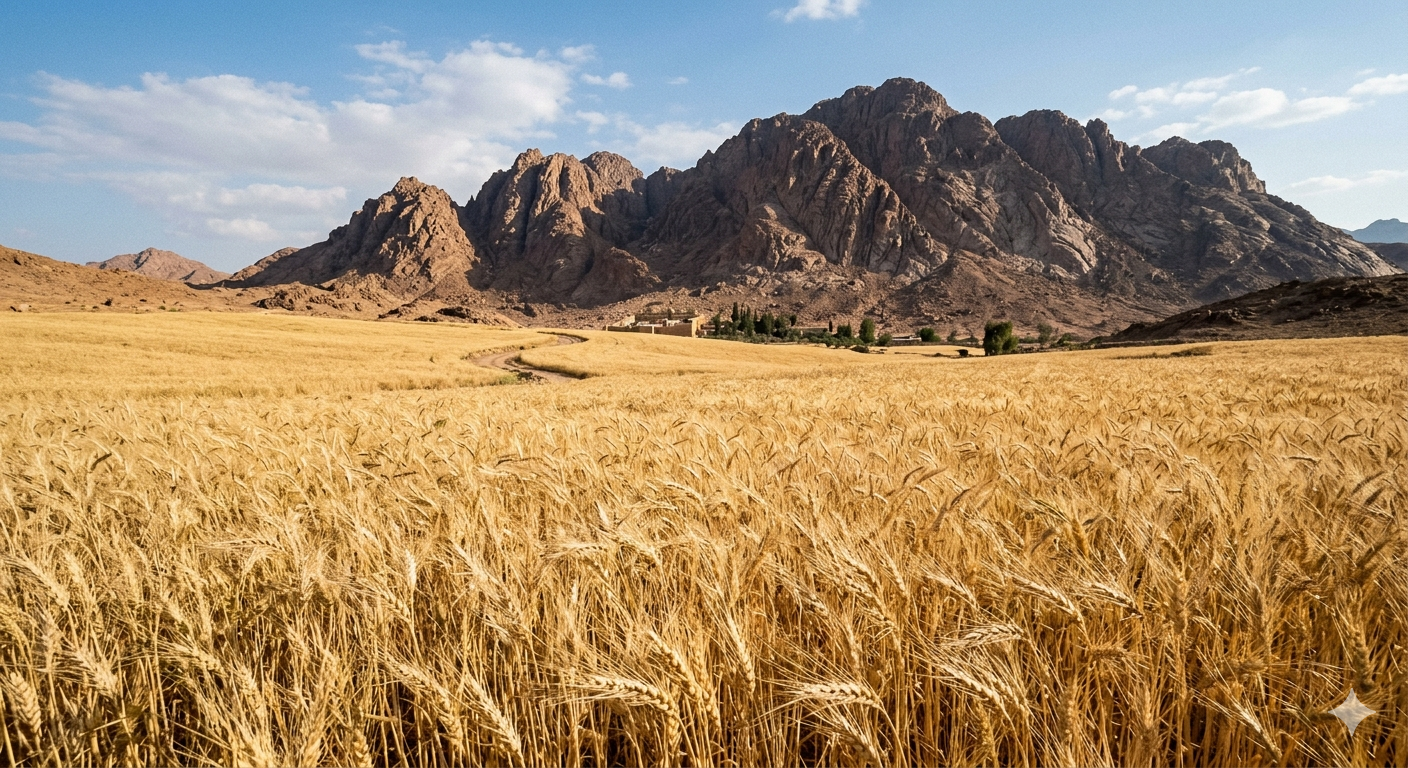
Building on Midrash and Zohar passages, I will argue that the timing of Matan Torah during the wheat harvest is not accidental; rather, it functions as an ancient bioethical reminder, a moral response to the ‘sin of wheat’ that still resonates powerfully in our age of global supply chains, genetic engineering, and climate warming.
The connection between Shavuot (also known as Atzeret and translated as Feast of Weeks) and the revelation at Mount Sinai feels so taken for granted in Jewish thought that it is easy to forget that the Torah itself says nothing explicit about it. The earliest clear identification of Shavuot, celebrated for millennia on the sixth day in Sivan, as the day the Torah was given appears in the Babylonian Talmud: “Atzeret is the day on which the Torah was given” (Pesahim 68b). Following this framing, the public Torah reading for Shavuot recounts the revelation at Sinai (Megillah 31a), and the festival’s liturgy explicitly names it zeman matan torateinu (the time of our Torah’s giving).
Medieval commentators uncovered subtle hints linking the revelation of the Torah to the wheat harvest. Ordinarily the Torah forbids bringing leavened bread as an offering: “No grain offering that you bring to YHWH shall be made with leaven” (Leviticus 2:11). Yet Shavuot is a striking exception, in which the Torah commands the offering of two loaves of leavened bread brought to the Temple with a communal peace offering (Leviticus 23:17). Ramban suggests that these offerings are not merely an expression of gratitude for the wheat harvest, but also an offering in honor of the giving of the Torah.[1] Ramban explains that pairing leavened and unleavened bread in a Thanksgiving offering is symbolic, hinting at a synthesis of din and rahamim (the contrasting Divine aspects of Judgment and Mercy) in the World to Come. Ramban may have been inspired by the appearance of similar communal peace offerings (shalmei tzibbur) in the Shavuot rite and at Mount Sinai, when the Israelites sealed the covenant with “peace-offerings to YHWH” (Exodus 24:5).
Other medieval commentators detected the Shavuot-harvest–revelation link even earlier in the biblical narrative. Rabbeinu Bahya, in his commentary on Genesis 4:3, explains that the offerings of Shavuot correspond to the offerings of Cain (“fruit of the ground”) and Abel (“firstlings of his flock”) that were brought on the fiftieth day of the world’s creation, paralleling the festival of Shavuot which occurs on the fiftieth day of the Omer count. The Torah permits leavened bread on Shavuot (7 weeks are 49 days), signaling the distant future of the “Great Jubilee” (jubilee, Hebrew yovel, is the fiftieth year following seven shemittah cycles). Yeitzer Ha-Ra (Evil Inclination) led Cain to bring an improper gift to YHWH and to kill his brother Abel, but that evil force will be ‘uprooted and lost’ in the distant ‘Great Jubilee’ according to R. Bahya, and therefore a gift of leavened bread, symbolizing Yeizer Ha-Ra, is brought on Shavuot to signal the ultimate victory over the evil inclination.[2]
The first explicit mention of “wheat harvest” appears in Genesis, when the young Reuben finds mandrakes in the field during “the time of the wheat harvest” (Genesis 30:14). Why specify the season at all? The Talmud reads the detail as a moral lesson about restraint from gathering other men’s property (Sanhedrin 99b). Hatam Sofer offers a more daring suggestion: throughout Scripture, “wheat harvest” alludes to Shavuot. If so, the Torah subtly signals that the conception of Issachar that following night, whose tribe was famed for Torah scholarship, occurred on the very day destined for the revelation at Sinai.[3]
More recent commentators, such as R. David Zvi Hoffmann, add another dimension. Unlike Passover or Sukkot, Shavuot has no physical ritual reenacting its historical event. Sinai, Hoffmann argues, resists material symbolism precisely because Israel saw no image at revelation. Instead, the memory of Sinai is preserved through gratitude for the harvest and a renewed acceptance of Divine Law.[4]
Academic scholars have argued that biblical Shavuot is merely an agricultural harvest festival that during Talmudic times was transformed into an anniversary of Matan Torah.[5] R. Hoffman and others fiercely debate these opinions to defend the dual nature of Shavuot as both a harvest and Torah celebration. What if Torah and Harvest are not just calendrically overlapping events but deliberately meant to be celebrated together? A striking bridge between wheat and Torah appears in the Zohar (Balak 188b) through the voice of the yanuka (child) who expounds the verse: “When you eat of the bread of the land, you shall set aside an offering for YHWH” (Numbers 15:19). The bread in question, the Zohar insists, must be made from wheat, not barley, even though barley ripens earlier and is harvested first. The Zohar associates barley with the five gevurot, the forces of judgment, while wheat symbolizes hesed, lovingkindness. It then asks an unexpected question—What is wheat (hittah)?—and answers cryptically that wheat is the totality of the twenty-two letters of the Hebrew alphabet. The sum of the numerical value of the letters het (8), tet (9), and heh (5) is 22—corresponding, by a play of numerology, to the number of letters in the Hebrew alphabet, and therefore representing the entire Torah from alef to tav.
The Zohar presses further. The root letters of hittah echo het (sin). What, then, is the ‘sin of wheat’? The answer returns us to Eden and the Talmudic interpretation of the biblical Tree of Knowledge. According to R. Yehuda, the forbidden fruit was wheat, because “A child does not know how to call ‘father’ and ‘mother’ until s/he tastes dagan (grain)” (Sanhedrin 70b). If eating grains (likely baked or cooked) awakens a child’s cognition, speech, and relational awareness, then eating wheat must have contributed to Adam and Eve’s development and awareness.
From the Zohar and the Talmud we learn that grains, particularly wheat, are the catalyst of human self-consciousness and social bonding. Yet wheat also represents sin and danger. By altering the spelling of hittah, replacing tet with tav, the Zohar reads mehittah (fracture, fear, collapse, as in Isaiah 54:14). According to the Zohar, wheat can nourish family bonding and civilization, but it can also unleash domination and dread.
Modern archaeology and wheat genetics offer a narrative strikingly similar to these mystical intuitions. Bread wheat (Triticum aestivum) emerged roughly ten thousand years ago through multiple rounds of Triticum and Aegilops hybridization.[6] While cross-breeding of species is forbidden as kil’ayim in Leviticus 19:19, the Mishnah (Kil’ayim 1:1) lists pairs of related grain species that are permitted for cross-seeding (min be-mino). Talmud Yerushalmi explains that crosses outside these enumerated pairs (for example crossing wheat with barley) are forbidden.[7] The botanical identifications of some of these species listed by the mishnah are still debated by scholars, rendering the crossings of Triticum and Aegilops as safek kil’ayim. Interestingly, although non-Jews are permitted to cross-seed grains, the Noahide prohibitions on tree cross-breeding and animal cross-breeding are deduced from the prohibition on eating the fruits of the Tree of Knowledge in Genesis 2:16 (Sanhedrin 56b). R. Yoel Bin-Nun has suggested that the Tree of Knowledge (da’at) should be read accordingly as the product of cross hybridizations; the term da’at is used in Genesis to describe sexual coupling, as in “Adam knew (yada et) Eve” (Genesis 4:1).[8]
The primordial sin was therefore not (only?) abstract moral discernment, but sexual promiscuity including mixing of species, practices that were essential for wheat (and other species) domestication but explicitly prohibited in Leviticus. This interpretation of the Sin of the Knowledge Tree can be expanded to a moral critique of the entire agrarian revolution. The cultivation of wheat and barley enabled humanity’s early urban civilizations, including Sumer in Mesopotamia and Egypt along the great “rivers flowing from Eden”(Genesis 2:10). Cultivation of grains brought written languages, alphabet, planning, food stability, abundance, and culture. But it also induced family and social hierarchy, forced labor, absolute kingship, and violent exploitation. Good and evil became inseparably intertwined. Genesis reflects this ambivalence: Eden ends with expulsion into agricultural toil, and Cain, the first farmer, murders his brother, Abel. Two of the forefathers (Abraham and Jacob) are portrayed as shepherds, not farmers. When young Joseph dreams of wheat shafts, his brothers immediately suspect that he wants to rule over them. Pharaoh, at the end of Genesis, dreams about seven wheat shafts and is advised by Joseph to tightly control Egypt’s wheat supply to the Pharaoh’s advantage.
And yet, the Torah is given precisely during the wheat harvest because the twenty-two letters of the Law can repair the sin of wheat. The moral distortions of humanity’s first great technological revolution are corrected not by rejecting agriculture, but by disciplining it through laws that balance land stewardship and labor, power and restraint. Shavuot marks the possibility of redeeming civilization from tyranny.
At the end of biblical prophecy (fifth century BCE), Malachi prophesies: “Then the offering of Judah and Jerusalem shall be pleasing to YHWH as in days of old and as in former years” (3:4). Rav Kook interpreted Malachi’s vision, which focuses on the minhah (meal offering) brought from plants (primarily wheat, although we find animal-based offerings termed minhah in the story of Abel and regarding the gift Jacob sent to Esau), as representing humanity’s complete moral repentance from sins between people, and even from sins toward animals : “Regarding that future time, which stands at the pinnacle of culture, the Sages said… ‘All sacrifices will be annulled in the future.’”[9]
Rav Kook, perhaps influenced by Ramban on Shavuot and Bahya on Cain and Abel (all three refer to the very same midrashic view on peace offering in the World to Come), offers a bold interpretation of the Midrash, stating that “all sacrifices will be annulled, but the Todah (Thanksgiving) offering will not be annulled” (Leviticus Rabbah 9:7). In this view, in the distant future, when Yeitzer Ha-Ra is finally eradicated, animal sacrifices will no longer be offered, and even from the Todah offering there will remain only the wheat-based meal offering.
[1] Ramban to Leviticus 23:17, s.v. “hameitz tei’afenah.”
[2] Rabbeinu Bahya to Genesis 4:3, s.v. “mi-peri ha-adamah.”
[3] Hatam Sofer, Commentary to Bereishit, Va-Yeitzei.
[5] See Dr. Rabbi Norman Solomon, “Shavuot: How the Festival of Harvest Grew,” TheTorah.com; Hoffman, ibid.
[6] See Gilles Charmet, “Wheat domestication: Lessons for the future,” Comptes Rendus Biologies 334:3 (March 2011), 212-220.
[7] See also Ohr Zarua 1:252, which cites this distinction of the Yerushalmi as legally dispositive.
[8] See Eliad & Yoel Bin Nun, “The Garden in Eden and the Earth–The Sin of Adam” [Heb.], Megadim 54 (2012).
[9] See The Vision of Vegetarianism and Peace 15; see also Olat Re’iyah I, 292.



 Site Operations and Technology by The Berman Consulting Group.