





The Pedagogical Imagination of a Subversive Conservative: Rabbi Soloveitchik’s Arrival as an Educational Visionary
Jeffrey Saks concludes The Lehrhaus series, mapping out the intellectual biography of Rabbi Joseph B. Soloveitchik

Killing Off the Rav (So He May Live)
William Kolbrener calls for an end to Rav-polemicizing so that all interested parties might finally take his legacy and teachings at full-depth.

Parshat Vayishlach: Rabin, Rachel, Rains and Retzach: How an untranslatable word shaped Judaism and...
In the anniversary month of Yitzchak Rabin's assassination, Aton Holzer considers definitions and perspectives of who is a killer and what it means to kill.

Racism Redux
Chaim Trachtman offers some concluding thoughts on Judaism and racisim, and responds to Elli Fischer.

Le-Dor Va-Dor, and then There’s Me
In this essay, Matt Brandstein reflects on his place in the Jewish community as a single man.

Know it All: Of Jewish Philosophers and Doctors
Chaim Trachtman squares biology with Spinoza and Maimonides.
Thriller
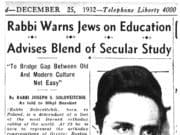
William Kolbrener offers insight into the intellectual underpinnings of the Rav's 1932 interview recently re-published by The Lehrhaus.

The Utility of Ambiguity
Dina Brawer explores "certainty" and "doubt" in rabbinic tradition.

Beyond the Shadow of Replacement: The Resilience of Jewish Identity and Covenant
Antisemitic thought has taken on various forms in different cultural contexts across history. Avraham Russell Shalev proposes that a common ideological thread links multiple of these forms--among them Christian replacement theology, the Islamic concept of tahrif, and the Khazar hypothesis. The Jewish people's renewed commitment to its covenant with God, as exemplified by the establishment of the State of Israel, serves as a powerful counterpoint to these ideologies of supersessionis.

Translation as Interpretation in the Thought of R. Shagar: Speaking with Levinas, Lacan, and...
One of the central concerns of the work of Rav Shagar is translation, in both its literal and figurative versions. Michael Blank explores Rav Shagar's use and conception of translation by examining the way he puts the writings of Rebbe Nachman, Jacque Lacan, and Emmanuel Levinas in conversation.




 Site Operations and Technology by The Berman Consulting Group.